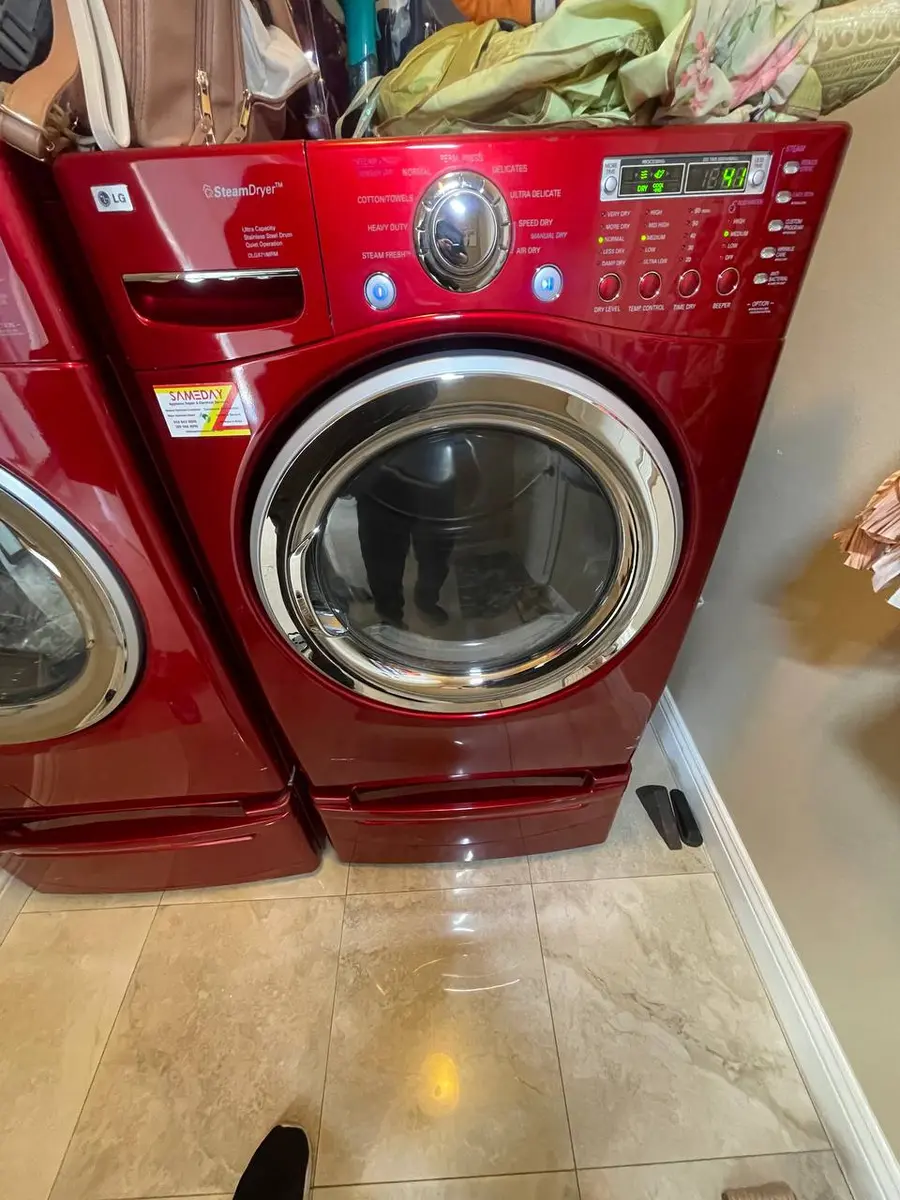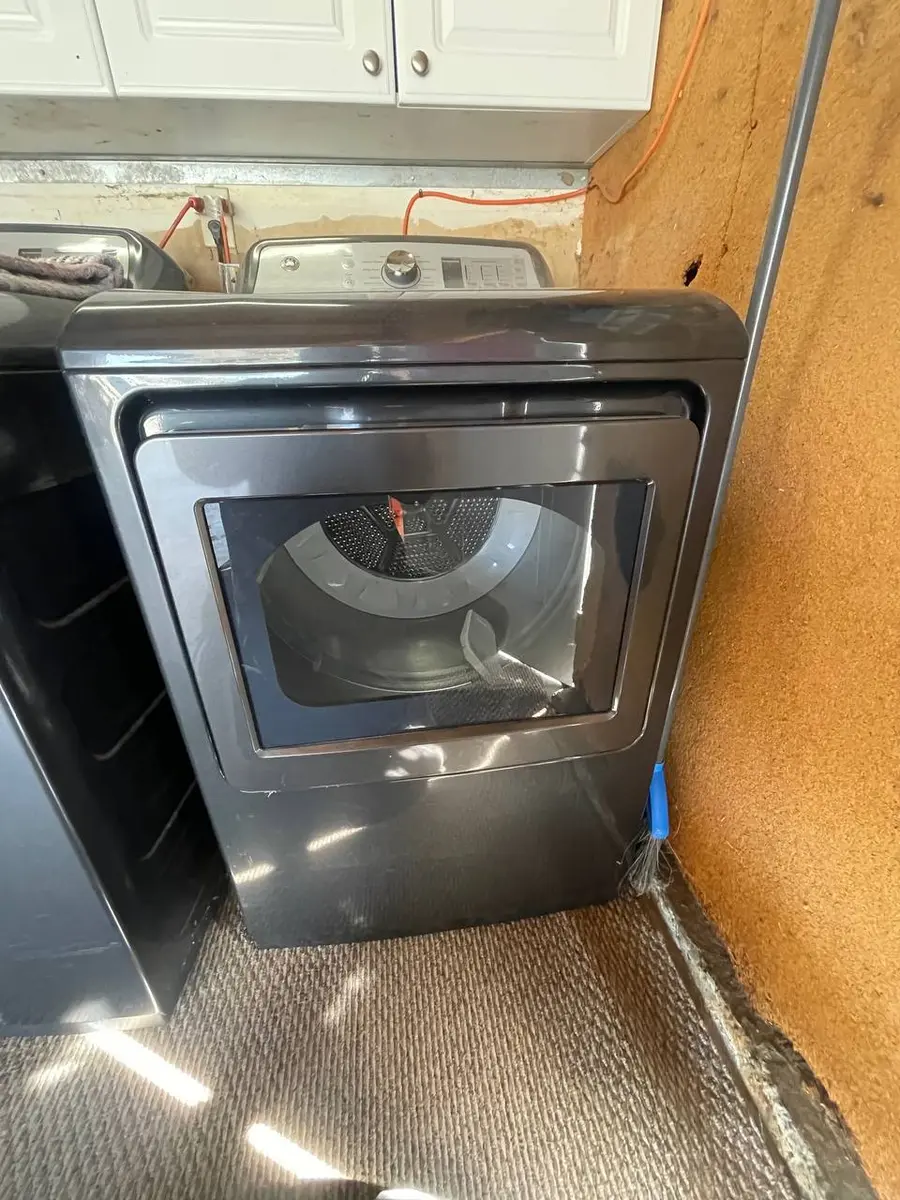
Kenmore dryers carry the Sears brand name, but the machines themselves are built by Whirlpool, LG, or Frigidaire — each with its own error code system. Before you can fix an error code on your Kenmore dryer, you need to know who actually made it. This guide covers all platforms so you never have to guess.
Identify Your Kenmore Dryer's Manufacturer#
Find the model number sticker — usually inside the door frame or on the back panel. The first three digits tell you who built your dryer:
- 110.xxxxx — Built by Whirlpool (the most common Kenmore dryers)
- 417.xxxxx — Built by Frigidaire/Electrolux (paired with Frigidaire-built washers)
- 796.xxxxx — Built by LG (Kenmore Elite models)
Critical safety note for dryers: Many Kenmore dryers are gas-powered. If you smell gas at any point during troubleshooting, stop immediately, leave the house, and call your gas utility. Never attempt to repair a gas valve or igniter with the gas line connected.
Do You Have the Right Tools?
Gas leak detector ($130), thermal fuse tester ($95), belt tension gauge, and vent inspection camera ($180). Our technician arrives with $3,000+ in professional tools — your diagnostic is free.
Licensed & Insured · 90-Day Warranty · Same-Day Service
Whirlpool-Built Kenmore Dryers (110.xxxxx)#
These are the most common Kenmore dryers and share their platform with Whirlpool, Maytag, and Amana dryers.
F01 — Main Control Board Failure#
The main electronic control board has detected an internal error and cannot operate the dryer.
Common causes:
- Control board component failure (capacitor, relay, or MOSFET)
- Power surge damage
- Moisture intrusion into the control board housing
How to fix:
- Unplug the dryer for 5 minutes and restart. F01 sometimes clears after a power reset.
- If F01 returns, remove the top panel and inspect the main control board (usually at the top-rear). Look for burn marks, swollen capacitors, or corroded solder joints.
- Check the board connector pins for corrosion or loose connections.
- If the board is visibly damaged, replace it. Part WPW10111606 cost varies by model and region.
Part cost: Main control board WPW10111606 is varies by part. Professional repair: varies by part.
F02 — Keypad / User Interface Error#
A button on the control panel is stuck or the user interface board has failed.
Common causes:
- Button stuck in pressed position from moisture or detergent spill
- User interface board failure
- Ribbon cable between UI board and main board damaged
How to fix:
- Check if any button on the panel feels stuck or does not spring back.
- Clean around the buttons with a slightly damp cloth — detergent residue or lint can jam buttons.
- If no button is physically stuck, the UI board membrane has likely failed. Replacement typically cost varies by model and region depending on model.
F22 — Exhaust Thermistor Fault#
The exhaust temperature sensor is reading out of range, indicating a shorted or open circuit.
Common causes:
- Failed exhaust thermistor (part WPW10545657)
- Disconnected thermistor wire
- Severely restricted lint screen or vent causing abnormal exhaust temperatures
How to fix:
- First, clean the lint screen and check the entire vent path from the dryer to the exterior wall. A restricted vent causes extreme temperatures that can damage the thermistor.
- Locate the exhaust thermistor — mounted in the exhaust duct housing at the back of the drum.
- Measure resistance at room temperature — should read approximately 10K–12K ohms at 77°F.
- If the reading is 0 (short) or infinite (open), replace it. Part WPW10545657 cost varies by model and region.
F23 — Exhaust Thermistor Open#
Specifically indicates an open circuit in the exhaust temperature sensor.
Common causes:
- Thermistor wire broken along its run
- Thermistor element failed open internally
- Connector detached from the control board
How to fix:
- Check the thermistor connector at the control board — a loose or corroded pin causes an open-circuit reading.
- Trace the wire from the board to the thermistor for breaks or chafe damage.
- Test with a multimeter — infinite resistance confirms an open circuit. Replace with WPW10545657 (varies by model and region).
F25 — Inlet Thermistor Fault#
The inlet temperature sensor (measures air entering the drum) is reading abnormally.
Common causes:
- Failed inlet thermistor (part WPW10563903)
- Wiring issue between sensor and control board
- On gas models, excessive heat from a gas valve issue damaging the sensor
How to fix:
- Locate the inlet thermistor in the duct housing where air enters the drum.
- Measure resistance — should be approximately 50K ohms at room temperature.
- On gas dryers, if the thermistor has failed, also inspect the gas valve solenoids and igniter. A faulty gas valve can cause intermittent overheating that kills the sensor repeatedly.
Part cost: Inlet thermistor WPW10563903 is varies by part.
F26 — Drive Motor Error#
The drive motor is not running or is drawing abnormal current.
Common causes:
- Motor winding failure
- Seized drum bearing or support roller preventing motor rotation
- Broken drive belt (motor spins freely without drum resistance)
- Motor start relay or centrifugal switch failure
How to fix:
- Open the dryer cabinet and try to turn the drum by hand. It should rotate smoothly with moderate resistance.
- Check the drive belt — if broken, the motor runs without load and newer boards flag this as F26. Belt part WPW10112954 cost varies by model and region.
- Test the motor with a multimeter — windings should read 2–6 ohms between each pair.
- If the drum is seized, the support rollers or rear bearing may need replacement.
Part cost: Drive belt WPW10112954 is varies by part. Motor WPW10448896 is varies by part.
F28 — Moisture Sensor Error#
The moisture sensor bars inside the drum are not detecting a signal.
Common causes:
- Dryer sheet residue coating the sensor bars (extremely common)
- Broken wire to moisture sensor
- Failed sensor or control board issue
How to fix:
- Locate the two metal sensor bars inside the drum — usually on the front bulkhead near the lint screen opening.
- Clean the bars with rubbing alcohol and a soft cloth. Dryer sheet residue forms an invisible insulating coating that prevents the bars from reading moisture in the clothes.
- If cleaning does not resolve the code, check the wire connections behind the front panel.
- The moisture sensor strip itself rarely fails — 90% of F28 codes are solved by cleaning the bars.
LG-Built Kenmore Dryers (796.xxxxx)#
These are Kenmore Elite dryers using LG's direct drive motor and steam features. They use LG's alphanumeric error codes.
d80 / d90 / d95 — Vent Restriction Warning#
This is not a mechanical malfunction — the dryer is detecting restricted exhaust airflow. The number indicates the percentage of blockage: d80 means 80% blocked, d95 means 95% blocked. This is a serious fire hazard.
Common causes:
- Lint buildup in the vent duct (the most dangerous cause — house fire risk)
- Crushed or kinked vent hose behind the dryer
- Bird nest or debris in the exterior vent cap
- Vent run too long (should not exceed 25 feet with turns)
How to fix:
- Disconnect the vent hose from both the dryer and the wall. Clean the entire vent path with a dryer vent brush kit ($20 at any hardware store).
- Go outside and check the vent cap — remove any lint, debris, or animal nests.
- Replace any crushed or vinyl flex vent hose with rigid or semi-rigid metal duct.
- If your vent run exceeds 25 feet or has more than two 90-degree turns, consider a dryer vent booster fan.
Safety warning: Clogged dryer vents cause approximately 15,000 house fires annually in the US. If you see d80 or higher, stop using the dryer until the vent is cleared.
tE1 / tE2 — Thermistor Error#
The temperature sensor (thermistor) is reading abnormally. tE1 is the primary sensor; tE2 is the secondary sensor if equipped.
Common causes:
- Failed thermistor (part ABA72913406)
- Disconnected wire harness at sensor
- Control board sensor circuit failure
How to fix:
- Locate the thermistor in the blower housing area.
- Measure resistance at room temperature — should read approximately 10K ohms at 77°F.
- If 0 ohms or infinite, replace the thermistor. Part ABA72913406 cost varies by model and region.
dE — Door Switch Error#
The dryer cannot detect that the door is closed.
Common causes:
- Door not fully latched
- Door switch failure (part 6601EL3001A)
- Wiring issue from switch to control board
How to fix:
- Close the door firmly until it clicks.
- Test the door switch with a multimeter — should show continuity when closed and open circuit when the door is open.
- If the switch is faulty, replacement 6601EL3001A cost varies by model and region.
FE — Power Frequency Error#
The dryer detects an incorrect electrical frequency — should be 60 Hz in North America.
Common causes:
- Unstable power supply (generator, brownout conditions)
- Main control board frequency detection circuit fault
How to fix:
- If running on a generator, ensure it provides stable 60 Hz power.
- Check for brownout symptoms in your home (flickering lights, dimming).
- If power is stable and FE persists, the control board may need replacement.
PS — Power Supply Error#
The dryer is not receiving adequate voltage — electric dryers need 240V, gas dryers need 120V.
Common causes:
- Tripped circuit breaker (one leg of a 240V circuit)
- Loose connection at the outlet or junction box
- Failing power cord or terminal block
How to fix:
- Check the circuit breaker panel — for electric dryers, the dedicated 30-amp breaker must be fully ON. Sometimes one pole trips while the other stays on, providing only 120V.
- Test the outlet with a multimeter — each leg should read 120V to neutral, and 240V between the two hot legs.
- Inspect the power cord and terminal block connections behind the dryer for loose or burned wires.
Safety First — Know the Risks
Gas dryers carry carbon monoxide and explosion risk. Even electric dryers involve 240V circuits that can deliver a fatal shock. Our techs are licensed and insured — let them handle the risk.
Licensed & Insured · 90-Day Warranty · Same-Day Service
Frigidaire/Electrolux-Built Kenmore Dryers (417.xxxxx)#
These Kenmore dryers use the Electrolux/Frigidaire platform and the E-code error system.
E64 — Heating Element Error#
The heating element circuit is not operating correctly.
Common causes:
- Heating element failure (part 137038200 for electric models)
- Hi-limit thermostat tripped (part 137032600)
- Wiring issue between element and board
- Vent restriction causing overheat and thermal fuse blow
How to fix:
- Test the heating element with a multimeter — should read 8–20 ohms for a 240V electric dryer.
- Check the hi-limit thermostat and thermal fuse — both should show continuity when intact.
- Inspect the vent for restriction — a blocked vent causes the thermal fuse to blow, cutting power to the element.
- On gas models, E64 may indicate a failed igniter or gas valve solenoid rather than the element.
Part cost: Heating element 137038200 is varies by part. Thermal fuse 137032600 is varies by part.
E61 — Low Heating#
The dryer heats but does not reach target temperature within the expected time.
Common causes:
- Partially restricted vent reducing airflow
- One leg of 240V supply missing (electric dryers run on 120V, producing weak heat)
- Failing heating element with partial break increasing resistance
How to fix:
- Check both legs of the 240V outlet — each should read 120V to neutral. If one reads 0V, the breaker has half-tripped.
- Clean the vent thoroughly — even partial restriction reduces heating efficiency significantly.
- Test the heating element resistance. An element on its way out shows high resistance (above 25 ohms) rather than a clean open.
E4A — Heater Relay Error#
The control board's heater relay has failed or is stuck in the closed position.
Common causes:
- Control board relay contacts welded shut from arcing
- Relay coil failure on the board
- Board-level component damage
How to fix:
- This is a control board failure. If the relay is welded shut, the heating element stays on continuously — a dangerous overheating condition.
- Unplug the dryer immediately if it is overheating or not stopping when the door opens.
- The control board (part 5304514200) needs replacement. Cost: varies by model and region.
E63 — Heating System Overheat#
The dryer has detected temperature exceeding safe operating limits.
Common causes:
- Severely restricted vent (the most common cause by far)
- Failed cycling thermostat staying closed too long
- Stuck heater relay on control board
How to fix:
- Check and clean the entire vent path — lint buildup in the duct is responsible for the vast majority of E63 codes.
- Test the cycling thermostat — it should open at its rated temperature and close when cooled.
- If vent is clear and thermostat is functional, the control board relay may be stuck.
Kenmore Dryer Diagnostic Mode#
- Whirlpool-built (110): With the dryer empty and door closed, press within 4 seconds: More Time, Less Time, More Time, Less Time. The display shows "88" to confirm diagnostic mode entry.
- LG-built (796): Press and hold Temp + Signal buttons for 3 seconds. The dryer cycles through component tests.
- Frigidaire-built (417): Hold any two adjacent buttons for 5 seconds to enter service mode.
The Real Cost of DIY
Average DIY attempt: $150-400 in tools you may use once, plus the risk of further damage. Our diagnostic visit costs $0 — we find the problem and give you an honest quote.
Licensed & Insured · 90-Day Warranty · Same-Day Service
Frequently Asked Questions#
Q: My Kenmore dryer runs but does not heat. What is the most likely cause? A: For electric dryers, the thermal fuse is the number one cause — it is a one-time safety device that blows when the dryer overheats from a restricted vent. For gas dryers, the most common cause is a failed gas valve solenoid coil. In both cases, clean the vent first — the root cause of the overheat must be addressed or the replacement part will fail again.
Q: How do I tell if my Kenmore dryer is gas or electric? A: Check the plug. Electric dryers use a large 240V plug with 3 or 4 prongs. Gas dryers use a standard 120V 3-prong plug plus a gas line connection. The model number sticker also specifies gas or electric.
Q: Why does my Kenmore dryer show d80 even after I cleaned the vent? A: The d80 code (LG-built models) can be caused by internal lint buildup inside the dryer housing, not just the external vent duct. Remove the back panel and vacuum all lint from the blower housing, around the heating element, and inside the exhaust path within the dryer itself. Also verify that the vent cap outside opens freely when the dryer runs.
Q: Can I replace a Kenmore dryer belt myself? A: Yes — dryer belt replacement is one of the most accessible DIY repairs. The belt wraps around the drum and threads through a tensioner pulley and the motor pulley. Match the belt to your manufacturer platform (Whirlpool, LG, or Frigidaire) using the model number prefix, since belt routing and tensioner design differ between platforms.
Q: How often should I clean my Kenmore dryer vent? A: At minimum once per year, but every 6 months is recommended if you do more than 5 loads per week. Professional dryer vent cleaning cost varies by model and region and includes inspection of the entire vent path. Clogged vents cause 15,000 house fires annually in the US, making this one of the most important home maintenance tasks.
When to Call a Professional#
- Gas dryer issues — If you smell gas or suspect a gas valve problem, call a professional immediately. Gas leak repair requires licensed tools and leak testing equipment.
- Vent blockage you cannot reach — If your dryer vent runs through walls or the roof, professional vent cleaning with rotary brush equipment is needed.
- Control board failures (F01, E4A) — Board replacement involves high-voltage connections and model-specific configuration.
- Drum bearing or roller replacement — Requires full drum removal, drum shaft inspection, and specialized tools to press new bearings.
- Any burning smell or visible sparking — Unplug immediately and call a technician. Do not attempt diagnosis on active electrical faults.
Need your Kenmore dryer fixed fast? EasyBear technicians are trained on all Kenmore manufacturer platforms and arrive with common parts in stock. We identify your dryer's manufacturer before the visit so we bring the right parts the first time. Free diagnostic, 90-day warranty. Book your free diagnosis today.
Lead Appliance Repair Technician · 12 years experience
Experienced technician with 12 years specializing in washing machine and dryer repairs across all major brands.