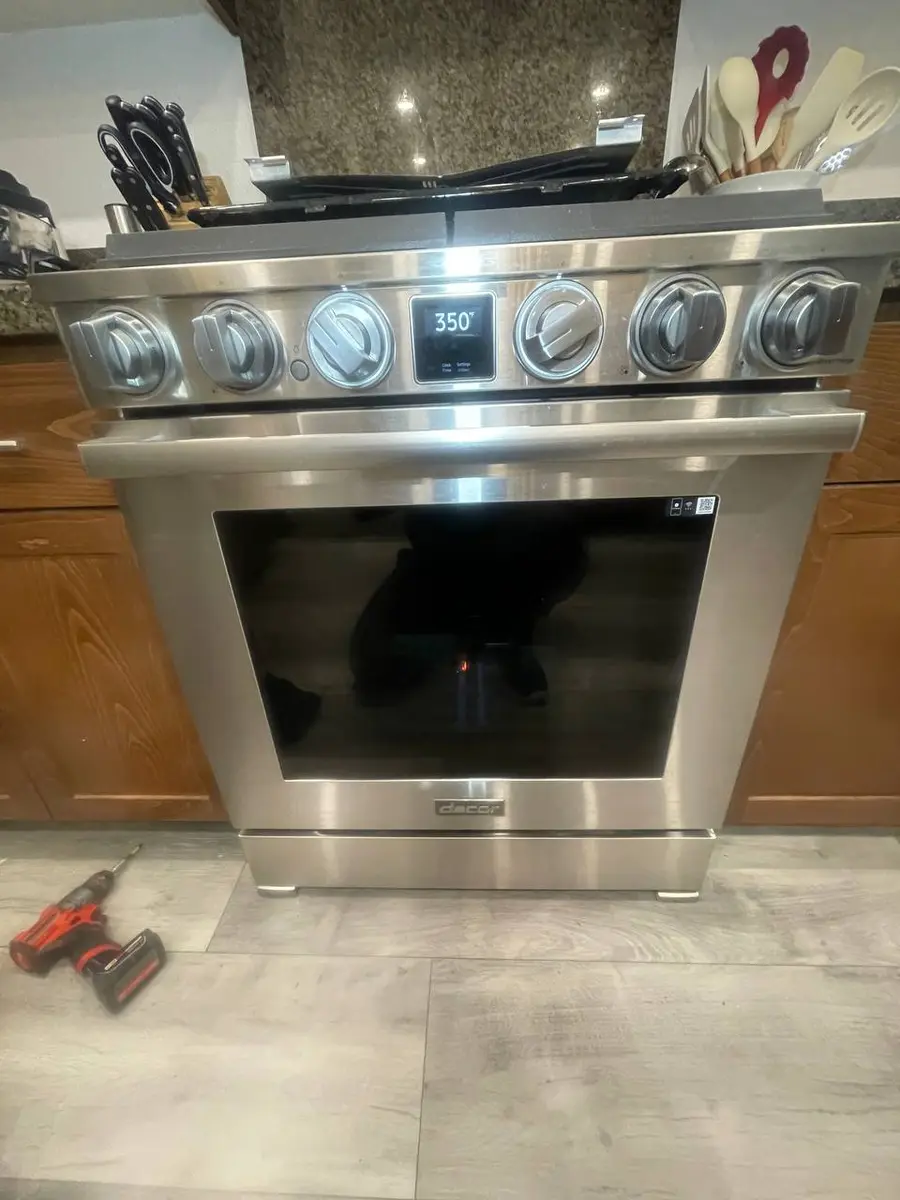
Jenn-Air ovens — from the Pro-Style wall ovens and dual fuel ranges to the combination speed ovens — represent Whirlpool Corporation's luxury cooking platform. These units ($2,500–significant cost) feature V2 True Convection (dual-fan for precise air circulation), Culinary Center guided cooking programs, and WiFi Connected diagnostics. They use the standard Whirlpool F#E# error code format but with model-specific codes for their premium convection and precision temperature systems.
Understanding Jenn-Air oven error codes prevents unnecessary service calls for minor issues and ensures you recognize safety-critical failures requiring immediate professional attention.
How Jenn-Air Oven Error Codes Work#
Jenn-Air ovens display errors on the color LCD touchscreen (newer Pro-Style models), the segmented digital display (earlier models), or through the Whirlpool WiFi app. The F# identifies the system category and E# identifies the specific fault.
Oven-specific code categories:
- F1: Touch pad / ERC (Electronic Range Control) issues
- F2: Oven over-temperature
- F3: Sensor short circuit
- F4: Sensor open circuit
- F5: Board/watchdog errors
- F9: Door lock mechanism
- F2E0 through F2E3: Temperature sensor identifiers for multi-cavity models
To enter diagnostic mode: On LCD touchscreen models, tap the Settings gear icon, then press and hold the "i" (info) button for 5 seconds. On segmented display models, hold the Bake and Broil buttons simultaneously for 5 seconds.
Basic reset: Disconnect power at the breaker for 5 minutes. For overtemperature codes (F2), wait until the oven is completely cool (1–2 hours) before resetting.
Do You Have the Right Tools?
Combustion analyzer ($300), igniter tester ($120), temperature calibrator ($150), and gas pressure manometer. Our technician arrives with $3,000+ in professional tools — your diagnostic is free.
Licensed & Insured · 90-Day Warranty · Same-Day Service
F1E1 — Control Board / ERC Internal Failure#
The Electronic Range Control has detected a processing error, watchdog timer fault, or memory corruption.
Common causes:
- Power surge damaging the ERC microprocessor
- Thermal stress on solder joints from repeated heating/cooling cycles
- Failed crystal oscillator (timing component) on the ERC board
- Moisture damage from steam (especially on models installed above a steam oven or dishwasher)
Troubleshooting steps:
- Disconnect power for 10 minutes (extended reset to clear volatile memory completely).
- If F1E1 returns immediately on power restoration, the ERC has a hardware failure and must be replaced.
- On Jenn-Air Pro-Style wall ovens, the ERC is behind the control panel at the top of the oven. Access requires removing the trim panel and display assembly.
- Inspect for visible board damage: bulging capacitors, discolored solder joints, or burn marks near power components.
- Before replacing the ERC, verify the power supply is clean — repeated brownouts or voltage spikes will destroy replacement boards. Consider a surge protector on the circuit.
Repair cost: varies by part. Jenn-Air ERC boards are premium-priced and often include the integrated LCD display as a single assembly on newer models. Aftermarket boards are not available for most Jenn-Air models.
F2E0 — Oven Over-Temperature (Cavity 1)#
The oven temperature exceeded the maximum safe limit (typically 650F during bake, 950F during self-clean). This is a safety-critical code — the oven shuts down all heating elements immediately.
Common causes:
- Bake or broil relay welded closed on the ERC (element stays on continuously)
- Temperature sensor drifted far out of calibration
- V2 True Convection fan failure causing localized hotspots
- Blocked cooling air vents (items placed on top of wall oven or against back panel)
- Self-clean cycle with excessively heavy soil (grease fire potential)
Troubleshooting steps:
- Turn off the oven at the circuit breaker immediately. Do not attempt to use the oven until diagnosed.
- Allow complete cooling (2 hours minimum). Attempting to reset while hot can mask the root cause.
- After cooling, test the temperature sensor: disconnect and measure resistance. At room temperature (77F), expect approximately 1,080 ohms for Jenn-Air RTD sensors.
- Check the heating elements visually — a relay welded closed causes continuous heating. If the element was glowing when the error appeared (even after you turned the oven off at the control), the relay is stuck.
- Inspect cooling vents above and to the sides of the wall oven cavity. On Jenn-Air Pro-Style double ovens, the vent clearances are critical for heat dissipation.
Repair cost: varies by part. Sensor replacement is varies by part. ERC replacement (for a welded relay) is varies by part. A welded relay is a fire hazard — do not use the oven until repaired.
Safety First — Know the Risks
Gas ovens involve live gas lines — a loose connection creates explosion and carbon monoxide risk. Electric ovens run on 240V circuits. Our techs are licensed and insured — let them handle the risk.
Licensed & Insured · 90-Day Warranty · Same-Day Service
F3E0 — Temperature Sensor Short Circuit (Cavity 1)#
The oven cavity temperature sensor is reading abnormally low resistance, indicating a short between the sensor leads or between a lead and ground.
Common causes:
- Sensor wire insulation melted from contact with the hot oven wall
- Physical damage to the sensor probe tip (ceramic cracked, allowing moisture entry)
- Connector pins shorted by carbon buildup from self-clean residue
- Replacement sensor installed incorrectly (wire routed touching metal)
Troubleshooting steps:
- Access the temperature sensor — it enters the oven cavity through the rear wall, secured by one or two mounting screws.
- Disconnect the sensor at its harness connector (rear of the oven or accessible through an access panel).
- Measure resistance: at room temperature, expect 1,080 ohms. A shorted sensor reads significantly below this (often under 100 ohms or near 0).
- If the sensor reads correctly at the connector, measure between each lead and ground (the metal sensor housing). Any reading to ground indicates insulation failure.
- Inspect the wire routing inside the cavity — after self-clean cycles, the extreme heat degrades wire insulation faster. Wires touching the oven wall will eventually short.
Repair cost: varies by part. The RTD sensor for Jenn-Air ovens is a standard Whirlpool family part (WPW10181986 or similar depending on model).
F4E0 — Temperature Sensor Open Circuit (Cavity 1)#
The opposite of F3E0 — the sensor reads infinite resistance, meaning a broken wire or failed sensor element. The oven cannot determine temperature and will not heat.
Common causes:
- Sensor wire broken from thermal fatigue (repeated expansion/contraction cycles)
- Connector not fully seated (vibration from door use loosened it)
- Sensor probe element failed internally (open NTC/RTD winding)
- Corroded connector pins (oxidation creating an open circuit)
Troubleshooting steps:
- Check the easiest cause first: reseat the sensor connector at the rear of the oven. This resolves approximately 15% of F4E0 cases.
- Measure resistance at the connector: if infinite (OL on multimeter), the sensor or wire is broken.
- If possible, measure at the sensor probe end directly — this confirms whether the break is in the wire or the probe.
- On Jenn-Air double ovens, ensure you identify the correct cavity sensor. F4E0 = cavity 1 (upper on double ovens). F4E1 = cavity 2 (lower).
- After replacing the sensor, route the wire carefully away from the oven walls. Use the wire clips/routing channels provided by the manufacturer.
Repair cost: varies by part. This is the most common and most affordable Jenn-Air oven repair — the sensor is a standard Whirlpool component.
The Real Cost of DIY
Average DIY attempt: $150-400 in tools you may use once, plus the risk of further damage. Our diagnostic visit costs $0 — we find the problem and give you an honest quote.
Licensed & Insured · 90-Day Warranty · Same-Day Service
F5E1 — Door Lock Motor Error (Self-Clean)#
The oven door lock mechanism failed to reach the locked position within the expected time when initiating self-clean, or failed to unlock when self-clean is complete and the oven has cooled.
Common causes:
- Lock motor gear assembly stripped (plastic gears worn from repeated self-clean use)
- Door lock switch not detecting the locked position
- Lock motor winding burned out
- Door alignment preventing full latch engagement (hinge wear on heavy Pro-Style doors)
- Lock mechanism physically blocked by food debris at the latch point
Troubleshooting steps:
- If the door is stuck locked: disconnect power and wait 30–60 minutes. The thermal interlock releases as the oven cools below its safety threshold (approximately 500F). If still locked, a manual release is accessible from the top of the oven (remove the trim panel above the door).
- Never force a locked oven door — you will break the latch mechanism.
- If the oven will not start self-clean (door fails to lock): clean the latch striker area where the lock catches the door. Grease and carbon buildup prevent full engagement.
- Listen for the lock motor: a whirring sound indicates the motor runs but the gears are stripped. Silence means the motor is burned out or the board is not sending power.
- On Jenn-Air Pro-Style ranges with heavy stainless steel doors, door sag from hinge wear is more common than on lighter consumer models. The lock mechanism has a narrow engagement window.
Repair cost: varies by part. Lock motor assemblies are moderately priced. Hinge adjustment or replacement adds varies by part on Pro-Style models.
F6E0 — Communication Error Between Boards#
The main ERC cannot communicate with a secondary board — this could be the display board, the convection fan controller, or (on dual fuel ranges) the gas valve controller.
Common causes:
- Ribbon cable or wire harness loose between boards
- Secondary board failure (one of multiple boards in complex Jenn-Air ovens)
- Power supply issue not delivering proper voltage to all boards
- Interference from nearby high-power appliances (induction cooktop electromagnetic noise)
Troubleshooting steps:
- Power cycle at the breaker for 5 minutes. Communication errors often clear after a cold restart.
- Note what functions are lost — this helps identify which secondary board has failed (display dead = UI board, fan not working = convection controller, no ignition = gas valve board).
- Access the wiring connections between boards and reseat each connector firmly. On Jenn-Air Pro-Style models, the board layout is distributed across the unit, with long wire runs susceptible to connector oxidation.
- Check for corrosion at connector pins — use contact cleaner spray on oxidized pins.
- On combination configurations (wall oven + microwave or wall oven + speed oven), verify the inter-unit communication cable is secure. These are separate appliances that communicate for synchronized operation.
Repair cost: varies by part depending on which board has failed. Communication harness issues are cheaper to resolve (varies by part labor only).
Don't Void Your Warranty
Opening your appliance yourself may void the manufacturer warranty. Our repair comes with a 90-day guarantee, and we document everything for warranty compliance.
Licensed & Insured · 90-Day Warranty · Same-Day Service
F2E1 — Broil Over-Temperature#
Specific to the broil element circuit — the oven exceeded safe temperature during broil operation. Similar to F2E0 but isolated to the broil heating system.
Common causes:
- Broil relay stuck closed (welded contacts — same failure mode as bake relay)
- Broil element cycling error (control not properly modulating power)
- Excessive grease accumulation igniting under broil heat
- Sensor failure causing incorrect temperature reading during broil
Troubleshooting steps:
- Same immediate response as F2E0 — turn off at breaker, allow full cooling.
- After cooling, check if the broil element continued glowing after the error appeared. If yes, the broil relay is welded closed on the ERC board.
- Clean excessive grease from the oven cavity. Accumulated grease can catch fire under the broil element's radiant heat, causing a genuine over-temperature event (not a sensor issue).
- Test the sensor as described in the F3E0 section. Broil uses the same sensor as bake for temperature monitoring.
- If the relay is welded, the ERC must be replaced. A welded relay cannot be repaired in the field.
Repair cost: varies by part. Same as F2E0 — dominated by ERC replacement cost if the relay is the cause.
V2 True Convection System Codes#
Jenn-Air's V2 True Convection uses dual fans with a dedicated heating element for precise air circulation. Convection-specific errors include:
F7E1 — Convection fan motor not detected: The ERC cannot sense fan rotation. Check for a seized fan motor (bearing failure) or a physically jammed fan blade (food debris fallen behind the rear panel).
F7E2 — Convection fan speed abnormal: The fan is running but not at the expected RPM. Usually caused by worn motor bearings creating drag. The oven may still heat but convection performance degrades.
F7E3 — Dual fan asymmetry (Pro-Style double fan models): On models with the dual-fan V2 system, one fan is running significantly slower than the other. This causes uneven cooking. Usually requires fan motor replacement for the affected side.
Repair cost for convection fan issues: varies by part. Jenn-Air convection fan motors are premium components, and access requires removing the oven's rear panel from inside the cavity.
Is It Worth Your Time?
Oven temperature issues require systematic testing of the igniter, gas valve, thermostat, and calibration. Average DIY: 4-6 hours. Our technician diagnoses the issue in about 30 minutes — same-day appointments available.
Licensed & Insured · 90-Day Warranty · Same-Day Service
WiFi Connected Oven Diagnostics#
Jenn-Air WiFi Connected ovens (via the Whirlpool app) provide:
Culinary Center integration: Guided cooking programs set precise temperatures and modes. If a sensor error occurs mid-program, the app logs exactly when the failure occurred relative to the cooking phase.
Remote preheat and monitoring: Start preheating remotely and receive notifications when target temperature is reached — or when an error interrupts preheating.
Error history: 90-day log of all events, helping identify patterns (e.g., sensor errors only occurring at high temperatures suggest thermal intermittent rather than complete failure).
Service coordination: Share diagnostic data with repair technicians before the service visit, reducing diagnosis time.
Frequently Asked Questions#
Q: My Jenn-Air oven shows F2E0 only during self-clean. Is self-clean damaging my oven? A: Self-clean operates at 900–950F, which stresses components to their design limits. Legitimate F2E0 during self-clean means: (1) the oven genuinely exceeded its self-clean limit — typically from excessive soil creating a grease fire, or (2) the sensor has drifted and is reading high at extreme temperatures even though it reads correctly at normal cooking temps. Clean heavy soil manually before running self-clean, and have the sensor tested across its full temperature range.
Q: Can I replace the oven temperature sensor myself on a Jenn-Air wall oven? A: On most Jenn-Air wall ovens, the sensor is accessible from inside the cavity (1–2 screws) with the connector reachable behind the unit. If you can pull the oven forward on its slide rails to access the rear connector, it is a feasible DIY repair. However, Pro-Style built-in models with no slide rails require more disassembly. Always disconnect power at the breaker before working inside the oven cavity.
Q: Why does my Jenn-Air Pro-Style range cost more to repair than my friend's Whirlpool oven? A: Three reasons: (1) Jenn-Air ERC/control boards are model-specific with premium firmware and LCD displays — varies by model and region vs. varies by model and region for standard Whirlpool boards; (2) Pro-Style models use commercial-grade components (heavier door assemblies, precision hinges, stainless steel cavity liners) that cost more; (3) built-in Pro-Style installations require more labor time for access compared to freestanding ranges.
Q: My Jenn-Air oven temperature seems off by 25F but no error code shows. Should I worry? A: A 25F drift is within the normal aging range for an RTD sensor after 5+ years. Use the temperature calibration offset in the settings (typically adjustable +/- 35F). If the offset needed exceeds 35F, replace the sensor proactively. A gradually drifting sensor will eventually trigger F3E0 or F4E0 when it exceeds the board's acceptable range.
Q: Is the Jenn-Air V2 True Convection repairable or is it a sealed unit? A: The V2 True Convection system uses replaceable fan motors and a standard heating element. The fan motors are individually replaceable without replacing the entire system. The rear baffle panel and element are also serviceable. However, the dual-fan control logic is on the ERC, so asymmetry issues (F7E3) that are not resolved by fan motor replacement may require a board replacement.
The Risk of Getting It Wrong
A wrong diagnosis often turns a simple fix into a costly replacement. Without proper diagnostic tools, you might replace the wrong part — or cause additional damage. Our free diagnostic eliminates the guesswork.
Licensed & Insured · 90-Day Warranty · Same-Day Service
Premium Jenn-Air Oven Repair from EasyBear#
Jenn-Air Pro-Style wall ovens and dual fuel ranges represent significant investments in your kitchen. EasyBear's certified technicians understand the Whirlpool platform engineering plus the premium Jenn-Air-specific systems — V2 True Convection, Culinary Center programming, heavy-duty Pro-Style hinge systems, and WiFi Connected diagnostics. Our free diagnostic visit includes full error history retrieval, sensor testing across the operating temperature range, and honest repair-vs-replace guidance. Every repair carries our 90-day parts and labor warranty, ensuring your luxury cooking investment delivers the performance you expect.
Lead Appliance Repair Technician · 12 years experience
Experienced technician with 12 years specializing in washing machine and dryer repairs across all major brands.