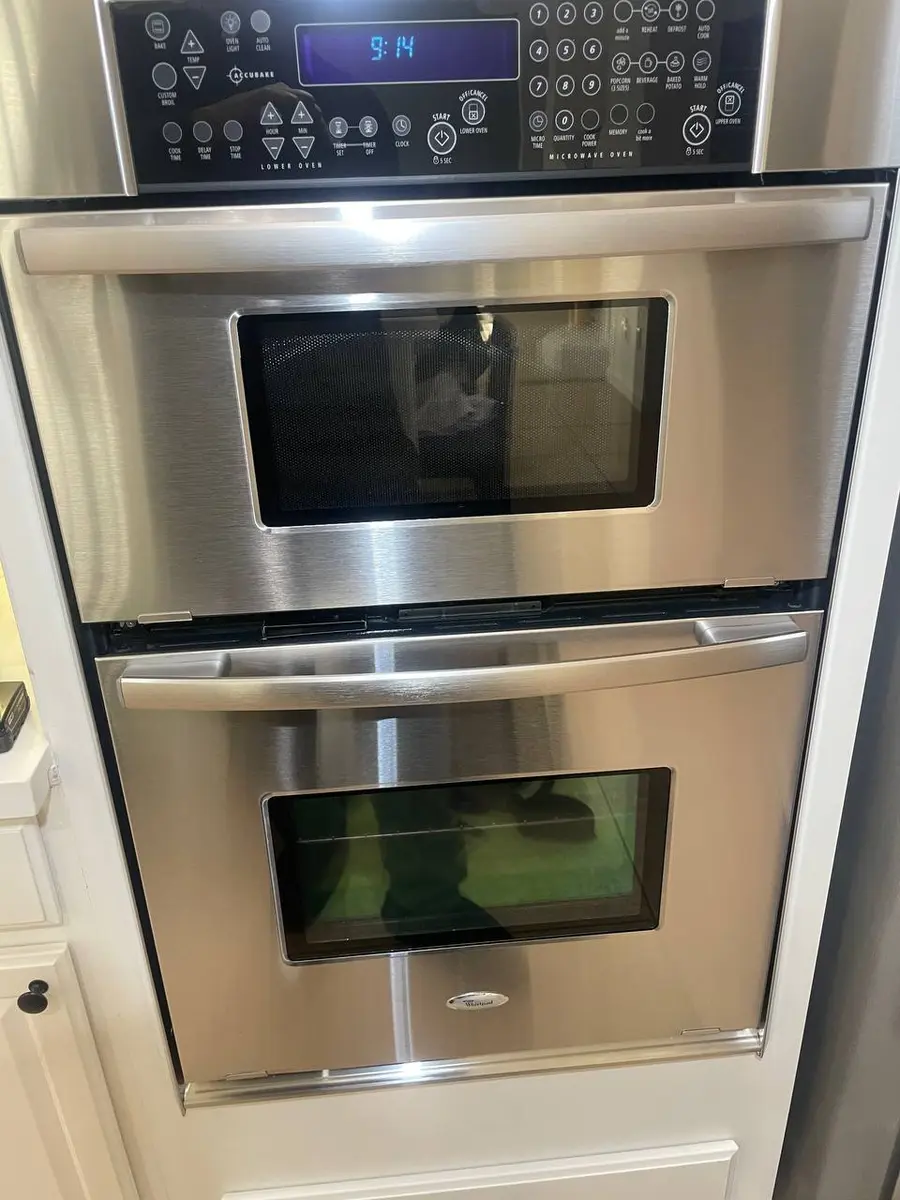
How to Replace a KitchenAid Built-In Microwave
Swapping a KitchenAid built-in microwave (KMBS or KMBP series) is an intermediate, 1-2 hour job. Because these units are hardwired to a junction box rather than plugged in, the work is as much wiring as it is lifting: kill the circuit, disconnect the old unit at the junction box, verify the cabinet cutout, then wire,…
KitchenAid built-ins share Whirlpool's mounting system, so some cabinet adaptors cross brands, but the trim kit that frames the oven is model-specific and changed design in 2019 and 2022. Convection versions draw up to 1800W and need a dedicated 20A, 120V circuit — worth confirming before you buy.
Before you start#
| Item | Use |
|---|---|
| Phillips #2 and #1, Torx T20 | Panels and mounts |
| 1/4-inch and 5/16-inch nut drivers | Cabinet hardware |
| Voltage tester, wire nuts, strippers | Junction-box wiring |
| Level, drill, helper | Mounting a 60-90 lb unit |
Safety warning: Turn off the dedicated circuit breaker. KitchenAid built-in microwaves are hardwired to a junction box — you will be working with 120V house wiring. Verify power is off with a non-contact voltage tester at the junction box before disconnecting anything.
Do You Have the Right Tools?
High-voltage capacitor discharge tool ($90), magnetron tester ($200), microwave leakage detector ($150). Our technician arrives with $3,000+ in professional tools — your diagnostic is free.
Licensed & Insured · 90-Day Warranty · Same-Day Service
Step-by-step#
1. Confirm the replacement fits#
Measure the cutout: standard KitchenAid built-ins use a 30-inch-wide opening, roughly 17 to 19 inches tall and at least 22 inches deep. Same-series swaps (KMBS to newer KMBS) usually reuse the trim kit; crossing generations may not, since the design changed in 2019 and 2022. Confirm the circuit is a dedicated 20A, 120V line — a convection model on a 15A circuit can trip the breaker.
2. Remove the old unit#
Kill the breaker and confirm dead with the tester. Take out the trim frame (four to six perimeter screws) and set it aside if reusing. In the cabinet above, open the junction box, back off the wire nuts, and separate the microwave leads from the house wiring. Pull the remaining mounting screws — through the top into the cabinet and through the support shelf below — and slide the heavy unit out with a helper steadying it.
3. Prepare the cabinet#
Wipe grease from the cutout, check that the support shelf is solid and level front-to-back and side-to-side, and confirm the junction-box wiring is sound with no frayed insulation. Clear any ventilation openings the new unit's manual calls for. Most same-series swaps need no cabinet changes; a slightly different cutout may want filler strips or minor enlargement.
4. Wire the new unit#
With the microwave still outside the cabinet, thread its flexible conduit into the junction box and join like to like: black to black, white to white, green or bare to ground, each under a wire nut. Tug every joint to confirm it is secure — a loose nut is a fire risk under the microwave's draw — then close the box cover.
5. Mount and level#
Slide the unit into the cutout, aligning it with the support shelf below and the mounting points above. Drive the anti-tip screws through the top into the cabinet and up through the shelf into the base; some models add side L-brackets. Level it front-to-back and side-to-side so the turntable spins true and liquids do not pool to one side.
6. Fit the trim kit#
Attach the trim brackets to the cabinet face, then snap or screw the frame on, checking for even gaps all around, no contact with the door, and clear ventilation slots. On PrintShield-finish models the trim is coated too, so handle it carefully to avoid scratches.
7. Test#
Restore power and confirm the display and clock work, the door latches cleanly without touching the trim, and an empty five-second run produces the normal magnetron hum and fan. Heat a cup of water for sixty seconds to confirm cooking, and test convection and vent-fan speeds if fitted.
Troubleshooting#
- Dead on power-up: recheck the breaker and every junction-box joint; a loose neutral stops all operation.
- Slides forward when the door opens: the mounting screws are not biting solid wood — use longer screws or anchors.
- Trim will not sit flush: a different-generation trim kit will not match; order the one for your new model number.
Safety First — Know the Risks
Microwave capacitors store lethal voltage (4,000V+) even when unplugged. This is the single most dangerous DIY appliance repair. Our techs are licensed and insured — let them handle the risk.
Licensed & Insured · 90-Day Warranty · Same-Day Service
When to call a professional#
EasyBear technicians serving Sacramento and the Bay Area carry KitchenAid-specific diagnostic tools and replacement parts on every service call. Call one if the junction-box wiring is damaged or undersized, if the cabinet needs structural changes, if you are unsure about the electrical connections, or if the unit is too heavy to support safely while mounting.
Need Professional Help?#
This fix requires some technical skill. If you'd rather have a pro handle it, book a same-day repair.
Senior Gas Appliance Specialist · 18 years experience
AGA-certified gas appliance specialist with 18 years of experience in residential and commercial oven, range, and cooktop repairs.