A refrigerator is the one appliance in your home that never clocks out. It runs 24 hours a day, every day, from the moment you plug it in until the day it dies. That non-stop duty cycle is exactly why "how long will it last?" is such a loaded question — and why the answer has real budget consequences.
How Long Does a Refrigerator Last?#
Most refrigerators last 10–15 years, with the average landing around 13. Where your unit falls inside that window depends far more on its design and how it is cared for than on the badge on the door.
| Configuration | Typical lifespan | What drives it |
|---|---|---|
| Top-freezer / bottom-freezer | 10–15 yr (avg ~13) | simplest layout, fewest electronics to fail |
| Side-by-side | 10–15 yr | ice and water lines add wear and maintenance |
| French-door | 10–15 yr | more dispensers and electronics that can age |
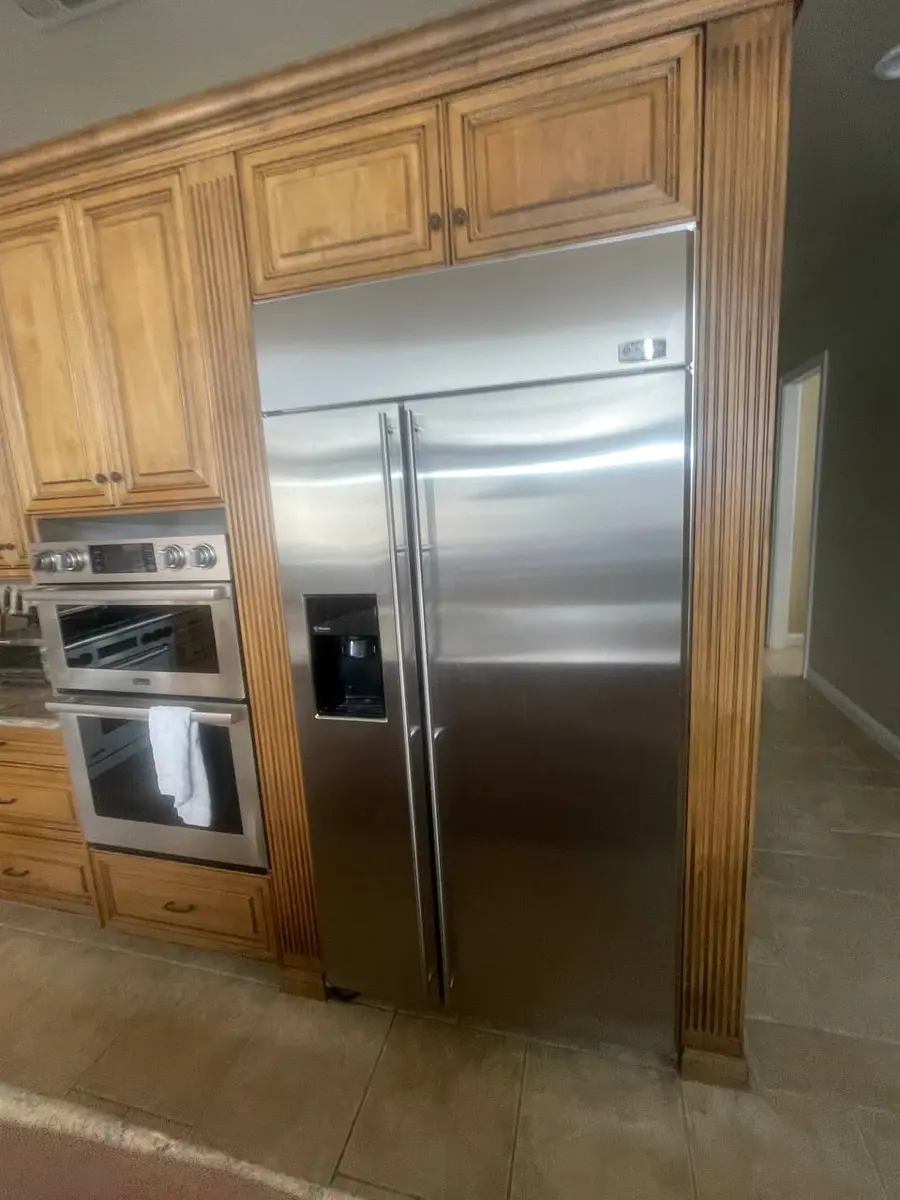
| Built-in / premium | upper end of 10–15 yr | built to be serviced; compressors often warrantied 5–10 yr |
Premium, long-warranty units and well-maintained built-ins tend to reach the top of that range, while a hard-used unit in a hot garage lands nearer the bottom. Treat the number as an average, not an expiration date.
Do You Have the Right Tools?
Refrigerant gauges ($200+), vacuum pump ($250), leak detector ($150), and EPA-certified recovery equipment. Our technician arrives with $3,000+ in professional tools — your diagnostic is free.
Licensed & Insured · 90-Day Warranty · Same-Day Service
What Actually Ends a Refrigerator's Life#
The part that decides a fridge's fate is the compressor and sealed refrigerant system. Everything else is a bolt-on; the sealed system is the heart. When it fails on an older unit, the repair runs $500–1,000 — and that is the number that usually pushes a refrigerator into retirement.
Here is the nuance that saves people money: compressors are frequently warrantied 5–10 years. Before you write off a fridge for a cooling failure, check that warranty — a covered compressor changes the entire calculation.
Almost every other failure is worth fixing at nearly any age, because each is cheap relative to a new fridge:
- Door gasket / seal: $100–250 — restores efficiency and stops frost buildup.
- Evaporator or condenser fan: $150–350 — common, straightforward, worth it.
- Ice maker: $150–350 — a repair, not a reason to replace the whole appliance.
- Control board: $250–550 — evaluate by age; borderline past a decade.
One safety-relevant design note: refrigerators built after 2025 use the flammable R-600a refrigerant, so sealed-system work on the newest units is specialized. Older R-134a units stay straightforward to service.
How to Get More Years From Your Refrigerator#
Longevity is mostly about heat management. The easier you make it for the compressor to shed heat, the longer it runs.
- Vacuum the condenser coils twice a year. Dust-caked coils force the compressor to run hotter and longer — the single most common cause of premature aging.
- Give it breathing room. Leave a gap behind and above the unit so hot air can escape.
- Keep it out of the heat. A fridge in a hot garage or beside an oven works far harder than one in a climate-controlled kitchen.
- Replace a worn door gasket promptly. A leaky seal makes the compressor run almost continuously.
- Keep it reasonably full but not packed — good internal airflow matters as much as external.
Safety First — Know the Risks
Refrigerant (R-134a/R-600a) requires EPA certification to handle. Improper discharge is a federal violation and health hazard. Our techs are licensed and insured — let them handle the risk.
Licensed & Insured · 90-Day Warranty · Same-Day Service
What to Do at 5, 10, and 15 Years#
Age reframes every repair quote. The same repair is an easy yes at five years and a hard maybe at fifteen.
| Age | Where it stands | What to do |
|---|---|---|
| ~5 years | early life | fix anything; most of the lifespan is still ahead — see is it worth repairing a 5-year-old refrigerator? |
| ~10 years | past the midpoint | apply the 50% rule; cheap fixes yes, sealed-system no — see the 10-year guide |
| ~15 years | end of expected life | replace-leaning on any major repair — see the 15-year guide |
Repair or Replace: Running the Numbers#
The rule technicians reach for first is the 50% rule: if a repair costs more than half the price of a comparable new unit, lean toward replacing. A mid-range refrigerator replacement runs $900–2,500, so a $150–350 fan or gasket is a clear repair, while a $500–1,000 compressor job on a 12-year-old fridge is a clear replace.
Two 2026 factors tilt the math:
- Energy. A modern ENERGY STAR refrigerator uses roughly 30–50% less electricity than a 12–15-year-old unit. On an appliance that runs constantly, that saving is real money and a legitimate reason to retire an aging, inefficient model.
- Tariffs and right-to-repair. After the 2025 tariffs, appliance prices rose about 4.3% and parts 5–20%, so replacement got more expensive faster than repair. Meanwhile California's SB-244 requires makers to keep parts and documentation available for 7 years after last manufacture (for appliances over $100), strengthening the repair case for any 2017-or-newer fridge.
For the full framework, see our refrigerator repair-or-replace guide.
The Real Cost of DIY
Average DIY attempt: $150-400 in tools you may use once, plus the risk of further damage. Our diagnostic visit costs $0 — we find the problem and give you an honest quote.
Licensed & Insured · 90-Day Warranty · Same-Day Service
From Our Technicians#
In our California service area, a typical diagnostic and labor charge on a refrigerator runs $150–350, and most non-sealed-system repairs we complete land between $200 and $600 all-in. The pattern is consistent: fridges rarely wear out all at once — they die of one expensive sealed-system failure. If the compressor is healthy and the unit is under a decade old, keeping it is almost always the smart money.
Signs Your Refrigerator Is Failing#
A few symptoms separate a fridge that needs a quick fix from one that is genuinely near the end:
- Warm or fluctuating temperatures despite a clean condenser and correct settings — a possible sealed-system sign.
- The compressor runs constantly or short-cycles, and the back of the unit is very hot to the touch.
- Heavy condensation or interior frost that returns right after you clear it.
- Food spoiling early in one zone, pointing to a failing evaporator fan or damper.
- Rising energy bills from an older unit that simply cannot keep up efficiently anymore.
Don't Void Your Warranty
Opening your appliance yourself may void the manufacturer warranty. Our repair comes with a 90-day guarantee, and we document everything for warranty compliance.
Licensed & Insured · 90-Day Warranty · Same-Day Service
Does Brand Affect How Long a Refrigerator Lasts?#
Longevity tracks design and maintenance more than the badge, but build quality is real. Premium, long-warranty units and true built-ins are engineered to be serviced and tend to reach the upper end of the 10–15-year range, especially where the compressor carries a 5–10-year warranty. Simpler top-freezer layouts from any maker last well because they carry the fewest electronics to fail. Feature-dense side-by-side and French-door models add ice makers, dispensers, and control boards — more to age — so they reward diligent coil and gasket maintenance. Rather than chase a brand, favor the simplest configuration that meets your needs and keep it cool and clean.
Frequently Asked Questions#
How long does a refrigerator last?#
Most refrigerators last 10–15 years, averaging about 13. Top- and bottom-freezer models tend to run longest because they carry the fewest electronics, while feature-heavy side-by-side and French-door units land anywhere in that range depending on maintenance.
What is the longest a refrigerator realistically lasts?#
The upper end of the typical band is around 15 years. A premium unit with a healthy, warrantied compressor and clean coils can push a little past that, but once a fridge is beyond 15 the mix of higher energy use and rising repair odds usually tips the math toward replacement.
What usually kills a refrigerator?#
The compressor and sealed refrigerant system. When it fails on an older unit the repair runs $500–1,000 — often more than half the fridge is worth. Nearly every other part (fans, gaskets, ice makers, control boards) is cheaper and worth repairing.
What shortens a refrigerator lifespan?#
Heat and dirty condenser coils, mostly. A fridge in a hot garage, shoved tight against a wall, or running on dust-caked coils forces the compressor to work harder and shortens its life. A worn door gasket has the same effect.
Is a 10-year-old refrigerator worth fixing?#
It depends on the repair. A $100–250 gasket or a $150–350 fan is worth doing at ten years; a $500–1,000 compressor job usually is not, unless the compressor is still under its 5–10-year warranty. Our 10-year refrigerator guide walks through the decision.
Does the 50% rule apply to refrigerators?#
Yes, with an energy twist. If a repair exceeds 50% of a comparable new unit ($900–2,500), lean toward replacing — and because a new fridge uses 30–50% less electricity than a 12–15-year-old one, the replace side of the ledger is stronger for refrigerators than for most appliances.
How much does a refrigerator repair cost?#
It ranges widely by fault. Common repairs run $100–250 for a door gasket, $150–350 for an evaporator or condenser fan or an ice maker, and $250–550 for a control board. The big one is the compressor or sealed system at $500–1,000 — the repair most likely to push an older fridge toward replacement.
When should I replace my refrigerator instead of fixing it?#
Replace when a repair tops 50% of a comparable new unit ($900–2,500), when the sealed system fails out of warranty past about a decade, or when an aging model's energy use climbs — a new fridge uses 30–50% less electricity than a 12–15-year-old one. Cheap fan, gasket, and ice-maker fixes almost always favor repair.
Senior Appliance Repair Technician · 15 years experience
EPA-certified technician with 15 years of experience specializing in refrigerator and cooling system repairs.