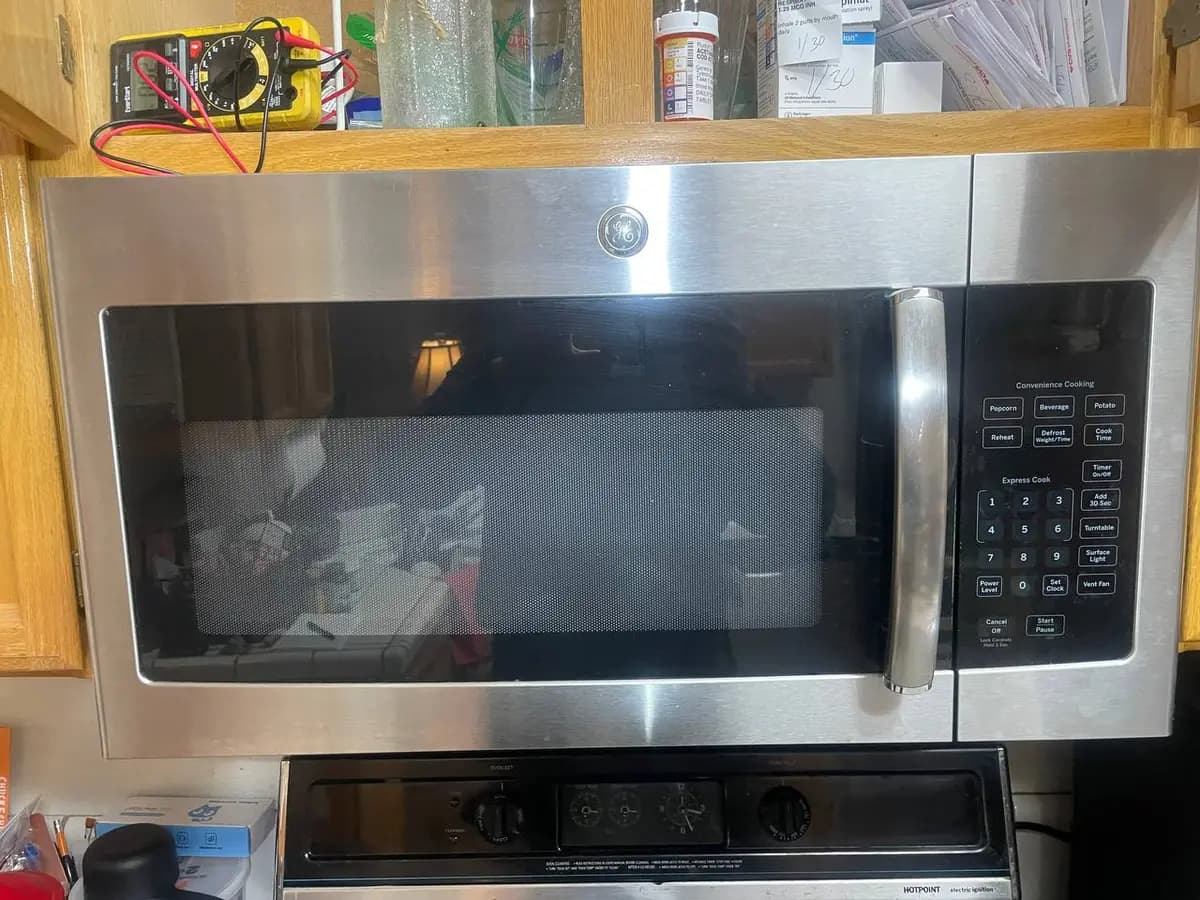
A GE microwave that is completely dead — no display, no beep, no response — almost always has a power-delivery fault rather than a cooking problem, and the usual culprit is a blown ceramic line fuse. The catch is that the fuse blows for a reason, so swapping it without finding the short that killed it just blows the next one.
Before You Open It: A Real Danger#
GE microwaves contain a high-voltage capacitor that stores lethal energy — 2,000+ volts — even when unplugged. Before touching any internal component, the capacitor must be discharged. If you are not equipped and comfortable doing that, stop here and call a professional; this is not a symptom to improvise on.
Do You Have the Right Tools?
High-voltage capacitor discharge tool ($90), magnetron tester ($200), microwave leakage detector ($150). Our technician arrives with $3,000+ in professional tools — your diagnostic is free.
Licensed & Insured · 90-Day Warranty · Same-Day Service
Check the Easy Things First#
Confirm the microwave is actually getting power before taking anything apart. Plug a lamp or phone charger into the same outlet, and on an over-the-range unit make sure the cord is fully seated in the outlet inside the upper cabinet — it is easily knocked loose during a filter change. Check the kitchen breaker too. If the outlet is live and the cord is seated, the fault is internal.
Most Likely Causes, Ranked#
| Cause | Share | Tell |
|---|---|---|
| Blown line fuse | 35% | totally dead, fuse reads open |
| Shorted door interlock switch | 25% | fuse blows again immediately |
| Faulty outlet or cord | 15% | no power at the plug |
| Control-board power supply | 15% | dead but line fuse is good |
| Tripped thermal fuse | 10% | dead after overheating |
1. Blown line fuse (35%)#
The 20A ceramic fast-blow line fuse (GE WB27X10388 on most JVM and JES models) cuts all power the instant it sees excessive current, protecting the house wiring from a downstream short. Pull it and test for continuity — a good fuse reads continuous, a blown one reads open. Then find why it blew: the usual triggers are a shorted door switch, a power surge, a shorted HV capacitor or diode, or a magnetron shorted to ground.
2. Shorted door interlock switch (25%)#
GE's interlock includes a monitor switch designed to blow the line fuse deliberately if a primary door switch fails — a safety feature. So a blown fuse plus a dead microwave very often means a door-switch problem, and replacing only the fuse leads to an immediate re-blow. GE units typically use three switches (parts such as WB24X829, WB24X25397, and WB24X830); test all three when one fails.
3. Faulty outlet or cord (15%)#
Over-the-range models plug into a standard 120V outlet in the upper cabinet, where the cord is easily displaced during filter or cabinet work. Countertop models should be tested at the wall — try a different, known-good outlet. This is the easiest cause to rule in or out.
4. Control-board power-supply section (15%)#
The board carries an onboard supply that converts 120V AC to the low-voltage DC the microprocessor, display, and relays need. If a rectifier or a surface-mount fuse on the board burns out, the whole microwave looks dead even with a good line fuse. GE boards (WB27X11215 on JVM, WB27X10911 on Advantium) often show visible damage — a scorched component or a bulging capacitor.
5. Tripped thermal fuse (10%)#
Some models add a one-shot thermal fuse on the magnetron housing or near the transformer that opens permanently after a severe overheat. Unlike the resettable thermostat, it must be replaced — and because it trips from genuine overheating, clear the blocked filters, restore the clearance above the unit, or fix the cooling fan that caused it.
Safety First — Know the Risks
Microwave capacitors store lethal voltage (4,000V+) even when unplugged. This is the single most dangerous DIY appliance repair. Our techs are licensed and insured — let them handle the risk.
Licensed & Insured · 90-Day Warranty · Same-Day Service
Diagnostic Order#
Confirm the outlet with a known-good device, reseat the cord on over-the-range units, and check the kitchen breaker. If power is confirmed, the fault is internal — but only after discharging the capacitor: test the line fuse, and if it is blown, test the door switches before installing a new one; if the fuse is good, look at the board's power-supply section.
GE microwave dead and you would rather not touch the high-voltage side? Our technicians discharge it safely, find why the fuse blew, and repair it same-day across [Sacramento](/sacramento/sacramento) and the Bay Area. Book your repair.
Why the ranking on this page cannot be worked through in order#
Most fault lists are also a work order: start at the top, stop when it clears. This one is not, and the reason is the capacitor.The ranking above orders the causes of a dead GE microwave against one another — it is a relative ordering rather than a measured incidence, and this guide names no sample behind it. But every entry past the outlet check sits behind a cabinet panel with a component capable of storing a lethal charge after the machine is unplugged, so the list cannot simply be worked down the way a dishwasher's or a dryer's can.
What that leaves a homeowner is a short list and a clear boundary: prove the outlet is live, prove any protected circuit has not tripped, and confirm the complaint really is a dead unit rather than a cooking fault. Everything past that boundary is not a matter of confidence or tools — it is a class of repair where a mistake is not recoverable, and the ranking should be read as information for whoever opens the cabinet rather than as instructions for you.
Senior Gas Appliance Specialist · 18 years experience
AGA-certified gas appliance specialist with 18 years of experience in residential and commercial oven, range, and cooktop repairs.