GE Microwave Touchpad Not Responding? Causes
Most likely the membrane switch panel has worn out — if some buttons still work and others are dead, that is the tell. When every key is dead at once, suspect the ribbon cable or the control board instead, and always rule out an accidentally engaged Control Lock first because that mimics a total failure.
How a GE touchpad actually works#
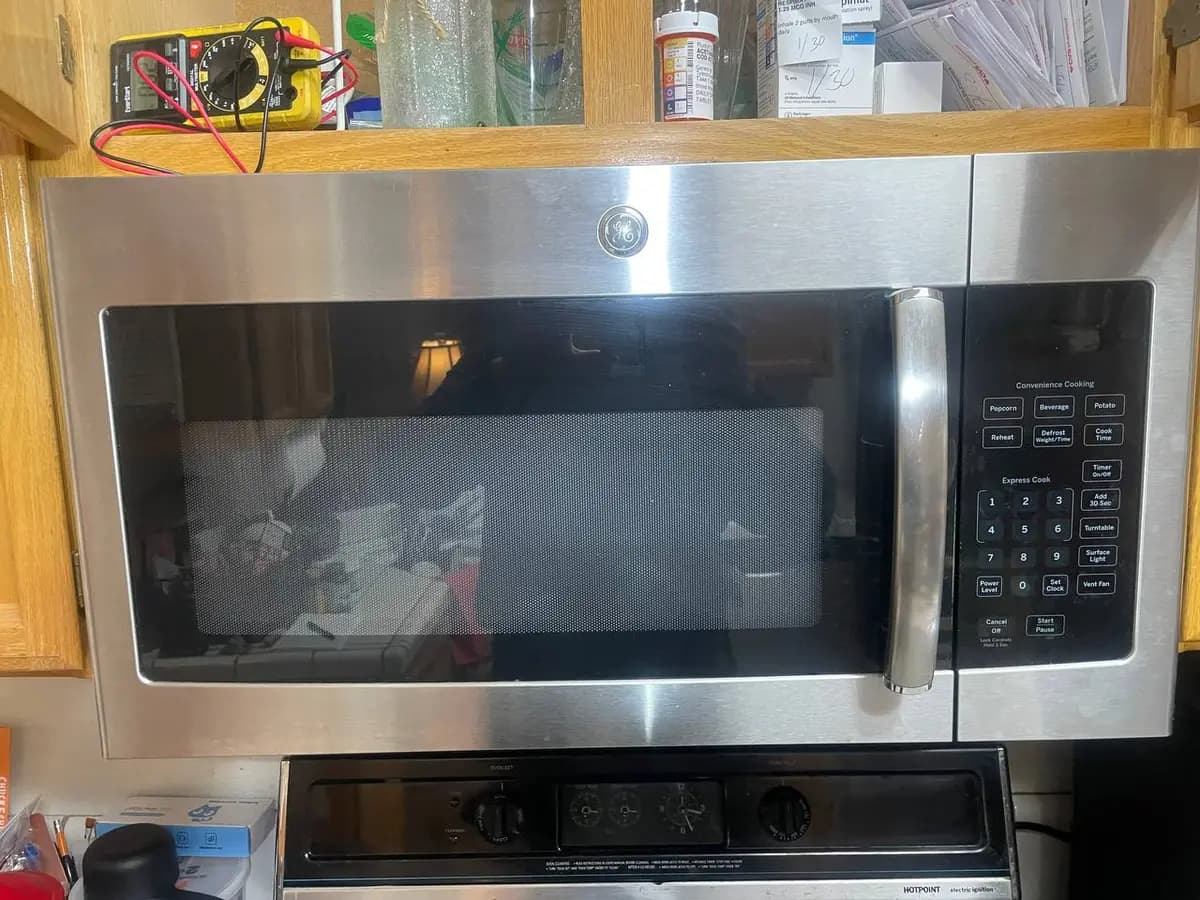
GE microwaves use a membrane switch panel: a thin flexible sheet of printed conductive traces that close a circuit when you press a key against its contact. That membrane feeds the main control board through a ribbon cable, and the board continuously scans the key matrix. A fault anywhere along that chain — membrane, cable, or board — reads as dead buttons.
Causes at a glance#
| Likely cause | What you'll notice | Share of cases | First move |
|---|---|---|---|
| Membrane switch panel failed | Some keys work, others dead | 40% | Replace the membrane/panel |
| Ribbon cable connection failed | All keys dead, clock still shown | 25% | Reseat or replace the ribbon |
| Control board failed | Garbled display plus dead keys | 20% | Replace the control board |
| Moisture damage | Puffy overlay, condensation behind glass | 10% | Dry out; usually needs the panel |
| Control Lock engaged | Lock icon shown, all keys off | 5% | Hold Off/Clear to release |
Do You Have the Right Tools?
High-voltage capacitor discharge tool ($90), magnetron tester ($200), microwave leakage detector ($150). Our technician arrives with $3,000+ in professional tools — your diagnostic is free.
Licensed & Insured · 90-Day Warranty · Same-Day Service
Working through the causes#
Failed membrane switch panel (40%). The membrane is a wear item — its silver-ink traces crack after years of pressing, heat, and kitchen grease, and the most-used keys such as Start and the number 1 fail first. Over-the-range JVM models degrade fastest because they sit in the cooktop's rising steam. On these, GE sells the panel and control board as assemblies like WB56X26872 and WB27X11215. Ribbon cable connection failed (25%). The cable linking membrane to board can work loose, crack at a fold, or corrode at the pins. The signature is every button dead at once while the clock still shows — the board has power but cannot read the keys. Reseat the connector; replace the ribbon if a conductor has broken. Control board failed (20%). The board's key-scanning section can drop out as its capacitors dry in the heat above a range, so it drives the display but no longer detects presses. A garbled, flickering, or partly-lit display alongside dead keys points here. GE boards such as WB27X10911 and WB27X10880 are replaced as a unit. Moisture damage (10%). Cooking steam works behind the overlay on over-the-range units and corrodes the membrane contacts; the panel may feel puffy or show condensation behind the glass. Running the exhaust fan while you cook below is the prevention, but corroded contacts usually mean the panel is replaced. Control Lock engaged (5% — not a fault). Before assuming failure, check the display for a lock icon or LOC text. On many GE models the Advantium and countertop panels lock and unlock by holding Off/Clear (often the Off button for 3 seconds on JVM units) — do that and the keys return.
Quick diagnostic order#
- Look for a lock icon; hold Off/Clear for 3 to 5 seconds to clear Control Lock.
- Hard reset — unplug the microwave for 60 seconds, then reconnect.
- Press every button: some working confirms a membrane fault, all dead points to cable or board.
- Check the display: garbled or partly lit alongside dead keys indicates the board; a clean clock points to the ribbon.
- Inspect the panel edge for condensation or a puffy overlay that signals moisture.
Safety First — Know the Risks
Microwave capacitors store lethal voltage (4,000V+) even when unplugged. This is the single most dangerous DIY appliance repair. Our techs are licensed and insured — let them handle the risk.
Licensed & Insured · 90-Day Warranty · Same-Day Service
Repair or replace?#
On over-the-range GE models the membrane and board are often one assembly, so match the part to your exact model before ordering; a keypad repair on a unit under eight to ten years old is well worth it beside a new microwave.
Buttons still dead after a reset? Our technicians repair GE microwaves same-day across Sacramento and the Bay Area. Book your repair.
Senior Gas Appliance Specialist · 18 years experience
AGA-certified gas appliance specialist with 18 years of experience in residential and commercial oven, range, and cooktop repairs.