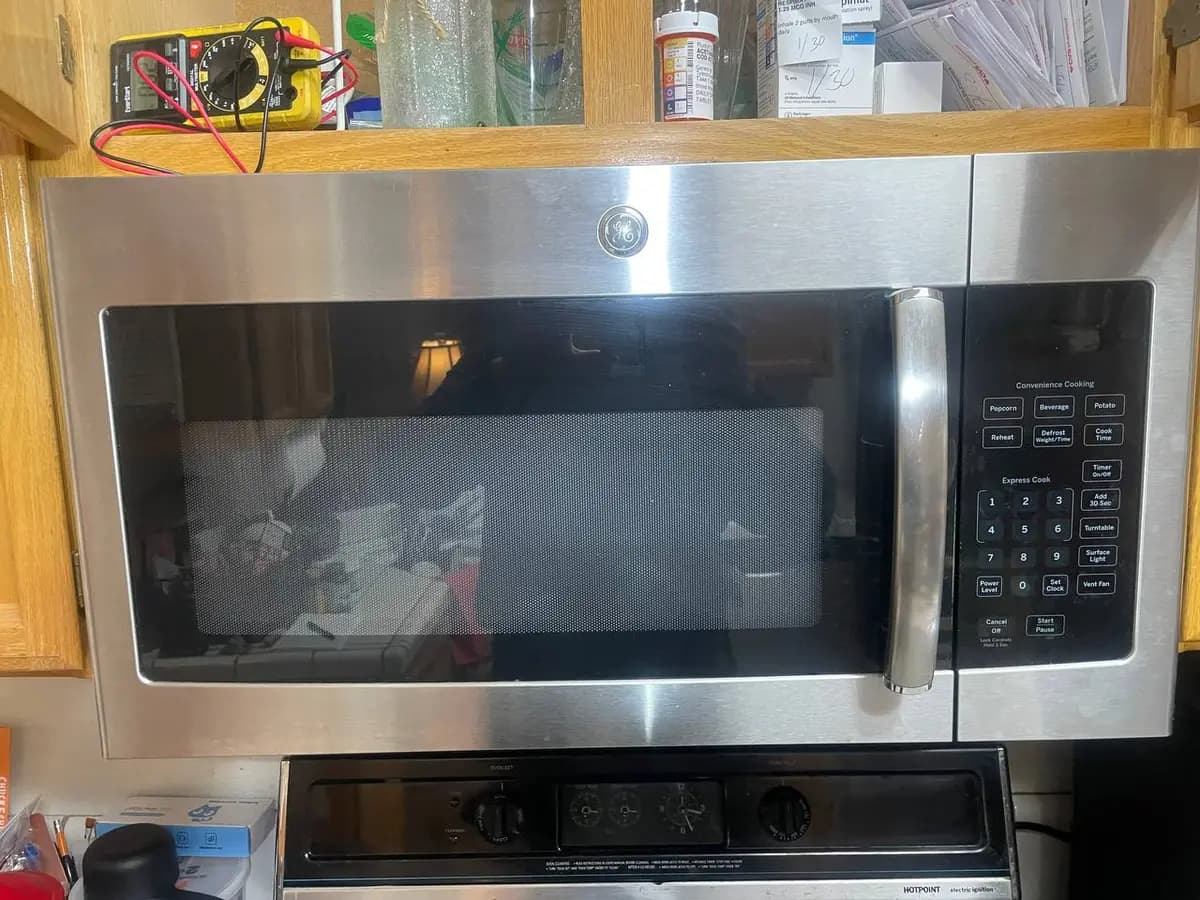
GE Microwave Shuts Off After a Few Seconds
Most likely an intermittent door interlock switch is opening a moment after the cycle starts and tripping the safety cutoff — but thermal protection, magnetron arcing, a control-board current fault, or loose wiring can each shut a GE microwave off seconds in, and the exact number of seconds before it quits is your…
The shutdown timing is a clue#
When a GE microwave has power and starts but quits after only a few seconds, count those seconds — the timing points at the cause:
- Under 2 seconds: usually a door switch — the interlock opens momentarily and forces an immediate shutdown.
- 2 to 5 seconds: often thermal protection, or the board detecting an abnormal current draw.
- 5 to 15 seconds: may be magnetron arcing that the board's protection circuit catches.
- 30 seconds or more: usually a thermal fuse or thermostat cutting out as something overheats.
Causes at a glance#
| Likely cause | Timing / sign | Share of cases | First move |
|---|---|---|---|
| Intermittent door interlock | Quits under ~2 seconds | 35% | Press the door while starting |
| Thermal protection tripping | Quits at 2-5 sec, won't restart | 25% | Let it cool, then retry |
| Magnetron arcing | Quits at 5-15 sec, buzz/arc | 20% | Professional test (high voltage) |
| Control-board current fault | Quits early, mixed behavior | 15% | Inspect the board |
| Loose high-current wiring | Random early cutout | 5% | Check the wiring connections |
Do You Have the Right Tools?
High-voltage capacitor discharge tool ($90), magnetron tester ($200), microwave leakage detector ($150). Our technician arrives with $3,000+ in professional tools — your diagnostic is free.
Licensed & Insured · 90-Day Warranty · Same-Day Service
Working through the causes#
Intermittent door interlock (35%). The door switches (parts WB24X829 and WB24X25397) can develop intermittent contact: they close enough to let the cycle start, but vibration as the magnetron energizes, or thermal expansion, nudges one open for an instant. The board treats any interlock interruption as a door-open event and stops immediately. Press the door firmly toward the latch as you start a cycle — if it then runs longer, a worn interlock switch is the cause.
Thermal protection tripping (25%). A thermal cutout on the magnetron or cavity opens when it senses excess heat, ending the cycle within a few seconds and refusing to restart until it cools. The tell is a microwave that quits early and then will not run again for several minutes. Let it cool completely and retry; if it runs again until it heats up, thermal protection — often from a cooling-fan or airflow problem — is engaging.
Magnetron arcing (20%). A failing magnetron, or arcing on a carbonized waveguide cover, produces a buzz or visible arc that the board's protection circuit catches, cutting the cycle at five to fifteen seconds. Because the magnetron sits in the high-voltage section, this is diagnosed and replaced by a professional, never opened up for a DIY test.
Control-board current fault (15%). The board monitors current and shuts down if it reads something abnormal. A board fault can misread a healthy circuit and cut cycles early, often with other odd behavior. Inspect the board once the door switches and thermal parts check out.
Loose high-current wiring (5%). A loose or corroded spade terminal in the high-current path can drop contact under vibration, so the board sees a fault and stops. Trace the wiring for loose or discolored connections and reseat or repair them.
Diagnostic sequence#
- Count the seconds from Start to shutdown — the duration alone narrows it a lot.
- Try again immediately; if it will not restart for several minutes, thermal protection has engaged.
- Press the door firmly while starting — running longer points to the interlock.
- Watch for a flashed code on Profile models (such as F3, F5, F6, or F9) just before shutdown.
- Listen for buzzing or arcing, which points toward the magnetron.
Safety First — Know the Risks
Microwave capacitors store lethal voltage (4,000V+) even when unplugged. This is the single most dangerous DIY appliance repair. Our techs are licensed and insured — let them handle the risk.
Licensed & Insured · 90-Day Warranty · Same-Day Service
A safety note#
Anything behind the outer cabinet — the magnetron and high-voltage parts — carries lethal stored voltage and is strictly a professional repair. Door switches and wiring can be diagnosed with the unit unplugged, but the high-voltage side is not a DIY area.
GE microwave quitting seconds after it starts? Our technicians diagnose interlocks, thermals, and magnetrons across Sacramento and the Bay Area. Book your repair.
Senior Gas Appliance Specialist · 18 years experience
AGA-certified gas appliance specialist with 18 years of experience in residential and commercial oven, range, and cooktop repairs.