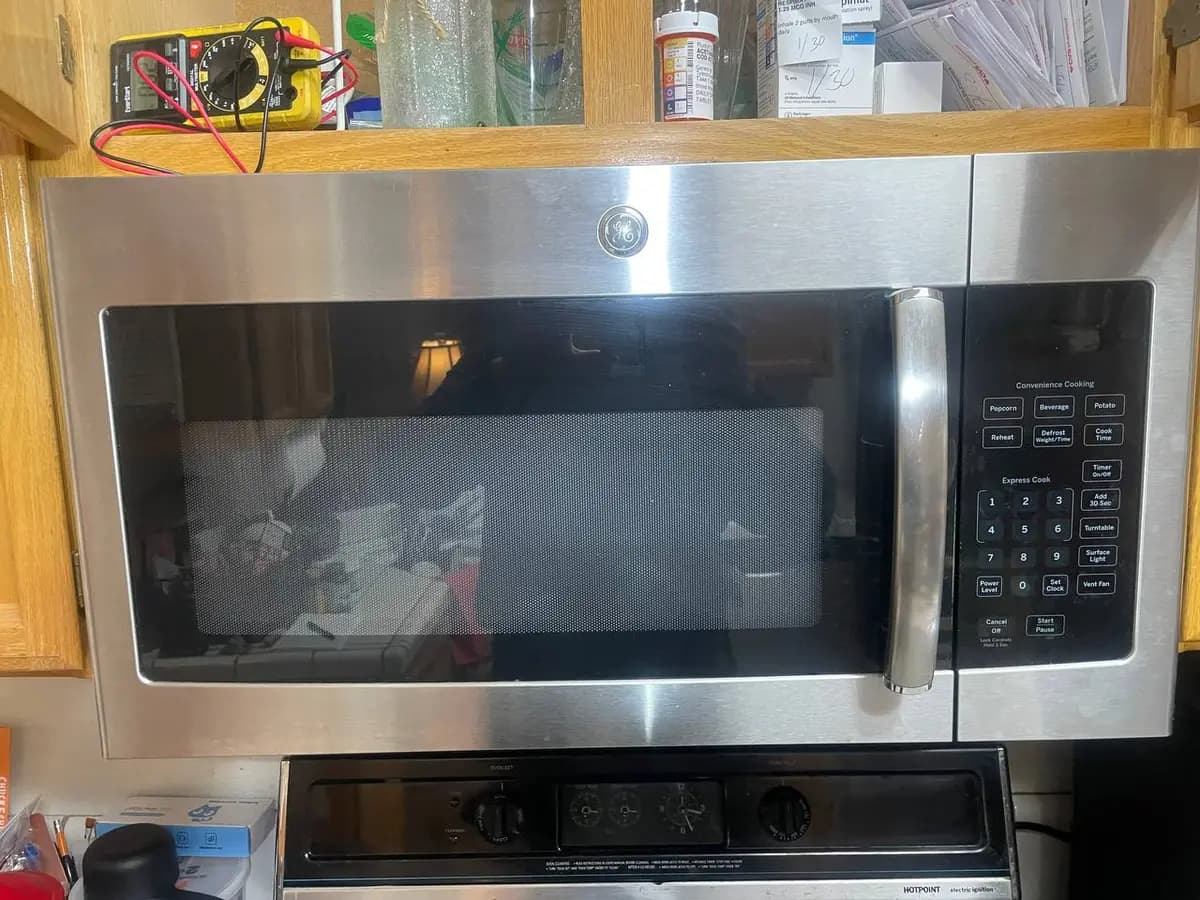
Quick Answer: Why Your GE Microwave Is Noisy#
Most likely: the exhaust-fan motor bearings on an over-the-range GE microwave have worn out. That motor runs in a hot, grease-laden environment, and over years the aerosolized cooking oil breaks down its lubrication until it grinds, rattles, or squeals whenever the fan runs. A failing magnetron rattling loose internally, a worn turntable motor, or loose internal parts are the other common sources. First tell normal from abnormal: a steady low magnetron hum, a constant fan whir, and a turntable click at start and stop are all normal — grinding, squealing, or a growing rattle are not.
Likely Causes at a Glance#
| Cause | Likelihood | What to check |
|---|---|---|
| Worn exhaust-fan motor bearings | Most likely | grinding or squealing when the fan runs, during cooking or as a range hood (GE WB26X10252) |
| Failing magnetron | Common | an irregular, louder buzz or growl unlike the normal steady hum (WB27X10880, WB27X11079) |
| Turntable motor wearing | Common | a rhythmic clicking or grinding from the cavity floor (WB26X10038) |
| Loose internal components | Occasional | a flapping waveguide cover, loose magnetron bolts, or a separated internal duct rattling |
| Cooling fan obstruction | Occasional | a click or rattle with each fan rotation from debris in the cooling-fan path |
Do You Have the Right Tools?
High-voltage capacitor discharge tool ($90), magnetron tester ($200), microwave leakage detector ($150). Our technician arrives with $3,000+ in professional tools — your diagnostic is free.
Licensed & Insured · 90-Day Warranty · Same-Day Service
Walking Through the Diagnosis#
Start by classifying the sound, because GE microwaves — JVM over-the-range, JES countertop, and Advantium — each have a normal profile: a steady magnetron hum, a constant-pitch fan whir, a gentle turntable click, and a relay click at start and stop. What is abnormal is a loud buzzing or rattling that grows over time, a grinding or squealing, or rhythmic knocking during operation.
Then match the abnormal sound to the part. Grinding or squealing that appears only when the fan runs — whether cooking or venting as a range hood — is the exhaust-fan motor (WB26X10252) whose bearings have absorbed cooking grease. A buzzing or growling that is louder and more irregular than the normal hum, especially if it changes pitch, is a magnetron (WB27X10880 or WB27X11079) with internally loosened components. A rhythmic clicking, grinding, or humming from the bottom of the cavity is the turntable motor (WB26X10038) whose gear reduction or shaft bearing has worn. A flapping or buzzing that comes and goes is usually loose hardware — the waveguide cover, magnetron mounting bolts, or a separated internal duct on over-the-range models — and a click with each fan rotation is debris fallen into the cooling-fan path. Let the timing guide urgency: a new noise with unchanged heating can wait a couple of weeks, a new noise with reduced heating means the magnetron is failing and needs attention within days, and any snapping or arcing sound means stop using it immediately.
Repair or Replace? The Short Version#
An exhaust-fan motor, a turntable motor, or tightening loose hardware is an inexpensive, targeted repair, and only a magnetron is a larger part — still well under a new microwave. The deciding factor is the sound: a rattle can wait a little, but arcing or a magnetron growl with weak heating should not. If the noise is only on the exhaust fan you can keep using the microwave to cook and simply avoid the fan until repaired — or our technicians match the sound to the part and carry GE microwave motors — book a repair.
Safety First — Know the Risks
Microwave capacitors store lethal voltage (4,000V+) even when unplugged. This is the single most dangerous DIY appliance repair. Our techs are licensed and insured — let them handle the risk.
Licensed & Insured · 90-Day Warranty · Same-Day Service
Frequently Asked Questions#
What GE microwave sounds are normal versus a problem?#
Normal sounds are a steady low magnetron hum, a constant-pitch fan whir, a gentle turntable click at start and stop, and a relay click. A problem is a loud buzzing or rattling that grows over time, a grinding or squealing, rhythmic knocking, or any snapping or arcing — those signal wear that will progress to failure.
Why does my GE microwave grind only when the fan runs?#
That is the exhaust-fan motor (WB26X10252) on an over-the-range unit. It works in a hot, greasy environment, and over five to ten years the grease breaks down its bearing lubrication, so it grinds or squeals whenever the fan runs — either during cooking or when you use it as a range hood. Replacing the motor resolves it.
Is a buzzing GE microwave dangerous to keep using?#
It depends on the buzz. The normal steady hum is fine, but a louder, irregular buzz or growl that comes with weaker heating is a failing magnetron and should be repaired within days. Any snapping or arcing sound means stop using it immediately, since that is a fire risk rather than simple wear.
How much noise from the turntable is normal?#
A gentle click as the turntable starts and stops is normal. A rhythmic clicking, grinding, or humming from the cavity floor throughout rotation is not — that is the turntable motor (WB26X10038) whose internal gears or shaft bearing have worn. It is an inexpensive part and not urgent, but a struggling motor will eventually stall.
Senior Gas Appliance Specialist · 18 years experience
AGA-certified gas appliance specialist with 18 years of experience in residential and commercial oven, range, and cooktop repairs.