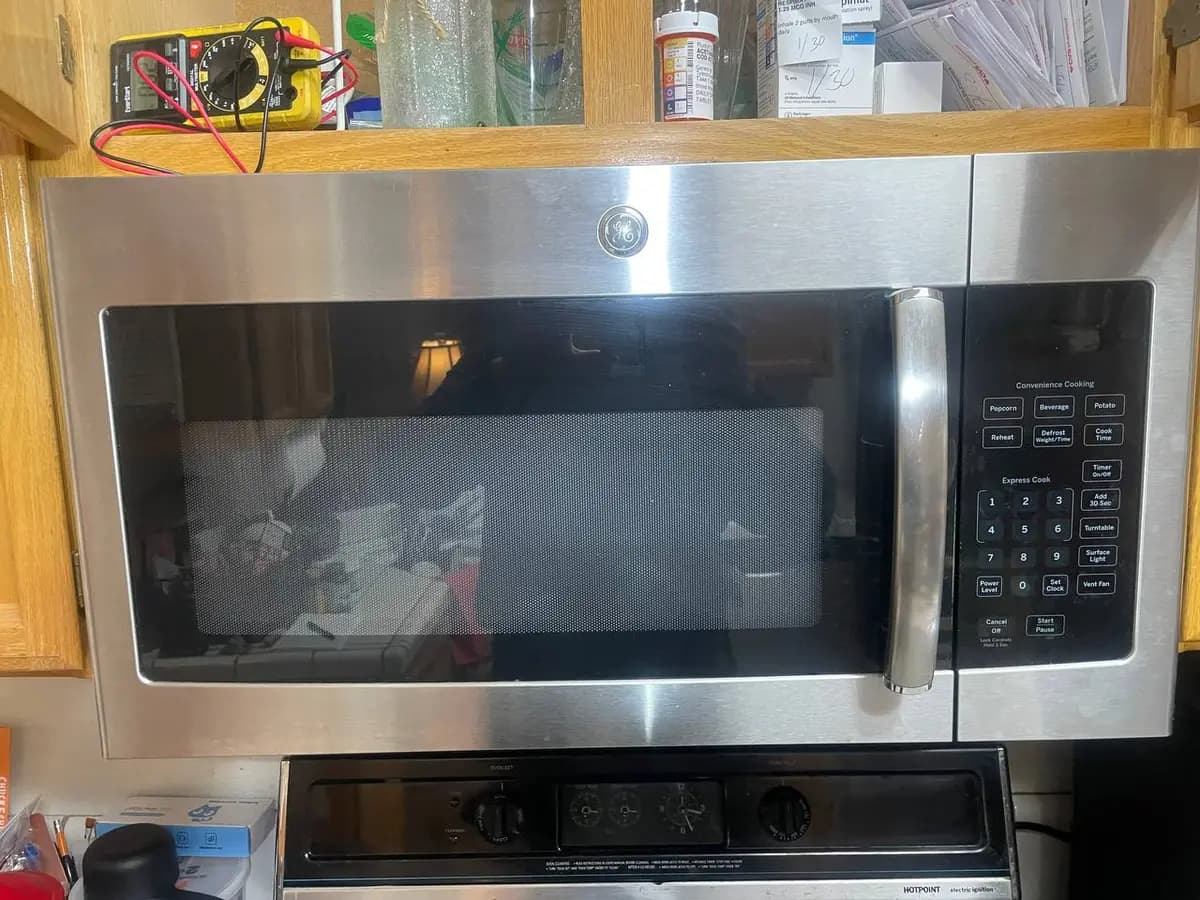
A GE microwave that trips the circuit breaker is drawing a fault current somewhere in its high-voltage section — a shorted door switch, capacitor, magnetron, or transformer — or the kitchen circuit is simply overloaded. Because the high-voltage parts hold a lethal charge, this is largely a diagnose-then-call situation. This guide ranks the causes and the important safety line.
The likely culprit#
Most likely: a shorted door (monitor) switch. GE microwaves use several interlock switches, and if the monitor switch — a normally-closed safety switch — shorts internally, it creates a dead short the instant the door is opened while running, tripping the breaker and usually blowing the internal fuse at the same time. If the switches are good, a failed high-voltage capacitor is the next suspect.
Do You Have the Right Tools?
High-voltage capacitor discharge tool ($90), magnetron tester ($200), microwave leakage detector ($150). Our technician arrives with $3,000+ in professional tools — your diagnostic is free.
Licensed & Insured · 90-Day Warranty · Same-Day Service
Safety first#
Do not reset the breaker and keep using the microwave — a repeated trip is a short-circuit condition that can damage house wiring or cause a fire.
The high-voltage capacitor stores a lethal charge even unplugged and must be discharged before any internal work — this is why high-voltage microwave faults are a technician's job.
Breaker trip vs. internal fuse#
GE microwaves also have an internal line fuse (typically a 20-amp ceramic type, part WB27X10388). If the internal fuse blows but the house breaker holds, the fault is inside the microwave; if the house breaker trips, it's either an overloaded circuit or an internal short drawing current beyond the breaker's rating.
Safety First — Know the Risks
Microwave capacitors store lethal voltage (4,000V+) even when unplugged. This is the single most dangerous DIY appliance repair. Our techs are licensed and insured — let them handle the risk.
Licensed & Insured · 90-Day Warranty · Same-Day Service
Ranked causes at a glance#
| Likely cause | How common | What you'll notice / what to check |
|---|---|---|
| Shorted door (monitor) switch | 30% of cases | Trips when the door is operated; a shorted monitor switch and a blown internal fuse. |
| Failed high-voltage capacitor | 25% of cases | Powers on normally, then trips the instant the magnetron circuit energizes; cap WB27X10240. |
| Shorted magnetron | 20% of cases | The HV circuit shorts to ground through the magnetron body; WB27X10880 or WB27X11079. |
| Overloaded circuit (not a fault) | 15% of cases | The microwave shares a circuit with other appliances that push it over the limit. |
| Shorted high-voltage transformer | 10% of cases | An internal transformer short, sometimes with visible smoke inside the cabinet. |
Working through each cause#
1. Shorted door (monitor) switch (30% of cases)#
GE microwaves have three to four interlock switches, and the monitor switch is a normally-closed safety that deliberately shorts to blow the fuse if the other interlocks fail. If it shorts internally while the door is closed, it creates a dead short the moment the door is opened during operation, tripping the breaker and usually blowing the internal fuse together. The switches are tested for continuity and replaced as a set with the fuse.
2. Failed high-voltage capacitor (25% of cases)#
The high-voltage capacitor (GE part WB27X10240 on JVM models) is part of the voltage-doubler that powers the magnetron, and when it develops an internal short it draws massive current the instant the magnetron circuit energizes — far past the breaker rating. The signature is a microwave that powers on normally, with the display and timer working, then trips the breaker the moment it tries to cook. The capacitor must be discharged before testing.
3. Shorted magnetron (20% of cases)#
The magnetron (WB27X10880 on JVM3160, WB27X11079 on newer models) can develop an internal short between its filament or cathode and the chassis, so the high-voltage circuit shorts to ground through the magnetron body and draws extreme current. With the microwave unplugged and the capacitor discharged, a technician isolates the magnetron and tests it. A magnetron shorted to its case is replaced.
4. Overloaded circuit — not a microwave fault (15% of cases)#
Before condemning the microwave, rule out a simply overloaded circuit: in older homes the microwave outlet may share a circuit with counter outlets, under-cabinet lights, a disposal, or even a dishwasher. If the microwave ran fine for years and suddenly trips only when other appliances are running, the circuit is overloaded rather than the microwave being faulty. A dedicated circuit resolves it.
5. Shorted high-voltage transformer (10% of cases)#
The HV transformer steps line voltage up to roughly 2,100V for the magnetron circuit, and an internal short between the primary winding and core, or between windings, creates a high-current path that trips the breaker — often with visible smoke from the transformer area inside the cabinet. This is a clear replace-the-transformer fault, done by a technician after discharging the capacitor.
The Real Cost of DIY
Average DIY attempt: $150-400 in tools you may use once, plus the risk of further damage. Our diagnostic visit costs $0 — we find the problem and give you an honest quote.
Licensed & Insured · 90-Day Warranty · Same-Day Service
The short version#
- Door / monitor switch — 30%; trips on door operation, blows the internal fuse.
- HV capacitor — 25%; powers on then trips when cooking starts, WB27X10240.
- Magnetron — 20%; shorts to ground, WB27X10880 or WB27X11079.
- Overloaded circuit — 15%; a shared circuit, not a microwave fault.
- HV transformer — 10%; an internal short, sometimes with smoke.
What the repair usually involves#
A breaker-trip repair first distinguishes an internal fault from an overloaded circuit, then — with the microwave unplugged and the capacitor safely discharged — tests the interlock switches, capacitor, magnetron, and transformer. Most repairs are a switch set, capacitor, or magnetron replacement. Because of the stored high-voltage charge, this diagnosis is a technician's job rather than a DIY one.
Don't Void Your Warranty
Opening your appliance yourself may void the manufacturer warranty. Our repair comes with a 90-day guarantee, and we document everything for warranty compliance.
Licensed & Insured · 90-Day Warranty · Same-Day Service
When to call a professional#
Call a technician for any GE microwave that trips the breaker or blows its internal fuse — the high-voltage capacitor holds a lethal charge, and the fault is usually a switch, capacitor, magnetron, or transformer. Don't keep resetting the breaker. Have your model (for example JVM3160, JVM6175, JVM7195, or PVM9179) ready so the right parts come along. The cost depends on the part plus labor, confirmed before work.
Microwave tripping the breaker? Book an EasyBear technician — we service GE over-the-range microwaves and handle high-voltage faults safely.
Senior Gas Appliance Specialist · 18 years experience
AGA-certified gas appliance specialist with 18 years of experience in residential and commercial oven, range, and cooktop repairs.