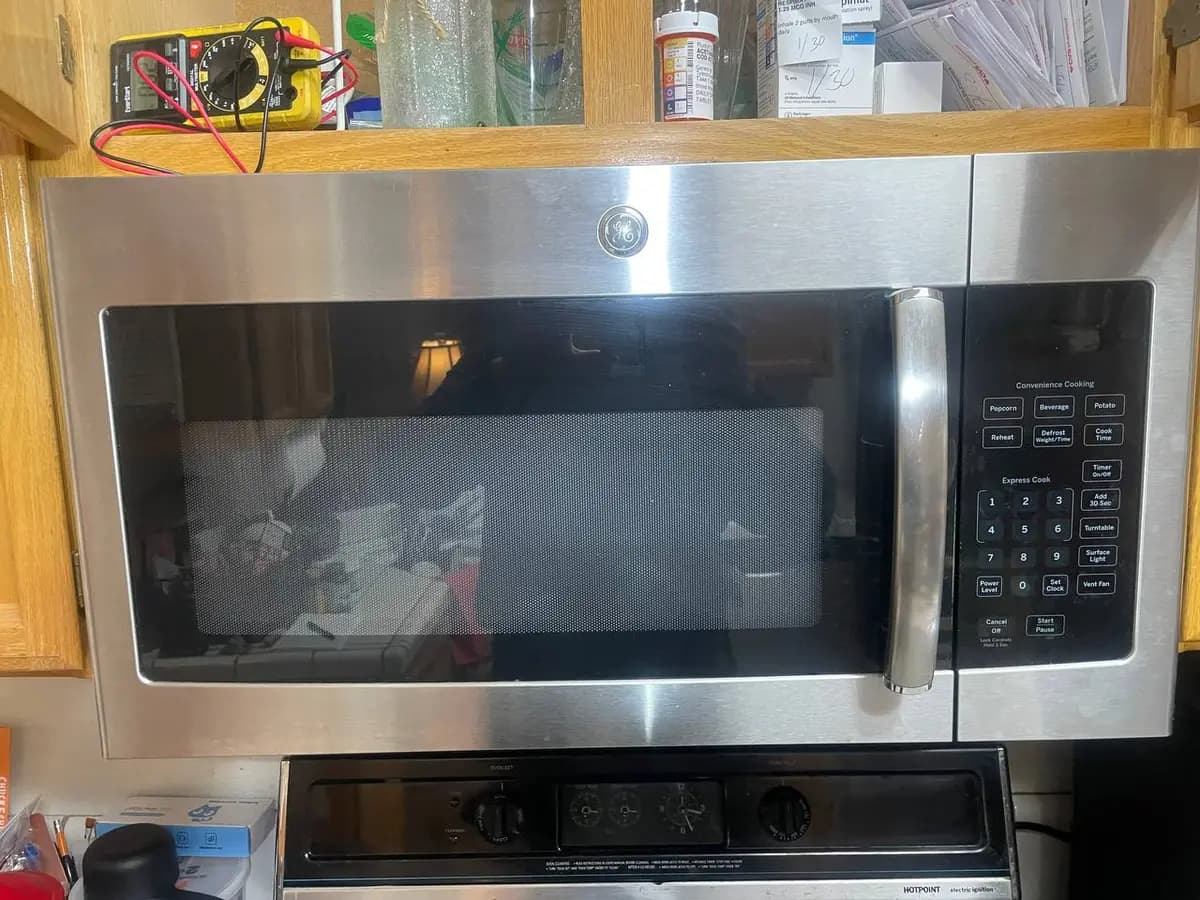
When a GE microwave door won't open, one quick test sorts the cause: press the release button and pay attention to the feel and the sound. A mushy button that doesn't spring back is a broken button spring. A firm click with no release is a broken hook or a failed linkage. And a normal-feeling button on a door that still won't budge points to a swollen door panel. This is most common on GE's over-the-range JVM series, where the release gets thousands of presses a year.
How the GE Release Works#
GE microwaves use one of two release designs. Button-release models (JVM, JES, and most others) put a push button on the front panel that drives an internal lever, which pushes the door hooks apart from the body catches; a return spring resets the button. Handle-pull models (Advantium and some Profile) use a cable or linkage between a handle and the hook mechanism, like a car door handle. Both rely on plastic parts rated for roughly 40,000 cycles — about ten years at a dozen uses a day — but kitchen heat, steam rising from the cooktop below, and forceful jabbing all wear them out faster.
Do You Have the Right Tools?
High-voltage capacitor discharge tool ($90), magnetron tester ($200), microwave leakage detector ($150). Our technician arrives with $3,000+ in professional tools — your diagnostic is free.
Licensed & Insured · 90-Day Warranty · Same-Day Service
The Four Causes, By Frequency#
1. Broken Release Button or Spring (35% of cases)#
The release button on GE JVM over-the-range models (part WB06X10654 on many JVM3 and JVM6 units) holds a small metal spring that returns it to the extended position. When that spring breaks or dislodges, the button either sticks down or no longer transmits enough force to free the hooks. On JES countertop models the button is integrated into the door panel itself, with an internal latch built from part WB10X10023 (spring) and WB06X10420 (latch body). The signs are a button that feels mushy or won't spring back, a button that clicks without releasing the door, a button stuck in the pressed position, or a door that only opens with hard pressing at a specific angle.
2. Jammed or Broken Door Hook (30% of cases)#
The door hooks are plastic pieces that latch into metal catches on the body. If a hook's tip breaks off while it is engaged with the catch, the fragment stays locked and the door will not open — different from a hook that breaks at the base and stops the door closing. GE hook assemblies vary by model: WB06X10780 (JVM7195, JVM3160), WB06X10290 (older JVM models), and WB06X10597 (Advantium PSA series). Look through the glass at where the door meets the body: a gap on one side but not the other means one hook has released while the other is still engaged, and you may spot a broken plastic fragment in the latch area.
3. Open Lever Linkage Failure (20% of cases)#
Between the button and the hooks sits a lever or linkage that carries the pressing force. On JVM over-the-range models this is a plastic rocker arm on a pivot pin; the pin wears, the arm cracks at the pivot, or its connection to the hook assembly separates. On Advantium models the linkage is a metal rod with plastic end connectors, and those connectors are the weak point — they clip onto the rod ends and crack off after years of thermal cycling between cold and the heat of halogen cooking. This repair is advanced and generally needs full disassembly.
4. Swollen or Warped Door Panel (15% of cases)#
Over-the-range GE microwaves sit right above the cooktop and absorb years of rising heat and steam. The inner door panel — a layered build of metal mesh, cardboard insulation, and a plastic frame — can absorb moisture and swell, shifting the geometry enough that the hooks cannot clear the catches even when the release works perfectly. The signature is a door that worked fine for years then grew gradually harder to open, with no clicking or snapping and a normally functioning button. This is not a repair so much as a door-panel replacement.
Emergency Release for Over-the-Range Models#
If you need the door open right away, do not pry it from the front — that cracks the door panel. Instead, unplug the microwave, remove the outer cabinet screws from the back (typically ten to twelve Phillips screws), and reach the interlock and hook area from behind, where you can manually push the hooks apart from the catches. This gets the door open without damaging the panel and gives you access to inspect the release mechanism.
Safety First — Know the Risks
Microwave capacitors store lethal voltage (4,000V+) even when unplugged. This is the single most dangerous DIY appliance repair. Our techs are licensed and insured — let them handle the risk.
Licensed & Insured · 90-Day Warranty · Same-Day Service
Troubleshooting Order#
- Test the button feel — mushy or stuck means the button or spring.
- Listen for the click — no click means a broken hook or a failed linkage.
- Check the hook areas through the glass for debris or broken plastic.
- Judge the force — much more force than usual with a working button suggests a swollen panel rather than a broken part.
- Try a slight inward push while pressing the button; if that helps, the hooks are worn to the edge of engagement rather than broken.
DIY Difficulty and Parts by Component#
| Component | DIY? | Common GE part numbers |
|---|---|---|
| Button / spring | Yes | WB06X10654, WB10X10023, WB06X10420 |
| Door hooks | Moderate | WB06X10780, WB06X10290, WB06X10597 |
| Open lever linkage | Advanced | Model-specific rocker arm / rod |
| Door panel assembly | No (heavy/awkward) | Complete door assembly |
The Real Cost of DIY
Average DIY attempt: $150-400 in tools you may use once, plus the risk of further damage. Our diagnostic visit costs $0 — we find the problem and give you an honest quote.
Licensed & Insured · 90-Day Warranty · Same-Day Service
When to Call a Professional#
Replacing a release button and spring is a reasonable DIY job once the cabinet is off, and the emergency-release method will get a stuck door open safely. Hooks and lever linkages are moderate-to-advanced work that often means full disassembly, and a swollen door panel is a complete door replacement rather than a repair — both are worth a technician if you are not comfortable pulling the unit apart. On over-the-range models especially, unplug the microwave before removing the cabinet, since the high-voltage compartment sits just inside and its capacitor holds a dangerous charge.
How to Prevent It#
- Press the release button with moderate force — jabbing it wears the spring faster.
- Keep excessive steam off the microwave by using lids on pots on the cooktop below.
- Clean the latch area monthly so sticky cooking residue cannot jam the hooks.
- Act early if the button starts feeling different, before a full failure traps the door shut.
Having trouble with your GE microwave? Get a same-day diagnosis from a technician who works on GE appliances daily. Request a technician
Senior Gas Appliance Specialist · 18 years experience
AGA-certified gas appliance specialist with 18 years of experience in residential and commercial oven, range, and cooktop repairs.