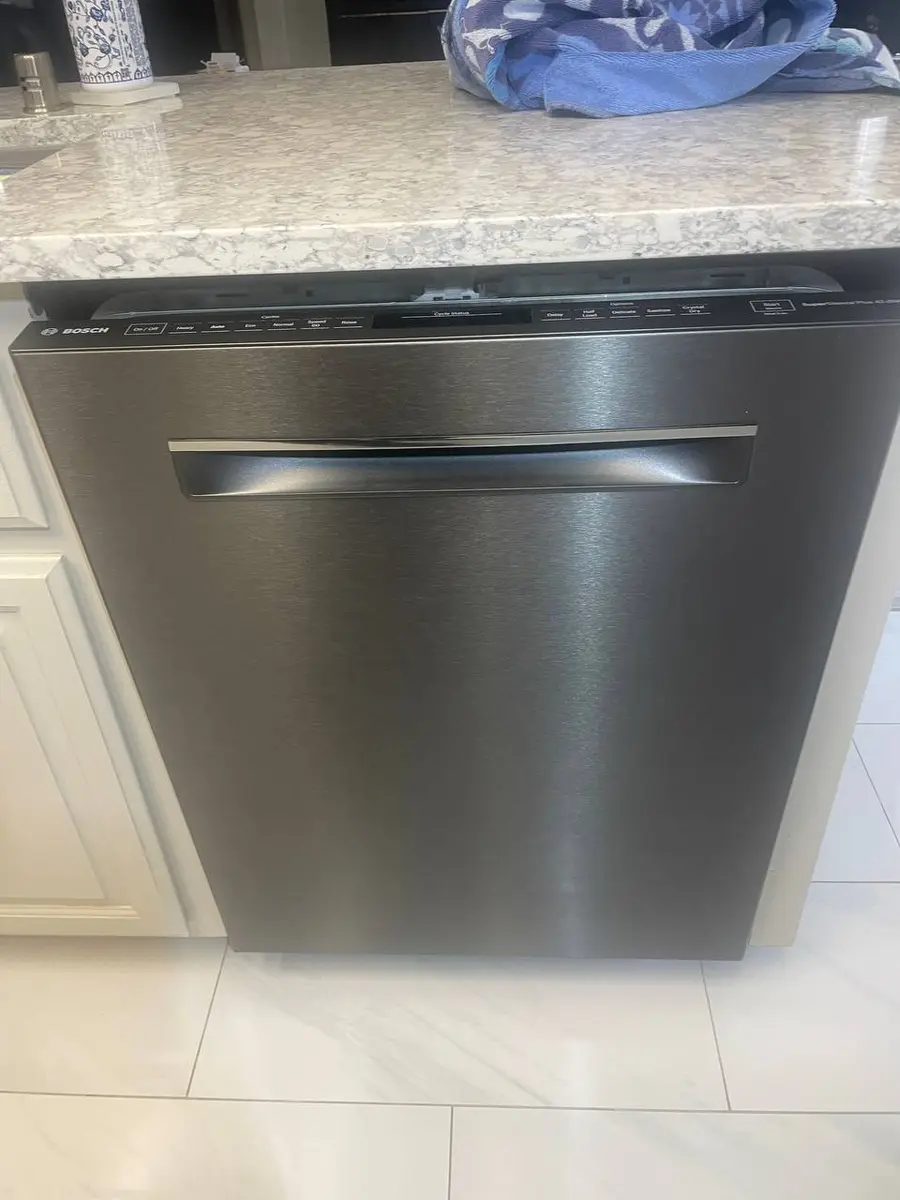
GE Dishwasher Overflowing: Shut It Down
Kill the power at the breaker and close the hot water supply valve under the sink before anything else. Water leaving the tub through the door gasket corners or the vent means the primary fill control has already failed — GE's base pan float switch is a secondary defence, not the thing that was supposed to stop this.…
Do this first#
- Disconnect power at the circuit breaker.
- Turn off the hot water supply valve under the sink.
- Put towels around the base to stop the water spreading.
- Look under the machine for water reaching the junction box or any electrical connection.
- Do not restart until you know what caused it.
How GE controls the fill#
Four parts share the job. The float dome is a plastic cylinder in the front-left of the tub floor that rises with the water. The float switch underneath is triggered when the dome reaches the full position. The inlet valve (WD15X10003) opens on a board command and closes when the float signals full, or when the board's timer expires. And a backup flood sensor in the base pan runs the drain pump and throws a C3 error.
An actual overflow therefore means two failures: the float never said stop, and the board's timed backup did not either.
Do You Have the Right Tools?
Water pressure gauge ($60), spray arm tester, float switch multimeter ($85), and drain inspection camera. Our technician arrives with $3,000+ in professional tools — your diagnostic is free.
Licensed & Insured · 90-Day Warranty · Same-Day Service
The five causes#
| Cause | Share | The tell |
|---|---|---|
| Stuck float switch | 35% | Dome will not lift and drop freely by hand |
| Inlet valve stuck open | 30% | Water trickles into the tub with the machine off |
| Control board fill relay welded | 20% | Filling continues even with the dome held up; C1 may appear |
| Drainage failure imitating overflow | 10% | No drain pump sound between wash and rinse |
| Backflow from the disposal or drain line | 5% | Tub fills while the machine sits idle |
Stuck float. Food debris, utensil fragments and undissolved detergent pod wrapper jam the dome down in its well so it never rises. GE's corner placement is part of why: unlike brands that mount the float centrally, the front-left position on GDT models catches debris deposited by the Piranha disposer during drain. Lift the dome and let go — it should move freely and fall back under gravity. Clear the well, then test the switch: continuity with the dome up, none with it down. No continuity with a freely moving dome means the switch itself is finished.
Inlet valve. The solenoid opens it and a spring closes it. A worn diaphragm, a weakened spring, or mineral scale on the seat lets a thin stream through after the click you hear. Over a full cycle that trickle overfills the tub. Test it with the machine off and the supply on: any water entering the tub confirms it. Replacing the valve means closing the supply, disconnecting both hoses and the wiring, and swapping it — and clean the fine mesh screen in the valve inlet while you are there, since buildup there also stops it closing against pressure.
Welded fill relay. The board relay that powers the valve can weld shut from repeated switching, so the board cannot turn the valve off no matter what it intends. Hold the dome up during a fill: if water keeps coming, the relay is stuck, and error code C1 may show after power is restored. That is a board replacement. Until it happens, keep the supply valve closed except when running the machine.
Drainage. Sometimes it is a normal fill that never drained. After two or three fills with no drain between phases, the accumulated water goes over. Listen for the drain pump between wash and rinse — silence means the drain system, not the fill system.
Backflow. Sink or disposal water siphons back through the drain hose when there is no high loop or air gap. GE's installation instructions require one; plenty of installations, especially older ones, do not have it.
Preventing the next one#
Lift the float dome monthly and check it moves freely, keep the area around it clear, install and maintain a drain hose high loop or air gap, and treat slow-filling symptoms as early warning — a valve struggling to close eventually fails to close. Closing the supply valve when you go away for a while is cheap insurance.
Water in the tub with the machine off? Book a repair — that is the valve or the drain hose, and neither fixes itself.
Senior Gas Appliance Specialist · 18 years experience
AGA-certified gas appliance specialist with 18 years of experience in residential and commercial oven, range, and cooktop repairs.