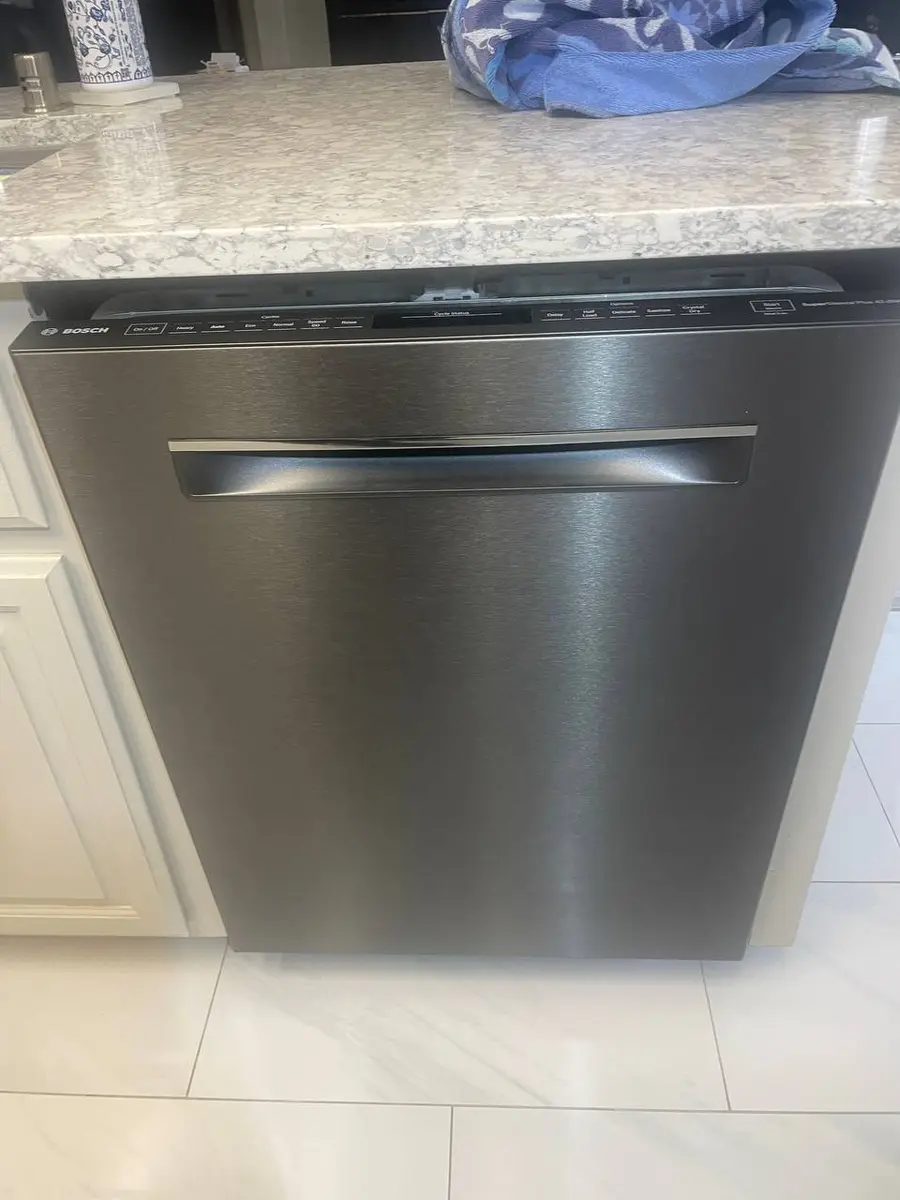
GE Cafe dishwashers — including the CDT800, CDT700, and CDD420 series — combine premium design with advanced wash technology. These units feature customizable hardware finishes to match your kitchen aesthetic, dedicated bottle wash jets, a steam prewash system, and SmartHQ Wi-Fi connectivity for remote monitoring and diagnostics. Priced between $1,200 and $2,200, Cafe dishwashers use the GE C-code error platform while adding connected diagnostics and features not found on standard GE models.
When a Cafe dishwasher displays an error, the code appears on the control panel along the top of the door. On hidden-control models (CDT800 series), the code displays on the interior top-of-door LED strip visible only when the door is slightly ajar or fully open. Understanding these codes helps you avoid unnecessary service calls and identify when professional repair is genuinely required.
How Cafe Dishwasher Error Codes Work#
Cafe dishwashers use a C-prefix numbering system for most fault codes, consistent with the broader GE dishwasher platform. The control board continuously monitors sensors for water level, temperature, turbidity (water clarity), motor current, and door seal status throughout each wash cycle phase. When a sensor reading falls outside the expected range for the current cycle phase, the control board pauses the cycle and displays the corresponding error code.
To reset most error codes: Press Start/Reset and wait for the dishwasher to drain (approximately 2 minutes). If the code persists, turn off the circuit breaker for 60 seconds and restore power. On SmartHQ-connected models, you can also initiate a reset remotely through the app.
Hidden-control models (CDT800): Because the controls are on the top edge of the door, you must open the door slightly to see the error code on the LED strip. The code also pushes as a notification in the SmartHQ app if your unit is connected to Wi-Fi.
Do You Have the Right Tools?
Water pressure gauge ($60), spray arm tester, float switch multimeter ($85), and drain inspection camera. Our technician arrives with $3,000+ in professional tools — your diagnostic is free.
Licensed & Insured · 90-Day Warranty · Same-Day Service
C1 — Stuck Key / Control Panel Error#
C1 indicates a continuously activated button on the control panel — the control board detects a button pressed for longer than 60 seconds without release. On Cafe dishwashers, the touch controls are integrated into the stainless or panel-ready door surface and are susceptible to moisture from steam venting.
Common causes:
- Steam condensation on the touch panel during or after a hot wash/sanitize cycle
- Grease or liquid detergent film on the touch surface creating phantom capacitive inputs
- Ribbon cable connection loosened at the control board from repeated thermal cycling
- Touch panel membrane delamination (typically develops after 4–5 years of daily use)
How to fix:
- Wipe the control panel completely dry with a lint-free cloth. On hidden-control CDT800 models, open the door fully and dry the top-edge control strip thoroughly — steam collects here during venting.
- Power off at the circuit breaker for 60 seconds, then restore. If C1 clears and does not return on the next cycle, moisture was the cause.
- If C1 persists after drying and power cycling, access the control board by removing the inner door panel (open door fully, remove the interior Torx screws along the inner door perimeter, carefully separate the inner panel from the outer door shell). Inspect the ribbon cable connector at the board — reseat firmly with even pressure.
- Disconnect the ribbon cable entirely from the board and power on. If C1 clears with the panel electrically disconnected, the touch panel overlay or membrane needs replacement.
Cafe-specific note: CDT800 hidden-control models direct venting steam directly past the top-edge control strip area. If C1 recurs specifically after Sanitize cycles or Steam Prewash operations (which generate the most steam), the door vent gasket may be deteriorating and allowing excess steam to reach the control surface. Inspect and replace the vent gasket (varies by model and region) before spending on the more expensive touch panel (varies by model and region). This vent gasket degradation is the number one Cafe-specific cause of C1.
Part cost: Touch panel overlay varies by part. Control board varies by part. Vent gasket varies by part. Professional repair: varies by part.
C3 — Pump Pressure Switch Error#
C3 means the control board is not receiving the expected pressure signal from the wash pump circuit. The dishwasher cannot confirm that water is being circulated through the spray arms at adequate pressure.
Common causes:
- Clogged filter assembly restricting water flow to and from the pressure switch sensing point
- Pressure switch mechanical failure (diaphragm stuck or perforated)
- Wash pump motor fault (seized bearings, failed windings, jammed impeller)
- Wiring break or corrosion between pressure switch and control board
How to fix:
- Remove the lower dish rack. Lift out the fine filter (twist counterclockwise) and then the coarse mesh filter cage. Clean all filter components thoroughly under running water — food particles, grease, and California hard water mineral deposits accumulate rapidly and are the primary cause of C3 in the Sacramento and Bay Area regions.
- Inspect the sump area beneath the filter for debris that may have bypassed filtration: glass fragments, fruit pits, broken dish pieces, or food bone fragments.
- Run a short Normal cycle after cleaning the filter assembly. If C3 clears and the cycle completes, inadequate filtration was restricting pump flow.
- If C3 persists with thoroughly clean filters, test the pressure switch — disconnect the sensing hose and blow gently. You should hear a distinct click as the switch activates. No click indicates internal switch failure.
- Test wash pump motor winding resistance: expect 5–20 ohms between leads. If the motor hums when activated but the pump does not move water, the impeller may be jammed with debris or the motor bearings have seized.
Cafe-specific note: Cafe dishwashers with the bottle wash jet system (CDT800 series) have an additional water diverter valve that routes pressurized water between the standard spray arms and the dedicated bottle wash jets. If C3 appears only when bottle wash is selected as a cycle option, the diverter valve may be stuck in one position or its actuator motor has failed, causing a pressure anomaly that the switch detects. Test with bottle wash deselected to confirm.
Part cost: Filter assembly varies by part. Pressure switch varies by part. Wash pump motor assembly varies by part. Diverter valve varies by part. Professional repair: varies by part.
Safety First — Know the Risks
Live 120V wiring in a wet environment is one of the most dangerous DIY scenarios. Water + electricity = serious shock risk. Our techs are licensed and insured — let them handle the risk.
Licensed & Insured · 90-Day Warranty · Same-Day Service
C6 / C7 — Turbidity Sensor Error#
C6 (optical signal out of range) and C7 (sensor communication lost) both relate to the turbidity sensor — an optical device in the sump that measures how dirty or clear the wash water is by shining light through it and measuring transmission. The dishwasher uses this real-time reading to determine whether additional rinse cycles are needed and when the water is clean enough to proceed to the next phase.
Common causes:
- Mineral deposits on the sensor optical lens (Sacramento and Bay Area hard water is the primary cause — calcium carbonate buildup blocks the optical path)
- Sensor LED or photodetector failure from age
- Wiring corrosion at the sensor connector from exposure to moisture and detergent vapors
- Control board analog-to-digital converter unable to process the sensor signal
How to fix:
- Run an empty cycle with a citric acid-based dishwasher cleaner to dissolve mineral buildup on the sensor lens and throughout the wash system.
- If the code persists after a cleaning cycle, remove the lower spray arm and filter assembly to access the turbidity sensor in the sump. It is a small cylindrical component with a clear optical window on one or both sides.
- Clean the sensor lens surfaces carefully with a soft cloth and white vinegar. Do not use abrasive pads or scrubbing — scratching the optical window permanently impairs sensor accuracy.
- Check the sensor wiring connector for green oxidation or loose pins. Disconnect and reconnect firmly, cleaning any corrosion with electrical contact cleaner.
- If cleaning does not resolve the code, replace the turbidity sensor (varies by model and region).
Cafe-specific note: Cafe dishwashers with the steam prewash feature introduce additional moisture and food particles into the tub before the main wash begins, which causes faster turbidity sensor contamination compared to standard models without steam prewash. If C6 appears frequently on your Cafe unit, running a monthly empty maintenance cycle with dishwasher cleaner prevents sensor buildup. Bay Area water hardness varies significantly by city — homes in San Jose, Fremont, and the East Bay typically have harder water than San Francisco peninsula locations.
Part cost: Turbidity sensor varies by part. Control board (rare) varies by part. Professional repair: varies by part.
PF — Power Failure#
PF appears after the dishwasher experienced a power interruption during an active cycle. The control board detected unexpected voltage loss and displays this status code upon power restoration.
Common causes:
- Actual power outage or circuit breaker trip
- Shared circuit overload — running a microwave or garbage disposal on the same circuit during a dishwasher cycle
- Loose wire nut connections in the hardwired junction box beneath the dishwasher
- GFCI outlet trip (if the dishwasher is on a GFCI-protected circuit)
How to fix:
- Press Start/Reset to clear PF and either restart the interrupted cycle or begin a fresh cycle.
- If the dishwasher was mid-cycle when power was lost, the tub likely still contains dirty water. Start a new Normal cycle to properly drain and rewash the load.
- Check the circuit breaker — GE recommends dishwashers on a dedicated 20A circuit. If the breaker tripped, determine the cause (overload, ground fault, or short) before resetting.
- For hardwired installations (most Cafe models are hardwired rather than plug-in), inspect the junction box beneath the dishwasher. Tighten all wire nut connections firmly — loose connections cause resistive heating and intermittent power loss under the high current draw of heating elements.
Cafe-specific note: If PF notifications appear in the SmartHQ app but the dishwasher seems to function normally otherwise, the issue may be a brief voltage dip (brownout) rather than a full outage. Sacramento summer demand spikes during afternoon HVAC peak hours can cause momentary voltage drops that trigger PF on sensitive digital control boards. A dedicated 20A circuit with proper wire gauge (12 AWG minimum) and tight connections typically resolves brownout-induced PF.
Part cost: $0 for simple power issues. Junction box repair $75–$150 (electrician). Control board replacement (if PF recurs with stable verified power): $150–$300.
The Real Cost of DIY
Average DIY attempt: $150-400 in tools you may use once, plus the risk of further damage. Our diagnostic visit costs $0 — we find the problem and give you an honest quote.
Licensed & Insured · 90-Day Warranty · Same-Day Service
C4 — Water Temperature Error#
C4 indicates the water temperature sensor in the sump is reading outside the expected range for the current cycle phase. The dishwasher requires incoming water at a minimum of 120 degrees F for effective cleaning and uses its internal heater to boost to 140–155 degrees F.
Common causes:
- Household water heater set below 120 degrees F (energy-saving mode too aggressive)
- Long hot water pipe run between the water heater and kitchen sink/dishwasher (water cools in transit)
- Failed water temperature thermistor in the dishwasher sump
- Heating element failure (the internal element that boosts water temperature for wash and sanitize cycles has burned out)
How to fix:
- Run the hot water tap at the kitchen sink until fully hot before starting the dishwasher. This purges cold standing water from the pipes and ensures hot water reaches the dishwasher immediately on the fill cycle rather than filling with lukewarm pipe water.
- Verify your water heater is set to at least 120 degrees F. Test actual hot water temperature at the kitchen sink with a cooking thermometer — the delivered temperature at the tap matters, not just the water heater dial setting.
- If incoming water is verifiably hot but C4 persists, the internal thermistor or heating element may have failed. Access the sump area and test thermistor resistance (approximately 50,000 ohms at 77 degrees F, decreasing proportionally as temperature rises).
- Test the heating element for continuity — expect 10–30 ohms between element leads. An open reading (infinite resistance) means the element has burned through and needs replacement.
Cafe-specific note: Cafe dishwashers with the Sanitize cycle option boost water to 155 degrees F (standard models only reach 140 degrees F). The heating element works significantly harder and longer in Sanitize mode and fails sooner than in standard models. If C4 appears only during Sanitize cycles but Normal and Heavy cycles complete successfully, the element is partially degraded — it can still achieve 140 degrees F but can no longer reach 155 degrees F within the allocated time window.
Part cost: Thermistor varies by part. Heating element varies by part. Professional repair: varies by part.
C8 — Drain Error#
C8 signals that the dishwasher cannot drain water from the tub within the expected timeframe (typically 2 minutes of drain pump operation).
Common causes:
- Clogged drain filter or drain path with food debris
- Kinked or blocked drain hose under the sink
- Drain pump motor failure (seized impeller or burned-out motor windings)
- Garbage disposal knockout plug not removed during new installation
- Air gap device or high loop section blocked with accumulated grease
How to fix:
- Clean the drain filter assembly — same thorough procedure as described for C3 above, focusing on the drain path specifically.
- Inspect the drain hose under the sink for kinks, sags, or blockages. The hose should loop up to the underside of the countertop (forming a high loop to prevent backflow) or connect through an air gap device before entering the garbage disposal or dedicated drain line.
- If connected to a garbage disposal, run the disposal to clear any food blockage at the dishwasher connection port. On new installations specifically, verify that the disposal knockout plug was punched out during installation — this is a common oversight that completely blocks drainage.
- Test the drain pump: with the dishwasher off and unplugged, access the drain pump at the bottom of the unit. Check the impeller for obstructions (glass shards, olive pits, food debris, broken toothpicks) and test motor winding continuity (expect 5–15 ohms).
Cafe-specific note: Cafe dishwashers with the AutoSense soil detection cycle use the turbidity sensor to dynamically adjust wash duration. If both C8 and C6 appear in the same session, the turbidity sensor may be incorrectly reporting dirty water (due to lens contamination), causing the control board to keep extending the cycle and eventually triggering a drain timeout. Clean the turbidity sensor first before investigating the drain pump.
Part cost: Drain pump varies by part. Drain hose varies by part. Professional repair: varies by part.
Don't Void Your Warranty
Opening your appliance yourself may void the manufacturer warranty. Our repair comes with a 90-day guarantee, and we document everything for warranty compliance.
Licensed & Insured · 90-Day Warranty · Same-Day Service
Additional Cafe Dishwasher Codes#
- LE — Leak detected. The float switch in the base pan has activated, indicating water where it should not be. Check the door gasket for deformation, spray arm hub connections for looseness, and tub-to-pump hose clamps for tightness. After fixing the leak source, tilt the dishwasher forward slightly to drain the accumulated water from the base pan and reset the float switch.
- HO — Heating timeout. The dishwasher could not heat water to the target cycle temperature within the allowed time (typically 30–45 minutes). Check the heating element for continuity and verify incoming hot water supply.
- FL — Flood protection activated. Similar to LE but indicates a larger volume of water in the base. This is a safety shutdown — disconnect both power and water supply immediately. Inspect all internal hose connections, the tub seal, and the door gasket bottom corners for the leak source.
SmartHQ Connected Diagnostics for Cafe Dishwashers#
Cafe dishwashers with SmartHQ Wi-Fi connectivity offer diagnostic features beyond what the display codes alone provide:
- Remote error notifications: Receive push notifications on your phone when an error occurs, including the specific code and suggested troubleshooting steps — even if you are not home when the error triggers.
- Cycle history with analytics: SmartHQ tracks the last 30 cycles with water usage, temperature curves, cycle duration, and any faults encountered. This data helps a technician identify patterns in intermittent issues.
- Remote cycle start and monitoring: Start and monitor cycles remotely through the app, useful for testing after a repair without needing to stand in the kitchen waiting.
- Maintenance reminders: SmartHQ tracks filter cleaning intervals and rinse aid levels, sending reminders that help prevent C3 and C6 codes from developing.
Is It Worth Your Time?
Dishwasher issues overlap between drain pump, wash motor, inlet valve, and control board. DIY diagnosis averages 3-5 hours. Our technician diagnoses the issue in about 30 minutes — same-day appointments available.
Licensed & Insured · 90-Day Warranty · Same-Day Service
Cafe Dishwasher Service Diagnostic Mode#
To enter the built-in diagnostic mode on Cafe dishwashers:
- Close the dishwasher door completely. Press the Cycle Select button rapidly 5 times within 3 seconds.
- The display shows sequential test codes (t1, t2, t3, etc.) corresponding to individual component tests.
- Press Start to run each test in sequence: fill valve (t1), wash pump (t2), drain pump (t3), heating element (t4), detergent dispenser (t5), fan dry motor (t6), door latch (t7).
- Each test runs for 30–60 seconds with a pass/fail indication on the display or LED strip.
- Press Cancel/Reset to exit diagnostic mode at any point.
Frequently Asked Questions#
Q: Are GE Cafe dishwasher error codes different from standard GE dishwasher codes? A: The core C-codes (C1, C3, C4, C6, C7, C8, PF) are the same across the GE dishwasher platform in terms of what they indicate. Cafe models add connected diagnostics through SmartHQ and include additional considerations related to premium features like steam prewash, bottle wash jets, and hidden-control panel placement. Control boards differ between Cafe and standard GE — parts are not interchangeable between product lines.
Q: Why does my Cafe dishwasher show C1 after every Sanitize cycle? A: The Sanitize cycle produces significantly more steam than standard wash cycles (water reaches 155 degrees F), and on hidden-control CDT800 models, this steam migrates directly past the top-edge control strip during venting. If C1 appears specifically and repeatedly after Sanitize cycles, the door vent gasket is likely degraded and allowing excess steam to reach the touch panel. Replace the vent gasket (varies by model and region from GE parts) to resolve this rather than the more expensive control panel.
Q: My dishes come out with a white chalky film. Is this an error code problem? A: A white film is typically hard water mineral deposits on dishes, not directly an error code issue. However, the same mineral buildup that causes dish film also coats the turbidity sensor lens over time, eventually triggering C6. Use rinse aid at the maximum setting for your water hardness, run monthly cleaner cycles with citric acid-based dishwasher cleaner, and if your Sacramento or Bay Area home has particularly hard water (above 12 grains per gallon), consider a water softener for long-term protection of both dishes and appliance components.
Q: Can I swap the Cafe dishwasher hardware panels without triggering error codes? A: Yes. The customizable hardware (handles, bezels, decorative trim) is designed for owner-swappable installation and does not connect to any electronic components. Changing hardware colors or finishes does not trigger error codes. However, if you remove the entire outer door panel for any reason, improper reassembly can pinch the internal door switch wiring, which may cause a dS (door switch) code or prevent the door from latching properly.
Q: How do I access the control board on a CDT800 hidden-control model? A: Open the dishwasher door fully. Remove the inner door panel Torx screws (typically 8–10 screws around the inner door perimeter). Carefully separate the inner door panel from the outer door shell — the control board is mounted on the inside face of the outer door at the top edge where the hidden controls are located. Disconnect all wiring harness connectors before fully separating the panels. Note connector positions or take a photo before disconnecting.
The Risk of Getting It Wrong
A wrong diagnosis often turns a simple fix into a costly replacement. Without proper diagnostic tools, you might replace the wrong part — or cause additional damage. Our free diagnostic eliminates the guesswork.
Licensed & Insured · 90-Day Warranty · Same-Day Service
Professional Cafe Dishwasher Repair#
GE Cafe dishwashers combine premium design with advanced wash technology, and they deserve service from technicians who understand both the aesthetics and the engineering. EasyBear is trained on the full Cafe product line, including hidden-control CDT800 models, bottle wash systems, steam prewash, and SmartHQ connected diagnostics. We provide free diagnostic visits — our technician identifies the exact error code cause, explains your repair options clearly, and completes the repair on-site in most cases. Every repair is backed by our 90-day parts and labor warranty. Schedule your free diagnosis today.
Appliance Repair Technician · 8 years experience
Experienced technician with 8 years specializing in dishwasher repairs and European appliance brands including Bosch and Thermador.