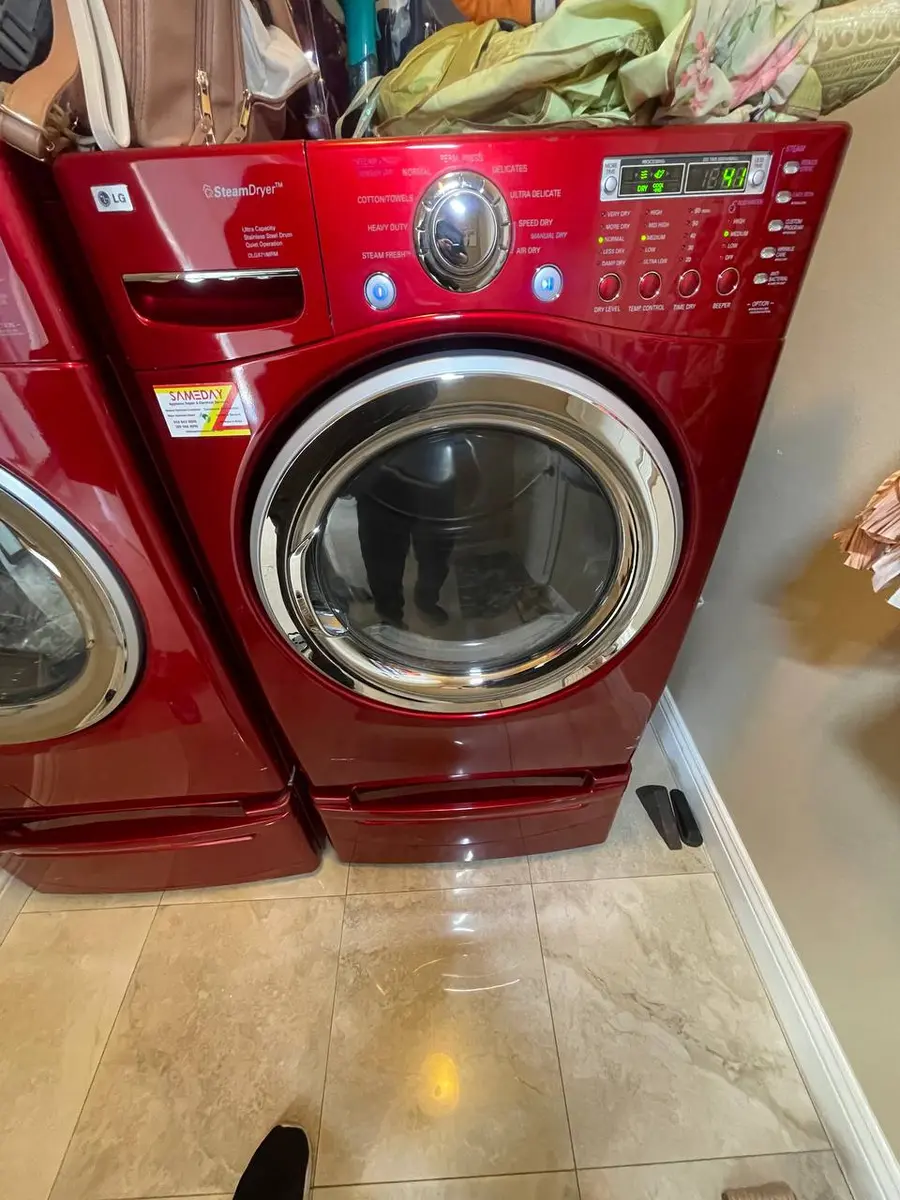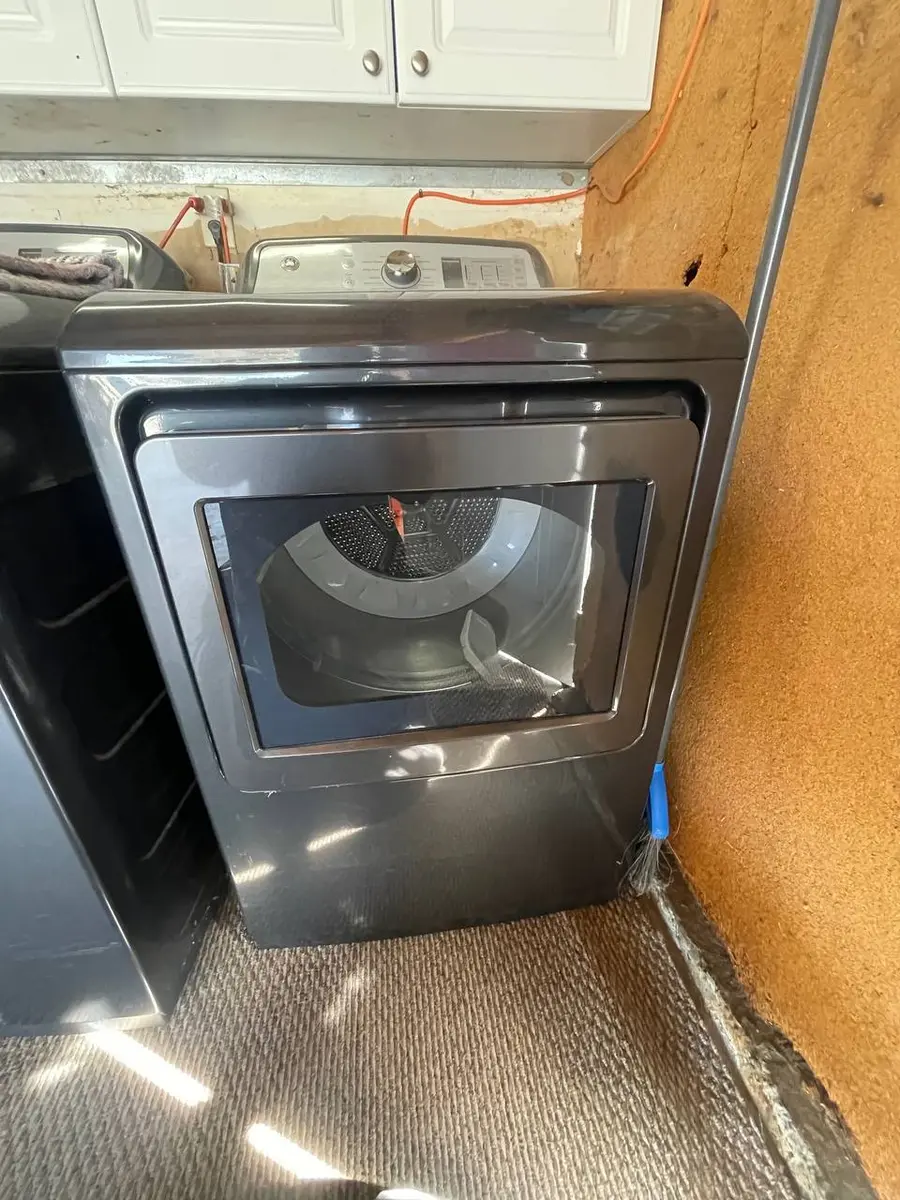
Frigidaire dryers — manufactured on Electrolux Group's shared platform — use E-series diagnostic codes to alert you when something goes wrong. Whether you own a Frigidaire Affinity, Gallery, or standard model (FFRE, FAQE, FASE, FFLG series), the error code system works the same way. This guide covers every Frigidaire dryer error code with detailed troubleshooting steps and clear guidance on when to call a professional.
How Frigidaire dryer error codes work
Frigidaire dryers display error codes on the control panel as E-prefixed alphanumeric codes (E10, E20, E40, etc.) or combined codes like E64 or E4A. The control board monitors the heating circuit, exhaust temperature, drum rotation, moisture sensors, and door latch throughout each cycle. When a fault is detected, the dryer stops the cycle and displays the code.
To retrieve stored error codes: On Affinity and Gallery models, press and hold the Start/Pause and Cancel buttons simultaneously for 3 seconds. The display scrolls through the last 4 stored fault codes.
Basic reset:
- Press Cancel to clear the current cycle.
- Unplug the dryer for 60 seconds.
- Plug back in and run a Timed Dry cycle for 10 minutes as a test.
E10 — no heat (electric: element circuit / gas: no ignition)
The dryer runs but does not heat. On electric models, the heating element circuit is not receiving power. On gas models, the igniter is not activating.
Common causes — electric models (FFRE, FAQE series):
- Blown thermal fuse — a common cause of no heat on Frigidaire dryers
- Heating element burned out
- Broken element wire inside the heater housing
- 240V supply issue — dryer needs both legs of the 240V circuit; if one leg trips, the drum turns but the element gets no power
Common causes — gas models (FFLG series):
- Gas igniter failure
- Gas valve solenoid coils failed
- Gas supply valve closed or gas line issue
- Flame sensor dirty or failed
How to fix (electric):
- Check the circuit breaker — dryers use a double-pole 30-amp breaker. If one pole trips and the other does not, you get a running drum with no heat. Reset both poles by flipping fully OFF first, then ON.
- Test the thermal fuse (located on the exhaust duct housing at the rear of the dryer). With the dryer unplugged, check continuity — it should read 0 ohms. Any other reading means a blown fuse. The thermal fuse is a one-time device that does not reset.
- If the thermal fuse is blown, also check the exhaust vent system — a clogged vent is a frequent root cause of a blown thermal fuse. Clear the vent before installing a new fuse, or the replacement will blow again quickly.
- Test the heating element: with the dryer still unplugged, disconnect the element wires, measure resistance and compare the reading with the value on the dryer's tech sheet. Infinite means a broken element.
How to fix (gas):
- Verify the gas supply valve behind the dryer is fully open.
- Check the igniter: it should glow bright orange during a heat cycle. If it glows but the gas never ignites, the gas valve solenoid coils have failed.
- Unplug the dryer, close the gas supply valve and let the igniter cool before you disconnect it. Test igniter continuity and compare the reading with the value on the dryer's tech sheet. Infinite means a failed igniter.
- With the dryer still unplugged and the gas supply closed, test each gas valve solenoid coil with a multimeter and compare the readings with the tech sheet values.
Parts: Thermal fuse, heating element, gas igniter, gas valve solenoid coils.
E20 — airflow restriction / exhaust temperature anomaly
The dryer detects abnormal exhaust temperature or restricted airflow. Cycles run excessively long, clothes come out damp, or the dryer shuts off prematurely.
Common causes:
- Clogged lint screen (check before every load)
- Blocked exhaust vent duct — lint accumulation in the duct run from the dryer to the exterior wall
- Crushed or kinked exhaust duct behind the dryer
- Exhaust vent flap stuck closed at the exterior wall
- Duct run too long or with too many elbows (max recommended: 25 feet with two 90-degree bends)
How to fix:
- Clean the lint screen completely. Wash it with soap and water if dryer sheet residue has created a film (hold up to light — if you cannot see through it, residue is blocking airflow).
- Disconnect the exhaust duct from the back of the dryer. Run a Timed Dry cycle for 5 minutes with the duct disconnected. If the dryer heats properly, the blockage is in the duct — not the dryer.
- Clean the entire vent run from the dryer to the exterior wall. Use a dryer vent brush kit or hire a vent cleaning service. In the Bay Area, annual vent cleaning is recommended due to lint buildup compounded by occasional dampness.
- Check the exterior vent flap. Go outside and verify the vent flap opens freely when the dryer runs. Bird nests, lint balls, and stuck dampers are common.
- Replace flexible foil duct with rigid or semi-rigid aluminum duct for better airflow and reduced lint accumulation.
Parts: Lint screen, exhaust duct adapter.
Fire safety warning: Lint-clogged dryer vents are a well-known cause of house fires. If your Frigidaire dryer takes more than one cycle to dry clothes, clean the vent immediately. E20 is a warning before a potential thermal fuse failure or fire risk.
E40 — door not closed / door switch failure
The dryer cannot detect that the door is closed. The dryer will not start.
Common causes:
- Door not fully latched (push firmly)
- Door catch worn or broken
- Door switch failure (the plunger switch that detects door closure)
- Wiring issue between the door switch and control board
How to fix:
- Open and close the door firmly — listen for a positive click from the latch.
- Inspect the door catch (the strike that the latch hooks onto). If the plastic catch is cracked or the spring is weak, the door may appear closed but not engage the switch.
- Test the door switch: with the dryer unplugged, access the switch behind the front panel. Press the switch plunger manually and test for continuity with a multimeter — should read 0 ohms when pressed, infinite when released.
- Check the wiring between the door switch and the control board for loose connections or breaks.
Parts: Door switch, door catch/strike.
Drum not turning (belt, idler pulley or rollers)
The motor is running but the drum is not rotating. This typically indicates a broken drive belt.
Common causes:
- Drive belt broken — the single most common mechanical failure on Frigidaire dryers
- Belt slipped off the drum or idler pulley
- Idler pulley seized or broken
- Drum rollers worn
How to fix:
- Open the dryer door and try spinning the drum by hand. If it spins freely with no resistance, the belt is broken. A functioning belt creates tension that makes the drum harder to turn.
- Unplug the dryer, remove the top panel (two screws at the rear), then lift the front panel to access the belt path. The belt wraps around the drum, under the idler pulley, and around the motor shaft.
- If the belt is broken, you will find the remnants draped around the drum or pooled at the bottom of the cabinet.
- While the cabinet is open, spin each drum roller by hand — they should spin freely. If they wobble, squeak, or resist, replace them at the same time as the belt.
- Check the idler pulley — it should spin smoothly on its shaft. A seized or cracked pulley causes the belt to slip or break prematurely.
Parts: Drive belt, idler pulley, drum roller kit, drum bearing.
DIY note: Belt replacement is one of the most accessible Frigidaire dryer repairs. If the belt broke from age, replacing the belt, idler pulley, and drum rollers together prevents repeat failures.
E50 — motor failure
The dryer motor has failed or is drawing abnormal current.
Common causes:
- Motor winding failure
- Motor capacitor failure (on models with a start capacitor)
- Motor bearings seized
- Lint buildup inside the motor housing restricting airflow around the motor windings
How to fix:
- Unplug the dryer and remove the belt from the motor. Try spinning the motor shaft by hand — it should rotate freely.
- Test motor winding resistance between the run winding terminals and compare the reading with the value on the dryer's tech sheet. Infinite means an open winding.
- Check for lint packed around the motor — heavy lint accumulation insulates the motor and causes thermal overload.
- If the motor hums but does not spin, the start capacitor (if equipped) or the motor start winding has failed.
Parts: Dryer motor, motor start capacitor (model-dependent).
E60 — heating element circuit error (electric models)
The control board detects an electrical fault specifically in the heating element circuit. Different from E10 (no heat): E60 indicates a wiring or circuit fault rather than a failed component.
Common causes:
- Element wire connection loose or arced at the terminal block
- Heating element grounded to the housing (element wire touching the metal case)
- High-limit thermostat failure
- Control board relay failure
How to fix:
- Unplug the dryer before you open the cabinet or touch the element terminals. Check the heating element terminal connections — look for signs of arcing (blackened or melted connectors). Tighten or replace the connector spade terminals.
- Test for a grounded element: measure resistance from each element terminal to the element housing. Any reading less than infinite indicates a ground fault — the element must be replaced.
- Test the high-limit thermostat (mounted on the element housing): should read 0 ohms at room temperature.
- If the element and connections test good, the control board relay may have welded shut or failed open.
Parts: Heating element, high-limit thermostat, element wire connector kit.
Rather have a pro handle it?
A vetted local technician can come out and diagnose your dryer at home.
E64 — heater open circuit
The heating element reads as open circuit — the element wire has burned through and broken.
How to fix: Identical to the element test in E10. Remove the element from the dryer and visually inspect the coil for a break. Test continuity — infinite reading confirms the break. Replace the entire element assembly.
E68 — heater relay welded closed
The control board has detected that the heater relay is worn and has welded closed, so the heating element can stay powered when the control calls for it to be off. Treat E68 as a fire risk.
What to do:
- Switch off the dryer's circuit breaker (both poles) and do not run the dryer again until it has been repaired.
- The heater relay sits on the control board, so the repair is a relay or control board replacement — leave it to a technician.
E8C — voltage supply error
The dryer detects abnormal supply voltage. Electric Frigidaire dryers require 240V AC from a dedicated 30-amp circuit.
How to fix:
- Check the outlet with a multimeter: should read 240V AC between the hot terminals, 120V from each hot to neutral.
- Verify the circuit breaker is a 30-amp double-pole breaker and both poles are engaged.
- Unplug the dryer before you remove the rear access panel. Check the dryer power cord connections at the terminal block (behind the rear access panel) — loose connections cause voltage drop.
- If voltage is correct at the outlet but the dryer still shows E8C, the internal power filter or control board voltage sensing circuit may have failed.
Additional quick reference codes
- E4A — Exhaust thermistor open circuit. The control reads the exhaust temperature sensor as open. Unplug the dryer, check the thermistor's wiring and connector, and test the thermistor against the value on the dryer's tech sheet; replace it if it reads open.
- E5B — Drive motor start failure. Unplug the dryer, check that the drum turns freely by hand and that the motor connector is firmly seated; if the motor still will not start, follow the E50 steps above.
- EF0 — No heat detected. The control sees no temperature rise in a heated cycle: on gas models check the igniter and gas valve coils, on electric models the heating element and thermal fuse — follow the E10 steps above.
- E92 — Communication error between boards. Power cycle first; if it persists, unplug the dryer before you check the ribbon cable connections.
Frigidaire dryer diagnostic mode
- Enter diagnostic mode: Press and hold Cancel and Start simultaneously for 3 seconds. The display shows dt (diagnostic test).
- Cycle through tests: Press the Temperature button to advance through tests: motor, heater, moisture sensor, thermistors, and fan.
- Read stored codes: In diagnostic mode, press Dryness Level to scroll through the last 4 stored error codes.
- Exit: Press Cancel or unplug.
Frequently asked questions
Q: How do I reset my Frigidaire dryer after an error code? A: Press Cancel, unplug for 60 seconds, plug back in. Run a short Timed Dry to test. If the code returns, the underlying issue needs repair. The error will not clear permanently until the fault is fixed.
Q: Why does my Frigidaire dryer run but not heat? A: The most common cause is a blown thermal fuse. Check the 240V circuit breaker — if one pole trips, the drum spins but the element gets no power. On gas models, check the igniter and gas valve solenoid coils.
Q: How often should I clean my Frigidaire dryer vent? A: Clean the lint screen before every load. Clean the full exhaust vent run (dryer to exterior wall) at least annually — more often if you do heavy laundry or have a long vent run. In the Bay Area, professional vent cleaning significantly reduces fire risk and energy waste.
Q: Can I replace a Frigidaire dryer belt myself? A: Yes — belt replacement is one of the most accessible dryer repairs. Unplug the dryer first. It requires removing the top and front panels and threading the new belt around the drum, under the idler pulley, and around the motor shaft. Consider replacing the idler pulley and drum rollers at the same time.
Q: Why does my Frigidaire dryer squeak or squeal? A: The most common causes are worn drum rollers, a dry or worn idler pulley, or worn drum glides. These friction parts wear with regular use and are best replaced as a set.
When to call a professional
- E50 with burning smell — Motor failure with overheating. Unplug immediately.
- E10/E60 on gas models with gas odor — If you smell gas, leave the area, do not operate any switches, and call your gas company. Do not attempt DIY repair on gas valve components.
- E8C with sparking at the outlet — Indicates a wiring fault in the house circuit. Call an electrician.
- Repeated thermal fuse failure — If the thermal fuse blows within weeks of replacement, the exhaust vent system has a hidden obstruction or the cycling thermostat has failed.
- Drum bearing replacement — Requires significant disassembly and is best left to a professional.
Tired of your Frigidaire dryer not working? EasyBear's certified technicians repair Frigidaire dryers daily across the Bay Area. We carry the most common Frigidaire dryer parts — thermal fuses, heating elements, belts, rollers, and motors — in our service vehicles. Our free diagnostic visit pinpoints the exact issue, and most repairs are completed the same day. Every repair includes a 90-day parts and labor warranty. Schedule your free diagnosis today.