Beverage Center Power Requirements at a Glance#
A beverage center runs on 120 volts and draws only 1 to 3 amps, so a dual-zone unit tops out around 300 watts and an undercounter model far less. It rides a standard 15-amp branch circuit and plugs into an ordinary three-prong 5-15R receptacle. The table above lists both configurations side by side.
Beverage Center Electrical Specifications#
| Configuration | Voltage | Amps | Watts (max load) | Breaker | Outlet (NEMA) |
|---|---|---|---|---|---|
| Undercounter beverage center | 120 V | 1–2 A | 100–240 W | 15 A | 5-15R |
| Dual-zone beverage and wine center | 120 V | 2–3 A | 180–300 W | 15 A | 5-15R |
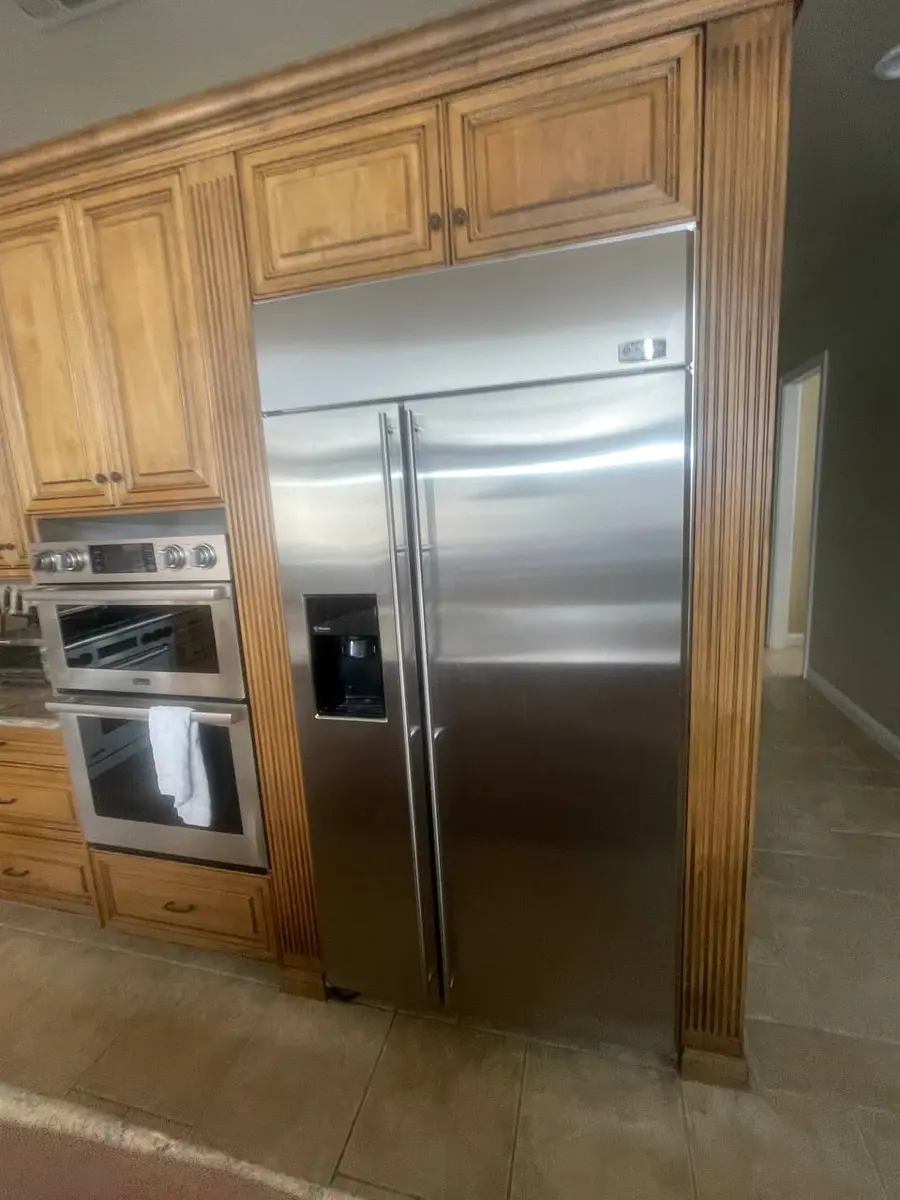
A beverage center chills cans and bottles behind a glass door, and the dual-zone models split the cabinet so sodas and wine hold different temperatures, yet all of that runs on one modest compressor drawing barely more than a nightlight. Built into an island or a bar run, it asks only for a nearby receptacle and never justifies a circuit set aside for it alone.
Do You Have the Right Tools?
Refrigerant gauges ($200+), vacuum pump ($250), leak detector ($150), and EPA-certified recovery equipment. Our technician arrives with $3,000+ in professional tools — your diagnostic is free.
Licensed & Insured · 90-Day Warranty · Same-Day Service
Circuit and Breaker Sizing for the Beverage Center#
The breaker is chosen from the amperage, and here the draw is tiny: at 1 to 3 amps the compressor barely registers on a 15-amp branch wired with standard 14-gauge copper. That leaves so much headroom that a beverage center almost never justifies a circuit of its own — it happily shares a general-purpose bar or kitchen branch with other light loads. You would only pull a dedicated line if code or the local inspector required one for a specific bar layout, not because the current demands it.
Installation and Safety Notes for Beverage Center Wiring#
Match the cord to the receptacle and you are nearly done: a beverage center comes with a standard three-prong cord that plugs into a grounded 5-15R outlet behind or beside the cabinet. Because it is a plug-in appliance on an existing branch, a straightforward install rarely needs a permit, though adding a new receptacle or a dedicated circuit does — and any new wiring is inspector territory. If the outlet is in a wet bar area, have it confirmed as properly grounded and, where local code calls for it, protected. When in doubt about the circuit, a licensed electrician settles it in one visit.
Appliance Repair Technician & Diagnostics Specialist · 10 years experience
Electronics and diagnostics specialist with 10 years of experience in modern smart appliance repair, specializing in LG and Samsung.