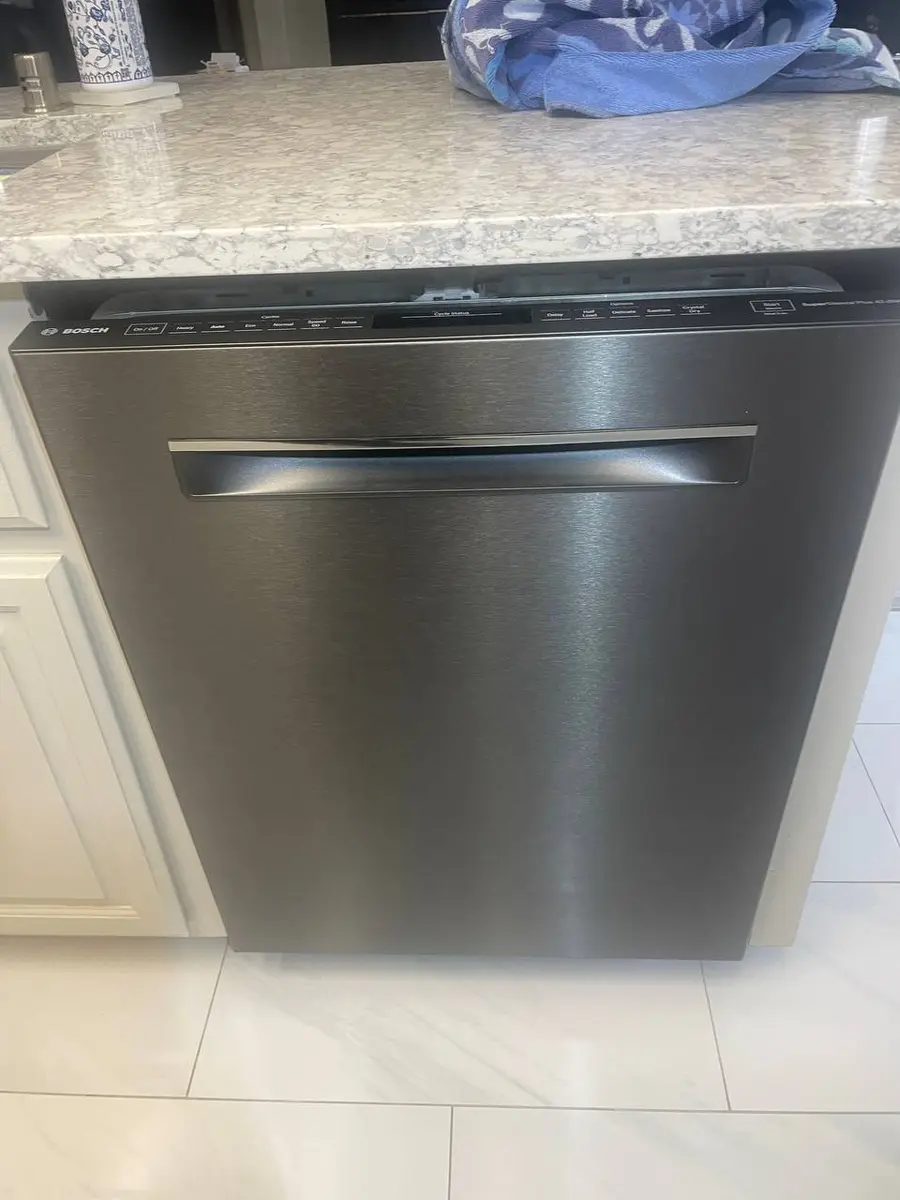
Beko dishwashers have become increasingly popular in the US market, particularly their full-size models with AutoDose technology — an automatic detergent dispensing system that uses sensors to determine the optimal amount of detergent for each load. As part of the Arçelik group (Turkey's largest manufacturer and Europe's second-largest appliance company), Beko brings decades of European engineering and water-efficiency standards that meet or exceed US ENERGY STAR requirements.
When your Beko dishwasher encounters a problem, it displays an error code on the digital panel or through a blinking LED pattern on models without a screen. This guide covers all Beko dishwasher error codes with practical troubleshooting steps.
How to read it, and what hard water has to do with it#
Two things get in the way of a Beko diagnosis: the model may have no screen, and the underlying cause is often the same on three different codes. Sort both here before you read the code sections below.
| What you have or see | What it is telling you | The free move first |
|---|---|---|
| No display, just a flashing indicator LED | the flash count between pauses is the error number — five flashes is E05 | count them twice before assuming. This is the whole diagnostic on an LED-only Beko and nothing else on the panel will tell you. |
| A digital display showing E01, E02 and so on | the alphanumeric code appears directly on the time and status display | clear it properly first: hold Start/Cancel for 3 seconds, power off at the button or breaker, wait 2 minutes, restore power and run a new cycle. A code that returns is real. |
| E01 — water heating error | the element is not raising the water to the 130-160°F the cycle expects | run the kitchen tap hot before starting so the machine fills at around 120°F from your water heater. On California hard water, look for heavy white limescale on the element at the bottom of the tub — a scaled element reads like a failing one long before it is. |
| E02 — water fill error | no water, or not enough of it inside roughly two minutes | clean the mesh inlet screen where the supply hose meets the valve, with vinegar and a toothbrush. Mineral sediment is what fills it. Then lift the mushroom-shaped float on the tub floor — debris jams it up and the machine reads full when it is empty. |
| E03 — drain error | water is not leaving inside the expected 90-120 seconds, and this is the most common Beko error there is | the cylindrical mesh filter and the flat plate beneath it. Lift both out, rinse and scrub. Food debris is the number one cause and it costs nothing to rule out. |
| You have AutoDose and the results changed | the sensors set the detergent dose per load | hard water changes what that dose has to do. Before you treat a dosing complaint as a fault, check whether the scale story above is running in the background on the element and the screens as well. |
| Any code that returns after a full reset | the underlying fault is real, not transient | move to the code section below with a multimeter: a healthy heating element reads 15-30 ohms and the NTC thermistor 10,000-50,000 ohms at room temperature. Infinite or zero on either is a failed part. |
| E04 — overflow and flood protection | the base tray has water in it and AquaStop has locked the machine out | it will pump out and refuse everything until the leak is resolved, which is the system working. Visible water under the machine with E04 is the one case on this page to stop and call rather than diagnose. |
| E05 — NTC temperature sensor fault | the thermistor is shorted, open, or returning impossible values | note the difference from E01: E01 is heat not arriving, E05 is the sensor that measures it. 10,000-50,000 ohms at room temperature is healthy; zero or infinite is a failed sensor. |
| E06 — water inlet valve error | the valve is stuck open, or not responding to fill commands | this is the electrical and mechanical twin of E02. E02 says no water arrived; E06 specifically implicates the valve itself, so the inlet-screen cleaning that cures many E02s will not touch this one. |
| E07 — turbidity sensor, on AutoDose models | the water-clarity sensor that tells AutoDose how dirty the load is has stopped reading | this is the sensor behind the dosing, so an AutoDose machine that has started over- or under-dosing is often here rather than in the detergent. |
| E08 — circulation pump or wash motor | the main wash pump is not starting, running intermittently, or drawing too much current | the tub fills and the dishes stay dirty. Unlike the filter and screen cases above, there is no free check that resolves this one. |
| E09 — drying system error | the drying fan, the drying heater or their sensors | dishes come out wet on a machine that washes perfectly. Worth separating from E01, which is about wash-water temperature rather than the drying phase. |
| E10 — main board communication fault | the main control board and the interface board have stopped talking | a full power-down for 2 minutes is worth one attempt; past that it is board-level work. |
| Your model has a salt reservoir | a built-in water softener, common in Europe and rare on US brands | use it. California water runs 10-25 grains per gallon in many areas, and the softener is the factory answer to the limescale that produces E01 and degrades wash performance. Most US owners of a Beko never discover this compartment exists. |
| You want the machine to run its own tests | Beko ships a service test mode | the diagnostic mode further down this page steps the machine through its components in sequence, which separates a sensor reporting a fault from a component that actually has one. Worth entering before you buy any part on the strength of a code alone. |
| A code that is not E01 through E10 | the quick-reference table below carries the rest | Beko code space is wider than the ten main faults, and AutoDose models add their own set on top. Check the additional-codes table before concluding the display is malfunctioning. |
| You are sourcing a part or a service visit | Beko is an Arcelik machine | the parent is Turkey largest manufacturer and Europe second-largest appliance company, which is why the engineering follows European water-efficiency practice — the salt reservoir above being the clearest example. It also means parts route through a European supply chain rather than a US aftermarket one, so lead time is worth asking about before you commit to a repair. |
Eighteen rows: the two ways a Beko reports a fault at all, the three codes this guide documents in the order they occur, the AutoDose case, and the point at which a reset stops being the answer. Three of the seven trace to the same root cause — mineral scale on the element, sediment in the inlet screen, and debris in the drain filter — which is why the hard-water thread is stated once at the top rather than repeated in each code section. Every resistance value and temperature here is Beko own from the sections below, not a generic dishwasher figure.
Do You Have the Right Tools?
Water pressure gauge ($60), spray arm tester, float switch multimeter ($85), and drain inspection camera. Our technician arrives with $3,000+ in professional tools — your diagnostic is free.
Licensed & Insured · 90-Day Warranty · Same-Day Service
How Beko Dishwasher Error Codes Display#
Beko dishwashers communicate errors in two ways depending on the model:
Digital display models: Show alphanumeric codes (E01, E02, etc.) directly on the time/status display.
LED-only models: Flash specific indicator LEDs in a pattern. Count the number of flashes between pauses — the flash count corresponds to the error number (e.g., 5 flashes = E05).
To reset any Beko dishwasher error:
- Press and hold the Start/Cancel button for 3 seconds to cancel the current cycle.
- Turn off the dishwasher at the power button or circuit breaker.
- Wait 2 minutes.
- Restore power and attempt a new cycle.
If the error returns, proceed with the specific troubleshooting below.
E01 — Water Heating Error#
The dishwasher's heating element is not raising water temperature as expected within the allotted time (typically to 130–160°F depending on cycle selection).
Common causes:
- Failed heating element (burned out or cracked)
- Faulty NTC temperature sensor giving incorrect readings
- Control board relay not sending power to heater
- Limescale buildup on heating element (California hard water is a primary cause)
- Low incoming water temperature combined with heavy soil cycle selection
How to fix:
- Run the hot water at the kitchen sink faucet until it's fully hot before starting the dishwasher. This ensures the dishwasher fills with already-hot water (120°F from your water heater), reducing the heating burden.
- Check the heating element: it's located at the bottom of the tub, beneath the lower spray arm. Look for visible cracks, discoloration, or heavy white limescale deposits.
- Test the element with a multimeter: disconnect the terminal wires and measure resistance. A working element typically reads 15–30 ohms. Infinite = burned out.
- Check the NTC thermistor (small sensor near the element): at room temperature should read 10,000–50,000 ohms. Zero or infinite = defective.
- Heating element replacement cost varies by model and region depending on model.
Professional repair cost: varies by model and region.
Safety First — Know the Risks
Live 120V wiring in a wet environment is one of the most dangerous DIY scenarios. Water + electricity = serious shock risk. Our techs are licensed and insured — let them handle the risk.
Licensed & Insured · 90-Day Warranty · Same-Day Service
E02 — Water Fill Error#
The dishwasher is not filling with water or cannot reach the required water level within the expected time frame (approximately 2 minutes per fill).
Common causes:
- Water supply valve under the sink not fully open
- Kinked or clogged water supply hose
- Clogged inlet screen/filter at the dishwasher's water valve
- Failed water inlet valve solenoid
- Float switch stuck in "full" position (false overfill detection)
- Low household water pressure
How to fix:
- Check the supply valve: Look under the sink — the dishwasher supply valve (usually on the hot water line) must be fully open. Turn it counterclockwise until it stops.
- Inspect the inlet hose: Turn off water supply, disconnect the hose from the dishwasher's inlet valve (bottom-front of machine, accessible by removing the kick plate). Check for kinks and run water through it.
- Clean the inlet screen: At the point where the supply hose connects to the dishwasher's inlet valve, there's a small mesh filter screen. Remove it carefully with needle-nose pliers, clean with vinegar and a toothbrush, and reinstall.
- Check the float switch: Inside the tub, on the floor of the dishwasher, there's a small float (mushroom-shaped plastic piece). Lift it and ensure it moves freely up and down. Food debris can jam it in the "up" position, making the dishwasher think it's already full.
- Test the inlet valve: Apply power directly to the valve solenoid (or test for 120V AC at the connector during a fill cycle). If voltage is present but no water flows, the valve is stuck closed and needs replacement (varies by model and region).
Professional repair cost: varies by model and region.
E03 — Drain Error#
The dishwasher cannot pump water out within the expected drain time (typically 90–120 seconds). This is the most common Beko dishwasher error.
Common causes:
- Clogged drain filter (food debris buildup — #1 cause)
- Blocked drain hose
- Failed drain pump or jammed impeller
- Garbage disposal knockout plug not removed (new installations)
- Air gap blockage
- Kinked drain hose under the sink
How to fix:
- Clean the drain filter system: Open the dishwasher, remove the lower rack. Lift out the cylindrical mesh filter and the flat plate filter beneath it. Rinse under running water and scrub with a brush. Clear any debris from the filter well in the tub floor. Beko recommends cleaning this monthly.
- Check the drain hose: Follow the drain hose from the dishwasher to where it connects under the sink (to the garbage disposal or drain tailpiece). Check for kinks or bends that could restrict flow. The hose should loop up to the bottom of the countertop (high loop) to prevent backflow.
- Garbage disposal check: If connected to a disposal, ensure the knockout plug inside the disposal's dishwasher inlet port was punched out during installation. A common installation error.
- Test the drain pump: With the filters removed, look into the pump well. You may see the pump impeller. Check that it's not blocked by glass shards, bones, or other hard debris. Try rotating it manually — it should spin freely.
- Run a forced drain: On some Beko models, pressing Start + Cancel together for 5 seconds initiates a forced drain cycle.
Professional repair cost: varies by model and region (pump replacement if needed).
The Real Cost of DIY
Average DIY attempt: $150-400 in tools you may use once, plus the risk of further damage. Our diagnostic visit costs $0 — we find the problem and give you an honest quote.
Licensed & Insured · 90-Day Warranty · Same-Day Service
E04 — Water Overflow / Flood Protection#
The dishwasher's base tray has detected water, activating the flood protection system (AquaStop on Beko models). The machine will attempt to pump out water and lock out all functions until the leak is resolved.
Common causes:
- Leaking door gasket/seal
- Loose or cracked hose connection internally
- Failed tub seal around the wash pump
- Leaking water inlet valve
- Cracked spray arm or tub
- Overfilling due to stuck inlet valve (combined with E02 failure)
How to fix:
- Carefully tilt the dishwasher back slightly (have someone hold it) to check if water has accumulated in the base tray. If yes, use towels to soak it up, or remove the kick plate and carefully sponge water from the base.
- Inspect the door gasket: Run your hand along the rubber seal around the door. Feel for tears, cracks, gaps, or debris preventing a proper seal. Clean the gasket and the mating surface on the tub with a damp cloth.
- Check internal hoses: Pull the dishwasher out from the cabinet (turn off water and disconnect power first). Inspect all hose connections — inlet hose to fill valve, fill valve to tub, tub to drain pump, drain pump to drain hose. Look for drips, mineral deposits at joints, or loose clamps.
- Check the door hinges and springs: A door that doesn't close flush can allow water to seep past the gasket during operation. Adjust or replace worn hinge springs (varies by model and region per side).
- AquaStop reset: After resolving the leak, the flood protection float switch in the base must return to its "dry" position. Tilting the machine forward and back, or using towels to dry the base, usually resets it.
Professional repair cost: varies by model and region.
E05 — NTC Temperature Sensor Fault#
The temperature sensor (NTC thermistor) is reporting readings outside the expected range — either shorted, open-circuit, or returning physically impossible values.
Common causes:
- Failed NTC thermistor
- Corroded sensor connector (hard water splash environment)
- Wiring damage between sensor and control board
- Control board analog input failure
How to fix:
- Locate the NTC sensor — typically attached to the wash sump/pump housing or near the heating element at the tub bottom.
- Disconnect the sensor connector and measure resistance. At room temperature, expect 10,000–50,000 ohms (model-dependent). Zero = shorted; infinite/OL = open circuit.
- Clean corrosion from connector pins with electrical contact cleaner.
- Replace the sensor if readings are abnormal (varies by model and region for the part).
- If the sensor tests good, check the wiring continuity from sensor to board.
Professional repair cost: varies by model and region.
Don't Void Your Warranty
Opening your appliance yourself may void the manufacturer warranty. Our repair comes with a 90-day guarantee, and we document everything for warranty compliance.
Licensed & Insured · 90-Day Warranty · Same-Day Service
E06 — Water Inlet Valve Error#
The control board has detected the inlet valve is either stuck open (water flowing when it shouldn't) or not responding to fill commands. This differs from E02 in that E06 specifically implicates the valve's electrical/mechanical function.
Common causes:
- Valve solenoid coil failure (won't open electrically)
- Valve mechanically stuck open (debris in valve seat)
- Wiring or connector issue to the valve
- Control board output transistor failure
How to fix:
- Listen during a fill cycle: you should hear a click from the inlet valve when the cycle starts. No click = the valve isn't being energized or the coil is failed.
- Test the valve coil: disconnect and measure resistance. Expect 500–1500 ohms. Infinite = open (failed). Zero = shorted.
- Verify the control board is sending voltage: during a fill command, measure for 120V AC at the valve connector.
- If the valve is stuck open (water drips in even when the dishwasher is off), the valve needs immediate replacement. Turn off the supply valve under the sink until repaired.
- Inlet valve replacement: varies by model and region for the part.
Professional repair cost: varies by model and region.
E07 — Turbidity Sensor Error (AutoDose Models)#
The water clarity sensor that helps the AutoDose system determine soil level and rinse effectiveness is malfunctioning.
Common causes:
- Dirty sensor lens (grease/film coating)
- Failed optical sensor element
- Disconnected sensor cable
- Food debris blocking the sensor window
How to fix:
- Locate the turbidity sensor — usually in the sump area beneath the tub floor, near the drain filter. It's a small optical sensor with a clear window.
- Clean the sensor window thoroughly with a soft cloth and mild detergent. Grease film from cooking oils can coat the lens over time.
- Check the cable connection to the sensor — vibration can loosen it.
- If cleaning doesn't resolve E07, the sensor itself may need replacement (varies by model and region).
- On AutoDose models, this error may cause the system to default to maximum detergent dispensing. Until repaired, you may want to switch to manual detergent dosing.
Professional repair cost: varies by model and region.
Is It Worth Your Time?
Dishwasher issues overlap between drain pump, wash motor, inlet valve, and control board. DIY diagnosis averages 3-5 hours. Our technician diagnoses the issue in about 30 minutes — same-day appointments available.
Licensed & Insured · 90-Day Warranty · Same-Day Service
E08 — Circulation Pump / Wash Motor Error#
The main wash pump motor is not operating correctly — either not starting, running intermittently, or drawing excessive current.
Common causes:
- Jammed pump impeller (glass shard, bone, or seed stuck)
- Failed pump motor (seized bearings or burned winding)
- Start capacitor failure (motor hums but won't spin)
- Control board motor driver failure
- Blocked wash pump intake (food debris)
How to fix:
- Check the drain filter area — large debris near the pump intake can prevent the wash pump from operating. Clean thoroughly.
- Listen when starting a cycle: after the fill, you should hear the wash pump activate (rushing water sound). Complete silence or a humming/buzzing indicates a pump issue.
- A jammed impeller sometimes frees up if you carefully reach into the pump well (with power off) and rotate the impeller manually.
- Wash pump replacement (varies by model and region) is a significant repair requiring partial disassembly.
- On some models, the wash pump and drain pump are separate units; on others, they share a single motor with different impellers. Verify your model configuration.
Professional repair cost: varies by model and region.
E09 — Drying System Error#
The drying fan, drying heater, or associated sensors aren't functioning correctly during the drying phase.
Common causes:
- Failed drying fan motor
- Drying heater element burned out (models with active drying)
- Blocked drying air vent/duct
- Condensation system not functioning (condenser models)
- Sensor error in the drying circuit
How to fix:
- Many Beko dishwashers use a condensation drying system rather than a heated drying element. Check your model's drying method in the manual.
- For models with a drying fan: ensure the vent opening (usually at the top rear of the tub) is clear of obstruction. Clean any lint or debris.
- For models with a heated dryer element: test the element resistance (15–30 ohms typical). Replace if open circuit.
- On AutoDry models with a fan, listen for the fan during the drying phase. If silent, the fan motor may need replacement (varies by model and region).
- Some Beko models have a door-opening feature during drying that can be mistaken for an error — the door cracks open automatically to release steam for energy-efficient drying.
Professional repair cost: varies by model and region.
The Risk of Getting It Wrong
A wrong diagnosis often turns a simple fix into a costly replacement. Without proper diagnostic tools, you might replace the wrong part — or cause additional damage. Our free diagnostic eliminates the guesswork.
Licensed & Insured · 90-Day Warranty · Same-Day Service
E10 — Main Board Communication Fault#
Internal communication error between the main control board and interface/display board.
Common causes:
- Loose ribbon cable between boards (vibration)
- Power surge damage
- Moisture on board connectors (steam from dishwasher)
- Failed control board
How to fix:
- Full power disconnect for 5 minutes (not just button off — unplug or breaker).
- If persistent, access the control board area (usually behind the door panel). Reseat all connectors.
- Check for visible board damage — swollen capacitors, burn marks, water staining.
- Board replacement is varies by model and region for the part.
Professional repair cost: varies by model and region.
AutoDose-Specific Errors#
Beko's AutoDose system automatically dispenses the right amount of detergent based on load size, soil level, and water hardness. These codes are specific to AutoDose-equipped models:
| Code | Meaning | Fix |
|---|---|---|
| E13 | AutoDose reservoir empty | Refill the detergent reservoir with liquid HE dishwasher detergent |
| E14 | AutoDose dispenser motor jammed | Remove reservoir, clean dispenser mechanism, check for crystallized detergent |
| E15 | AutoDose calibration error | Run AutoDose calibration cycle (consult manual for procedure) |
| E16 | Water hardness sensor error | Clean sensor; recalibrate water hardness setting |
AutoDose maintenance tip: Use only liquid detergent recommended for automatic dispensing systems. Thick gels or eco-concentrated formulas can clog the dispensing mechanism. Flush the system with warm water monthly by running a hot cycle with the reservoir empty.
Free Diagnostic Visit — Zero Risk
Our certified technician comes to your home, diagnoses the problem with professional tools, and gives you an honest quote — all at zero cost. No parts markup, no hidden fees. If you decide not to proceed, you pay nothing.
Licensed & Insured · 90-Day Warranty · Same-Day Service
Additional Beko Dishwasher Error Codes#
| Code | Meaning | Quick Fix |
|---|---|---|
| E11 | Spray arm rotation blocked | Check for tall items blocking arm; remove and clean spray arm pivot |
| E12 | Salt reservoir sensor error | Refill salt; check sensor float mechanism |
| E17 | Door latch micro-switch fault | Inspect latch alignment; test switch continuity |
| E18 | Water leak at spray arm seal | Tighten spray arm nut; replace worn gasket |
Beko Dishwasher Diagnostic Mode#
Access the service test mode for detailed diagnostics:
- Enter test mode: Close the door. Press and hold the Program button and the Start button simultaneously for 5–8 seconds. The display shows "tSt" or all LEDs illuminate.
- Navigate tests: Use the Program selector to cycle through test sequences — fill test, drain test, wash pump test, heater test, drying test.
- Read error history: In test mode, some models display the last 3–5 error codes stored in memory.
- Exit: Press Power or wait 5 minutes for auto-timeout.
Top-Rated Service — Free Consultation
Bay Area and Sacramento homeowners trust EasyBear. Free consultation, transparent pricing, and a 90-day repair guarantee — see why customers choose EasyBear.
Licensed & Insured · 90-Day Warranty · Same-Day Service
US Market Considerations for Beko Dishwashers#
- Water hardness: Many Beko dishwashers have a built-in water softener that uses dishwasher salt (common in Europe, less common in US brands). If your model has a salt reservoir, use it — California's hard water (10–25 grains/gallon in many areas) causes limescale buildup on the heating element and spray arms, leading to E01 and performance degradation.
- Detergent compatibility: Beko dishwashers work best with powder or tablet detergent. If using the AutoDose system, only use the recommended liquid type. Gel pods can leave residue and don't distribute evenly in European-designed spray patterns.
- Noise levels: Beko dishwashers are engineered for European open-plan kitchens and typically run at 42–46 dB — among the quietest available. Unusual noise accompanying an error code may indicate a more serious mechanical issue.
- Parts supply: Beko has expanded their US parts network significantly since 2023. Most common components ship within 3–5 days. Control boards and model-specific items may take 7–14 days.
Frequently Asked Questions#
Q: How do I reset my Beko dishwasher after an error code? A: Press and hold Start/Cancel for 3 seconds, then turn off power at the breaker or unplug for 2 minutes. Restore power and test with a new cycle. Persistent errors require addressing the underlying cause.
Q: My Beko dishwasher shows E03 (drain) but the filter is clean. What else should I check? A: After the filter, check: (1) the drain hose under the sink for kinks, (2) if connected to a garbage disposal, run the disposal to clear any blockage at the inlet, (3) verify the high loop in the drain hose is intact, (4) check the drain pump impeller for glass shards or hard debris jammed in it.
Q: Do I need to use dishwasher salt in my Beko dishwasher? A: If your model has a salt reservoir (check the bottom of the tub for a screw cap), yes — especially in California with its hard water. The built-in softener prevents limescale on the heating element and improves cleaning. Use only granular dishwasher salt, never table salt or sea salt.
Q: How do I maintain the AutoDose system? A: Refill the liquid detergent reservoir before it empties completely (the dishwasher will show E13 when empty). Once monthly, run a hot cycle with the reservoir empty to flush the dispensing lines. Wipe the reservoir opening clean of dried detergent. Use only low-viscosity liquid detergents designed for automatic dispensers.
Q: Is it safe to run my Beko dishwasher with error E04 (overflow)? A: No. E04 indicates water has reached the base tray, meaning there's an active leak inside the machine. Running it could cause water damage to your cabinetry or flooring. Resolve the leak source first, dry the base tray, and verify the flood sensor resets before operating again.
On-Site Diagnosis, No Fix No Fee
Our technicians diagnose on-site with $3,000+ in professional equipment. If we can't fix it, you don't pay — that's our no-fix-no-fee promise. Average repair completed in under 90 minutes.
Licensed & Insured · 90-Day Warranty · Same-Day Service
When to Call a Professional#
- E04 (overflow) with visible water under the machine — Active leak requires finding and sealing the source.
- E08 (wash pump) with no water sound at all — Pump replacement requires specialized tools and disassembly.
- E10 (board) recurring after reset — Board-level diagnostics require specialized equipment.
- E01 with burning smell — Potential heater ground fault. Unplug immediately.
- Any error on a newly installed dishwasher — May indicate incorrect installation (water supply, drain connection, or leveling).
Beko dishwasher giving you trouble? EasyBear's technicians service all major and emerging dishwasher brands, including Beko's full-size and AutoDose models. We understand the nuances of European-designed dishwashers — from water softener maintenance to AutoDose calibration. Schedule a free diagnostic visit and our tech will identify the exact problem, explain your options, and complete the repair on the spot in most cases. All repairs backed by our 90-day warranty.
Q: My Beko dishwasher has no display. How do I read the error? A: Count the flashes. On LED-only models the indicator light flashes a set number of times, pauses, and repeats — and the flash count is the error number, so five flashes means E05. Count it through at least twice before acting, because it is the only diagnostic output the machine has. Digital-display models show the code as E01, E02 and so on directly.
Q: Why do so many Beko codes come back to hard water? A: Because three different failures share one cause. Mineral scale coats the heating element and makes E01 look like a dead element; sediment fills the mesh inlet screen and produces E02; and debris in the drain filter is the number one cause of E03, the most common code on the brand. None of the three needs a part on the first attempt, which is why the free checks come before the multimeter.
Lead Appliance Repair Technician · 12 years experience
Experienced technician with 12 years specializing in washing machine and dryer repairs across all major brands.