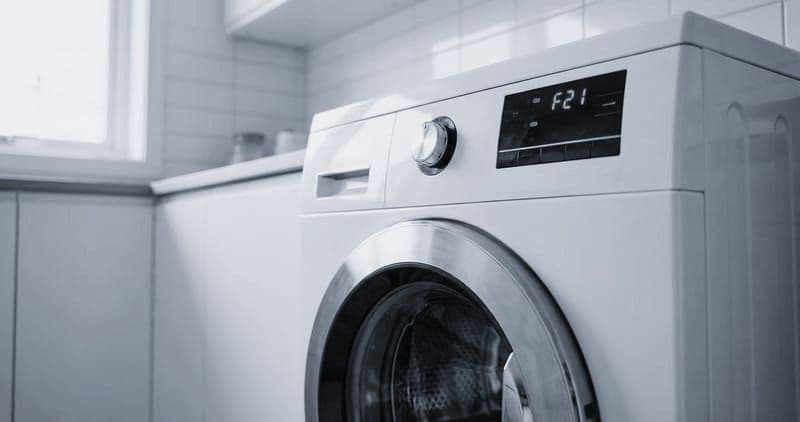
What is the Whirlpool Washer F5E3 error?#
F5E3 is a lid-lock fault on a top-loader — the control cannot confirm the lid is locked, so the tub fills but never agitates or spins. The usual cause is a stripped lid-lock cam or a stuck lock-state switch inside the module. If the lock motor pulses over and over without the bolt ever seating, the module is the place to look.
F5E3 on a Whirlpool Washer: likely causes and repair cost#
On a Whirlpool Washer, the F5E3 code signals: lid lock error.
| Likely cause | Typical likelihood |
|---|---|
| Motorized lid-lock cam stripped so the bolt never seats | Most common |
| Lock-state microswitch stuck, so the board cannot confirm a locked lid | Common |
| Striker tab bent or missing where the lid meets the console bridge | Less common |
| Auto-relock timing out because the lid rebounds open on a tired hinge spring | Occasional |
Typical professional repair: $80–$200 · Difficulty: moderate · usually a technician job
Symptoms that often accompany F5E3: Lock motor pulses over and over but the bolt never latches; Tub fills then sits with no agitation while the lid indicator blinks; Pressing down on the lid during start lets the cycle run once; Fault reappears only on the spin ramp when the cabinet flexes
Technician diagnostic sequence for F5E3:
- Watch the lid-lock module through one cycle: on this top-loader the motor drives a cam that pulls a bolt across the striker over about four seconds — a motor that spins without the bolt travelling means a stripped cam
- Lift the console bridge and check that the striker tab on the lid still sits square to the lock throat; a splayed tab lets the bolt pass without tripping the lock-state switch
- Back-probe the three-wire lock plug at the board and cycle a lock command — you want the lock-state line to change state as the bolt seats, not just the motor line to pulse
- Flex the harness where it crosses the rear console pivot; intermittent F5E3 that comes and goes with lid position is almost always a conductor cracked at that pivot, not the lock body
- If the cam, striker, and switch all check out, replace the lid-lock module as a unit — the internal gear train is not sold separately
Parts a technician may check or replace: Lid Lock Module; Lid Striker
Field note: This top-loader will fill but refuse to agitate or spin until the board sees the lock-state switch close, so a good motor with a stripped cam looks identical to a dead motor from the front panel — the tell is whether the bolt physically travels. Because the module is a sealed gear-and-switch pack, a chattering cam is a replace, not a lubricate.
Do You Have the Right Tools?
Bearing puller set ($120), drum spider wrench ($85), multimeter ($85), and diagnostic software. Our technician arrives with $3,000+ in professional tools — your diagnostic is free.
Licensed & Insured · 90-Day Warranty · Same-Day Service
How to troubleshoot the F5E3 error yourself#
There is a little safe checking here. Unplug for a minute and restart in case the lock-state switch hung on a single cycle. Inspect where the lid meets the console bridge for a bent or missing striker tab, since the bolt has nothing to catch if the striker is damaged. Try pressing down firmly on the lid as the cycle starts — if it runs once with pressure, the lid is rebounding open on a tired hinge or the cam is not seating. That is where DIY ends: the lid-lock module is a sealed gear-and-switch pack, so a chattering or stripped cam cannot be lubricated back to health, it has to be replaced. Reading the lock-state switch and swapping the module is a technician job, and forcing more cycles on a lid that will not lock only wears the cam further. Two observations sharpen the diagnosis before that call. First, notice when it fails: a fault that reappears only on the spin ramp, when the cabinet flexes, hints at a striker that is close but not quite meeting the bolt, whereas a lock motor that pulses from the very start of the cycle points at a stripped cam. Second, check the striker tab itself for a bent or missing edge, since the bolt has nothing to grab if the striker is damaged, and a new tab is far cheaper than a module. What you should not do is keep pressing down on the lid to coax one more cycle out of it, because a lid rebounding open on a tired hinge spring is its own fault and papering over it only delays the real fix.
Is the Whirlpool Washer F5E3 error worth fixing?#
F5E3 is an affordable, worthwhile fix. A replacement lid-lock module and striker, installed, runs $80 to $200, and it brings back agitation and spin the washer withholds until the lid reads locked. On nearly any top-loader that is well below the cost of a new machine and easy to justify. Because the module is a discrete part rather than a symptom of larger wear, I repair this confidently; only a washer already failing in other ways would tip me toward replacement instead.
Safety First — Know the Risks
High-voltage components and pressurized water lines create flood and shock risk. A single loose fitting can cause thousands in water damage. Our techs are licensed and insured — let them handle the risk.
Licensed & Insured · 90-Day Warranty · Same-Day Service
Whirlpool Washer F5E3: frequently asked questions#
What does F5E3 mean on a Whirlpool washer?#
It is a lid-lock error on a top-loader — the control cannot confirm the lid is locked, so the tub fills but will not agitate or spin.
Is it safe to keep using the washer with F5E3?#
It simply will not wash past the fill, and the lock is a safety interlock, so there is no hazard — just no cycle until it is fixed.
Can I clear F5E3 myself?#
Try a reset and check the striker tab for damage. If the lock motor pulses without the bolt seating, the module is stripped and needs replacing.
How much does it cost to repair F5E3?#
From $80 to $200 for a lid-lock module and striker, installed.
Which parts fail when a washer throws F5E3?#
The motorized lid-lock cam or the lock-state microswitch inside the module, sometimes a bent striker tab where the lid meets the console.
Is a washer with F5E3 worth repairing?#
Yes. A sub-$200 module swap restores agitation and spin and is far cheaper than a new washer on an otherwise sound machine.
Why does a stripped lid-lock cam trigger F5E3?#
The board waits to see the lock-state switch close before it agitates or spins. A stripped cam never drives the bolt home, so the switch never closes and F5E3 is raised.
Senior Appliance Repair Technician · 15 years experience
EPA-certified technician with 15 years of experience specializing in refrigerator and cooling system repairs.