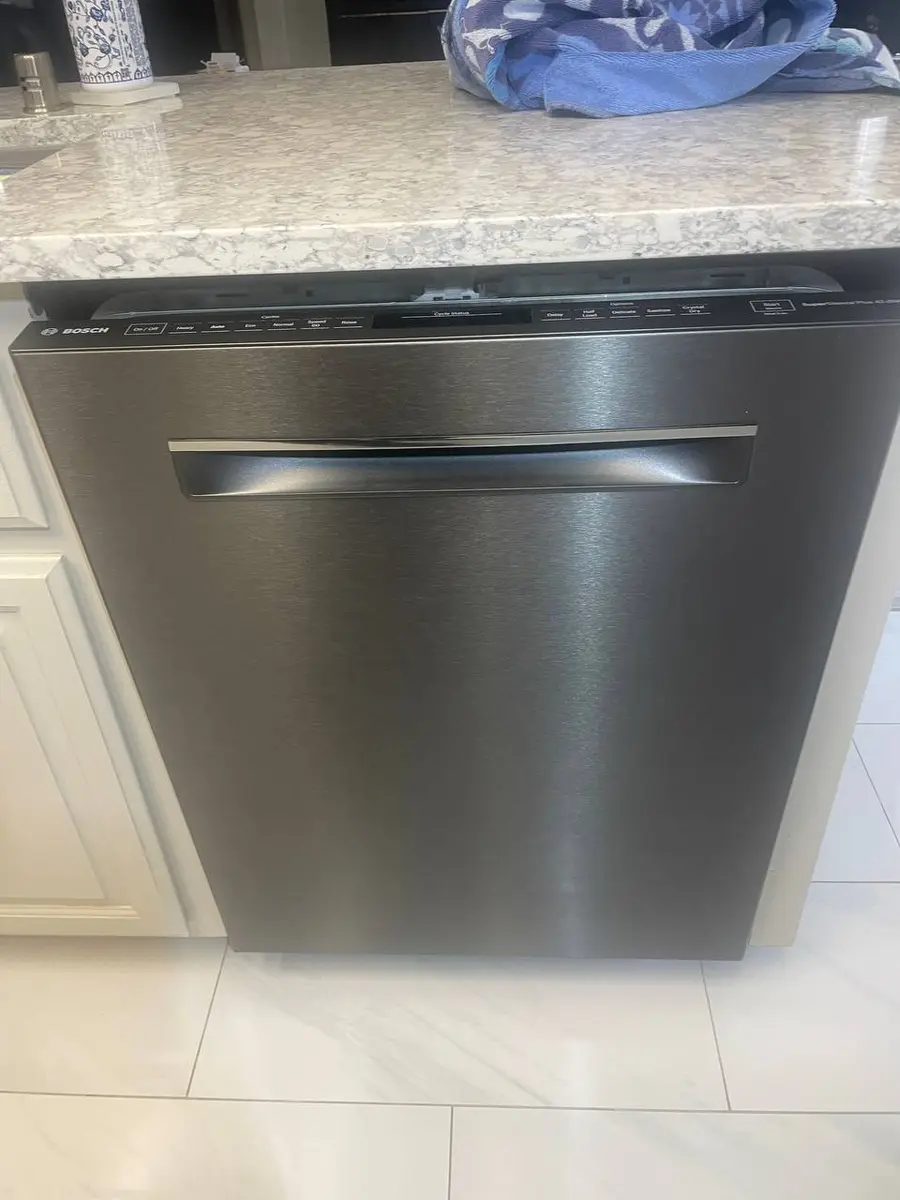
Quick Answer: Why Your Whirlpool Dishwasher Leaves Dishes Wet#
Most likely: an empty or weak rinse-aid dispenser — it is the single biggest reason dishes come out wet, because without rinse aid water beads on surfaces instead of sheeting off to evaporate. A failed bottom heating element is the next suspect, followed by a tripped high-limit thermostat or thermal fuse cutting power to that element. WDT700 and WDF500 units dry two ways: a heated-dry element at the tub floor and condensation onto the cooler stainless walls, so plastic-tub models lean harder on the element. Rule out the free fixes before opening the kick panel.
Likely Causes at a Glance#
| Cause | Likelihood | What to check |
|---|---|---|
| Empty / malfunctioning rinse-aid dispenser | Most likely (~30%) | check the level indicator and set the dispenser to 3-4 for typical water hardness |
| Heating element failure | Common (~25%) | the outer door should feel warm 10 minutes into Heated Dry; element reads 15-30 ohms, open if infinite |
| Tripped high-limit thermostat or thermal fuse | Occasional (~15%) | test each for continuity; an open reading means it cut power to a healthy element |
| Vent system stuck closed | Occasional (~12%) | moist air must escape the door vent; if it stays shut, humidity re-condenses on dishes |
| Improper loading | Occasional (~10%) | nested items and upturned bowls trap water; plastics never retain heat well |
| Low final-rinse water temperature | Rare (~5%) | F3E1 or F3E2 thermistor codes; the sump thermistor reads about 50K ohms cold |
| Cycle without Heated Dry selected | Rare (~3%) | eco and 1-Hour cycles may default to air dry unless Heated Dry is chosen |
Do You Have the Right Tools?
Water pressure gauge ($60), spray arm tester, float switch multimeter ($85), and drain inspection camera. Our technician arrives with $3,000+ in professional tools — your diagnostic is free.
Licensed & Insured · 90-Day Warranty · Same-Day Service
Walking Through the Diagnosis#
Start with the cheapest, most common miss: rinse aid. Check the reservoir's level window, fill it to the MAX line, and set the dispenser to 3-4 for typical hardness. Without it, even a perfect heating element leaves droplets clinging to every surface.
If rinse aid is fine, test the heat. Run a cycle with Heated Dry selected and, after the wash and rinse finish, feel the outer door panel about ten minutes in — it should be noticeably warm. A door that stays cool means no heat is reaching the tub. Disconnect power and reach the element terminals through the bottom kick panel (two 1/4-inch hex screws drop it down): a healthy element reads 15-30 ohms between terminals, while an infinite reading means it has opened. If the element itself is good, test the high-limit thermostat and thermal fuse for continuity — an open one has tripped and starved the element of power, so investigate the overheating cause before replacing it.
From there, chase the smaller contributors. Feel for warm, moist air leaving the door vent during the dry phase; a jammed vent traps humidity that re-wets the load. Confirm Heated Dry is actually selected, since energy-saving cycles may air-dry by default. And where dishes feel barely warm at the end, an F3E1 or F3E2 code points at the sump thermistor (about 50K ohms at room temperature) failing to boost rinse temperature.
Repair or Replace? The Short Version#
Most drying faults are rinse aid, an element, or a safety thermostat — low-cost parts that keep the repair well under the half-rule line on a dishwasher under eight to ten years old. Loading habits and cycle choice cost nothing to correct at all. If the element and thermostats need metering behind the kick panel, our technicians carry the parts and confirm the failure first — book now.
Safety First — Know the Risks
Live 120V wiring in a wet environment is one of the most dangerous DIY scenarios. Water + electricity = serious shock risk. Our techs are licensed and insured — let them handle the risk.
Licensed & Insured · 90-Day Warranty · Same-Day Service
Frequently Asked Questions#
Why are my dishes still wet after a full Whirlpool cycle?#
The most common reason is an empty or under-set rinse-aid dispenser, which lets water bead instead of sheeting off to dry. A failed heating element or a tripped high-limit thermostat is the next thing to check.
How do I know if the heating element failed?#
Run Heated Dry and feel the outer door about ten minutes in — it should be warm; a cool door means no heat. With power off, a good element reads 15-30 ohms at the terminals, and an infinite reading confirms it is open.
Does loading really affect drying?#
Yes — nested items and bowls facing up trap water, and plastics never hold heat the way glass and ceramic do. Load concave items face-down and angled, and put plastics on the upper rack nearer the rising heat.
What do the F3E1 and F3E2 codes mean for drying?#
They are thermistor errors that point to the sump temperature sensor, which reads about 50K ohms cold. A faulty thermistor can leave the final rinse too cool, so dishes enter the dry phase holding more moisture.
Lead Appliance Repair Technician · 12 years experience
Experienced technician with 12 years specializing in washing machine and dryer repairs across all major brands.