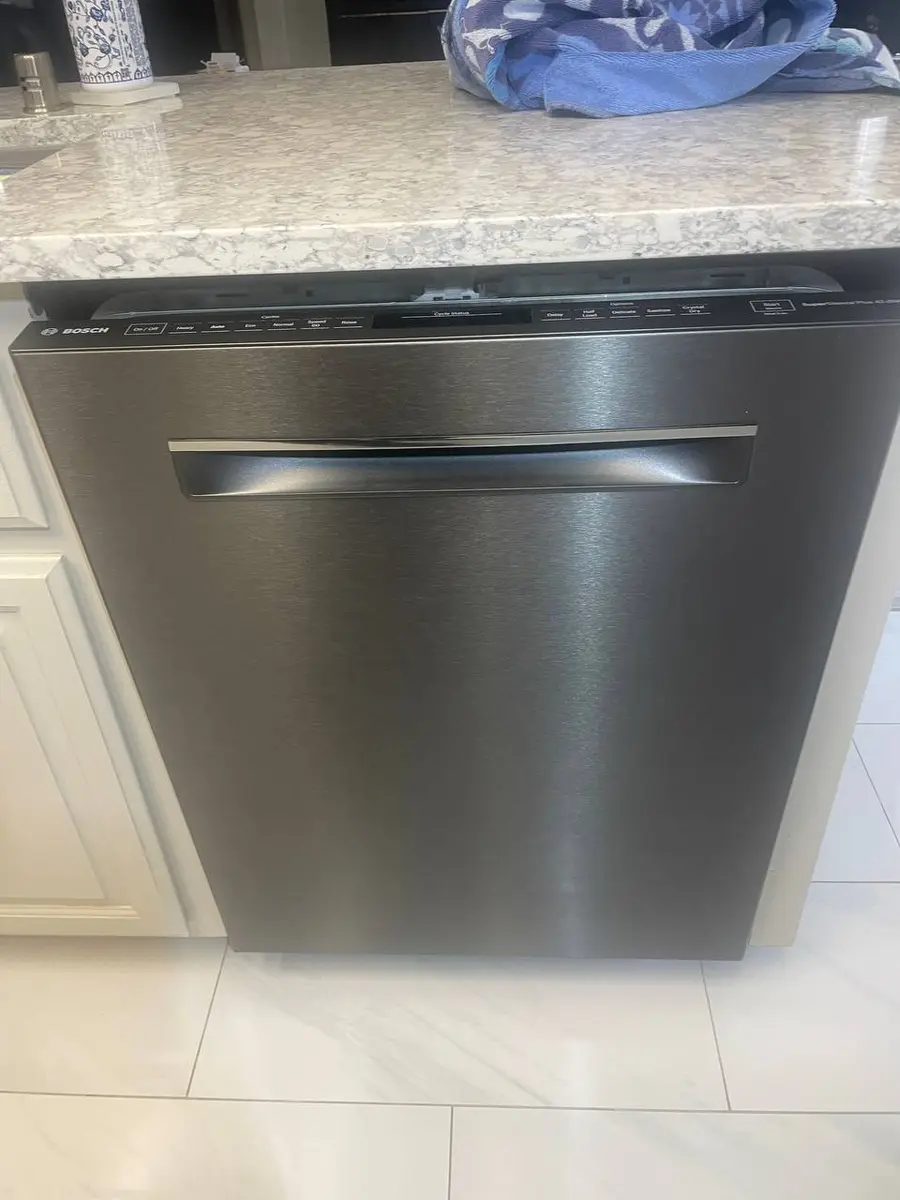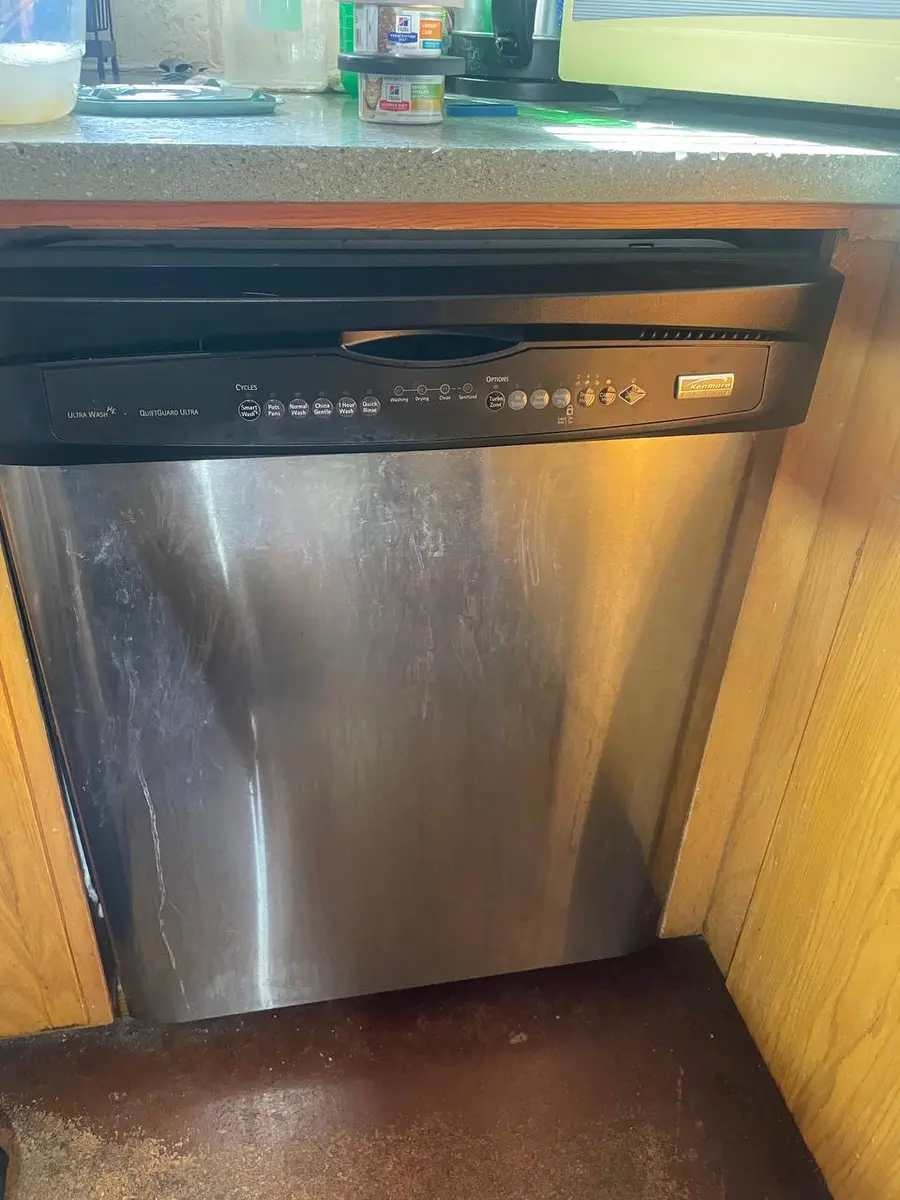
Whirlpool Dishwasher Vent Fan Replacement
If a Whirlpool dishwasher leaves dishes wet even though the tub is hot at the end of the cycle, the door's vent (dry-assist) fan has usually failed — it's the part that pushes humid air out the door vent so drier room air can take its place. It's one of the easiest dishwasher repairs going.
Not every Whirlpool has one. Lower-end WDF models dry by condensation on the stainless tub with no fan at all, so if the door has no vent opening at the top, this part doesn't exist on your machine.
Spotting the vent fan#
Look along the top edge of the door from outside for a rectangular vent opening about 2 inches wide. During the drying phase you should feel warm, moist air pushing out of it; hold a hand there and feel nothing, and the fan has probably quit. Behind that opening sits a small 12V DC motor with a centrifugal blower wheel, switched on by the main board only during drying.
Do You Have the Right Tools?
Water pressure gauge ($60), spray arm tester, float switch multimeter ($85), and drain inspection camera. Our technician arrives with $3,000+ in professional tools — your diagnostic is free.
Licensed & Insured · 90-Day Warranty · Same-Day Service
Symptoms of a dead vent fan#
- Wet dishes after a heated-dry cycle — you can feel heat inside the tub, but the moisture never leaves.
- No airflow at the door vent during drying.
- A faint hum from the door with no air moving — the motor has power but the blower wheel is stuck, cracked, or spun off its shaft.
- A musty smell between uses — trapped moisture breeds mildew on the gasket and tub walls.
Wet dishes aren't always the fan, though: a dead heating element, incoming water below 120°F, or an empty rinse-aid dispenser all leave dishes damp. The fan is the suspect only when there's heat but no airflow.
Replacing it#
- Cut power at the breaker.
- Open the door and remove the inner door panel — 8 Torx T20 screws around the edge.
- Separate the panel to reach the door interior; the fan sits at the top, right behind the exterior vent.
- The assembly is held by 2–3 screws with a single two-wire connector to the main board.
- Press the locking tab and unplug the connector.
- Remove the screws and lift the fan out.
- Before fitting the new one, ohm the old motor across its terminals — 20–60 ohms is normal, infinite means a burned winding, near-zero a short.
- Check the blower wheel for cracks; a split wheel moves no air even if the motor spins, and on some models the wheel swaps separately.
- Fit the new assembly, secure the screws, and reconnect.
- Rebuild the inner door panel.
- Run a heated-dry cycle and confirm airflow at the vent.
Tools: Torx T20, Phillips #2, multimeter — about 15–25 minutes.
Safety First — Know the Risks
Live 120V wiring in a wet environment is one of the most dangerous DIY scenarios. Water + electricity = serious shock risk. Our techs are licensed and insured — let them handle the risk.
Licensed & Insured · 90-Day Warranty · Same-Day Service
Why this one's easy#
The vent fan has no plumbing, sits in the dry upper door above the waterline, uses a single keyed two-wire plug, weighs under a pound, and needs no calibration — it's simply on or off. That's about as friendly as dishwasher repairs get.
Parts and cost#
| Part | Role | Cost & effort |
|---|---|---|
| Vent fan motor (WPW10294048 / W10861584) | Pushes humid air out the door vent | Board only — DIY, 15–25 min |
| Blower wheel (some models) | Moves the air | Separate part on certain models |
The Real Cost of DIY
Average DIY attempt: $150-400 in tools you may use once, plus the risk of further damage. Our diagnostic visit costs $0 — we find the problem and give you an honest quote.
Licensed & Insured · 90-Day Warranty · Same-Day Service
Before you order#
Two quick checks save a wasted part: refill the rinse-aid dispenser (without it, water beads and clings no matter how well the fan runs), and reseat the two-pin connector at the motor, which years of vibration can loosen. Then meter for 12V DC at the fan connector during the dry phase — no voltage means the board or its relay is at fault, not the fan. Vent fans usually last 8–14 years; because they run only during drying, bearing wear or lint on the blower wheel is the usual end.
Whirlpool dishwasher repair — diagnosis, parts, and the fix in one visit across Sacramento and the Bay Area. Schedule a visit
Appliance Repair Technician · 8 years experience
Experienced technician with 8 years specializing in dishwasher repairs and European appliance brands including Bosch and Thermador.