What is the Samsung Oven/Range E-OA error?#
An E-OA code on your Samsung oven or range means the oven is overheating — it climbed well beyond the set temperature, and the control tripped a protective fault. This is the oven code to take seriously: the causes in the table above are a stuck relay feeding the heating element or a failed sensor, and a relay welded closed keeps the element powered when it should be off. The tell-tales are an oven far hotter than its setting, a burning smell at moderate settings, and the oven shutting itself off. If it is running away hot, turn it off and shut off power at the breaker until it is repaired.
E-OA on a Samsung Oven/Range: likely causes and repair cost#
On a Samsung Oven/Range, the E-OA code signals: oven overheating.
| Likely cause | Typical likelihood |
|---|---|
| Relay failure | Most common |
| Sensor failure | Common |
Typical professional repair: $200–$450 · Difficulty: professional only · usually a technician job
Symptoms that often accompany E-OA: Oven gets extremely hot, well beyond set temperature; Burning smell even when oven should be at moderate temperature; Oven shuts itself off with an error code; Smoke from the oven vent during normal use
Technician diagnostic sequence for E-OA:
- Turn off the oven immediately at the circuit breaker — an overheating oven is a safety hazard. Do not open the door if you suspect extreme heat inside
- Wait for the oven to cool completely (1-2 hours). Then test the temperature sensor (see tE troubleshooting) — a sensor reading artificially low causes the board to keep heating
- If the sensor tests good, the relay on the control board that switches the heating element may be welded closed (stuck on). Access the board and visually inspect the relay for burn marks or discoloration
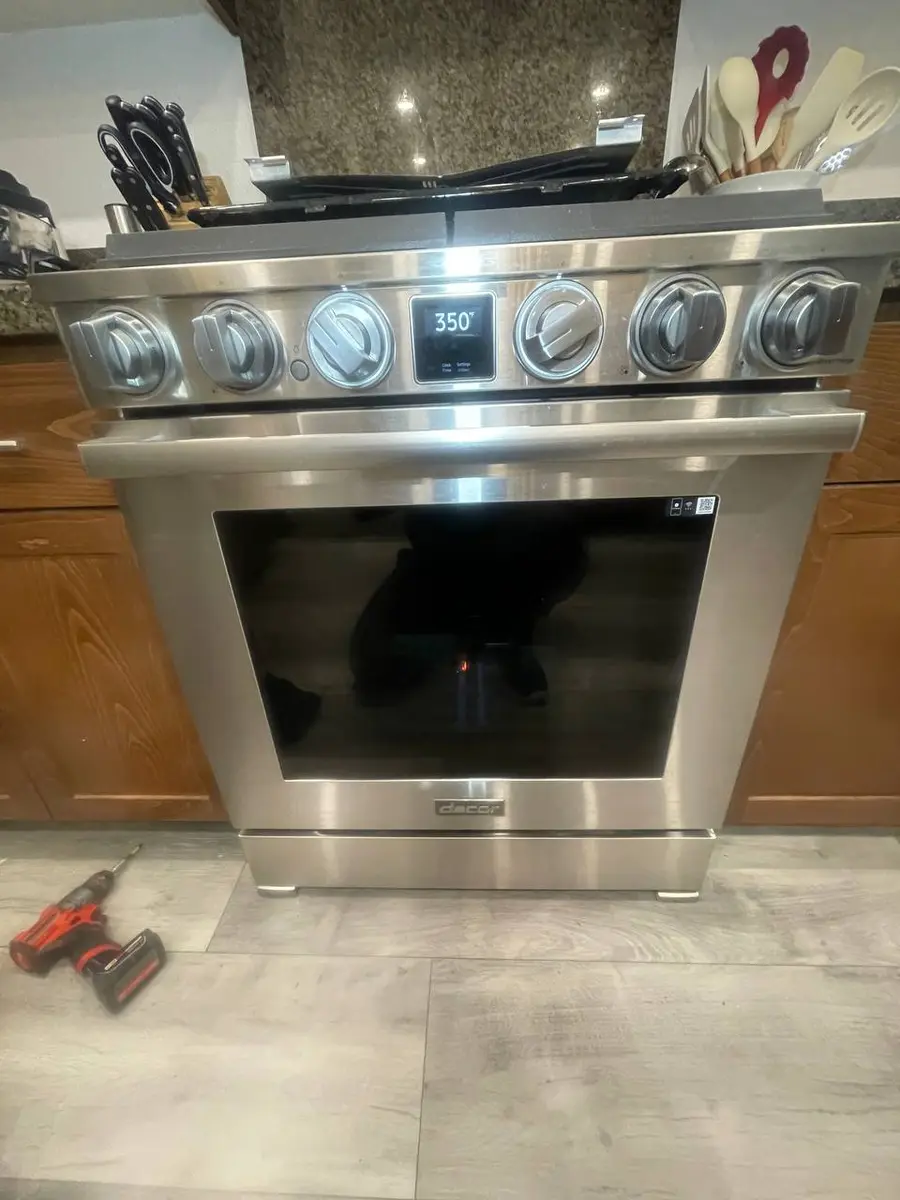
- Test the oven: set to 350 °F and use a separate oven thermometer to verify. If the oven climbs past 400 °F and keeps rising, the relay is welded. E-OA = upper element; E-OB = lower element
Parts a technician may check or replace: Samsung DG92-01003D or model-specific; Samsung DG32-00002B; Samsung DG47-00023A
Field note: A welded relay on a Samsung oven control board is visible under magnification — the relay contacts are fused together. This happens when the relay switches a failing element that draws excessive current. Always test the element impedance when replacing the board to avoid killing the new board too.
Safety note: An overheating oven is a fire and burn hazard. Do not use the oven until the root cause is repaired. If you smell burning or see smoke, turn off the breaker and keep the oven door closed to starve any fire of oxygen.
Do You Have the Right Tools?
Combustion analyzer ($300), igniter tester ($120), temperature calibrator ($150), and gas pressure manometer. Our technician arrives with $3,000+ in professional tools — your diagnostic is free.
Licensed & Insured · 90-Day Warranty · Same-Day Service
How to troubleshoot the E-OA error yourself#
E-OA leaves very little for an owner to do safely, and that is by design — a runaway-hot oven is not something to experiment with. Turn the oven off and cut power at the breaker; do not keep running it hoping the fault clears. You can do one controlled reset: leave it off at the breaker for several minutes, restore power, and set a low temperature while watching closely. Beyond that, the causes in the table above — a stuck heating relay or a failed sensor — are "professional" territory. A relay welded closed is a genuine safety fault that must be diagnosed and replaced by a technician. This is the oven code where I firmly tell owners to stop after cutting power and call a pro.
Is the Samsung Oven/Range E-OA error worth fixing?#
E-OA is worth repairing on a range with life left, but it is not optional to address — an overheating oven is a safety issue you cannot ignore. The table above lists $200 to $450, the highest of the oven codes, reflecting relay or sensor work on the heat circuit. On a newer or higher-end range, that is clearly worth it. On an older basic unit, $200 to $450 is a meaningful fraction of a new range, so pricing replacement is fair — but until it is fixed or replaced, the oven should stay off at the breaker for safety. Unlike a cosmetic or convenience fault you can defer, this one forces the decision now, because continuing to run an oven that overheats risks both the food and the surrounding cabinetry.
Safety First — Know the Risks
Gas ovens involve live gas lines — a loose connection creates explosion and carbon monoxide risk. Electric ovens run on 240V circuits. Our techs are licensed and insured — let them handle the risk.
Licensed & Insured · 90-Day Warranty · Same-Day Service
Samsung Oven/Range E-OA: frequently asked questions#
What does the E-OA error mean on a Samsung Oven?#
It means the oven overheated well beyond its set temperature and tripped a protective fault. A stuck heating relay or failed sensor is the usual cause.
Is it safe to keep using a Samsung Oven that shows the E-OA error?#
No — an overheating oven is a safety issue. Turn it off and cut power at the breaker until it is repaired or replaced.
Can I clear the E-OA error myself, or do I need a technician?#
You can cut power and try one careful reset, but a stuck relay or failed sensor is a technician repair — this is a safety fault, not a DIY one.
How much does it cost to repair the E-OA error on a Samsung Oven?#
The table above lists $200 to $450, the priciest oven code, reflecting heat-relay or sensor repair.
Which parts usually fail when an oven throws the E-OA code?#
A stuck heating relay or a failed temperature sensor, as shown in the table above.
Is a Samsung Oven with the E-OA error worth repairing?#
On a newer or higher-end range, yes. On an older basic unit, the $200 to $450 repair is a meaningful share of a new one, so pricing replacement is fair — but keep it powered off until then.
Appliance Repair Technician · 11 years experience
Experienced technician with 11 years specializing in Frigidaire and Electrolux refrigerator and dryer repair with a focus on safety.