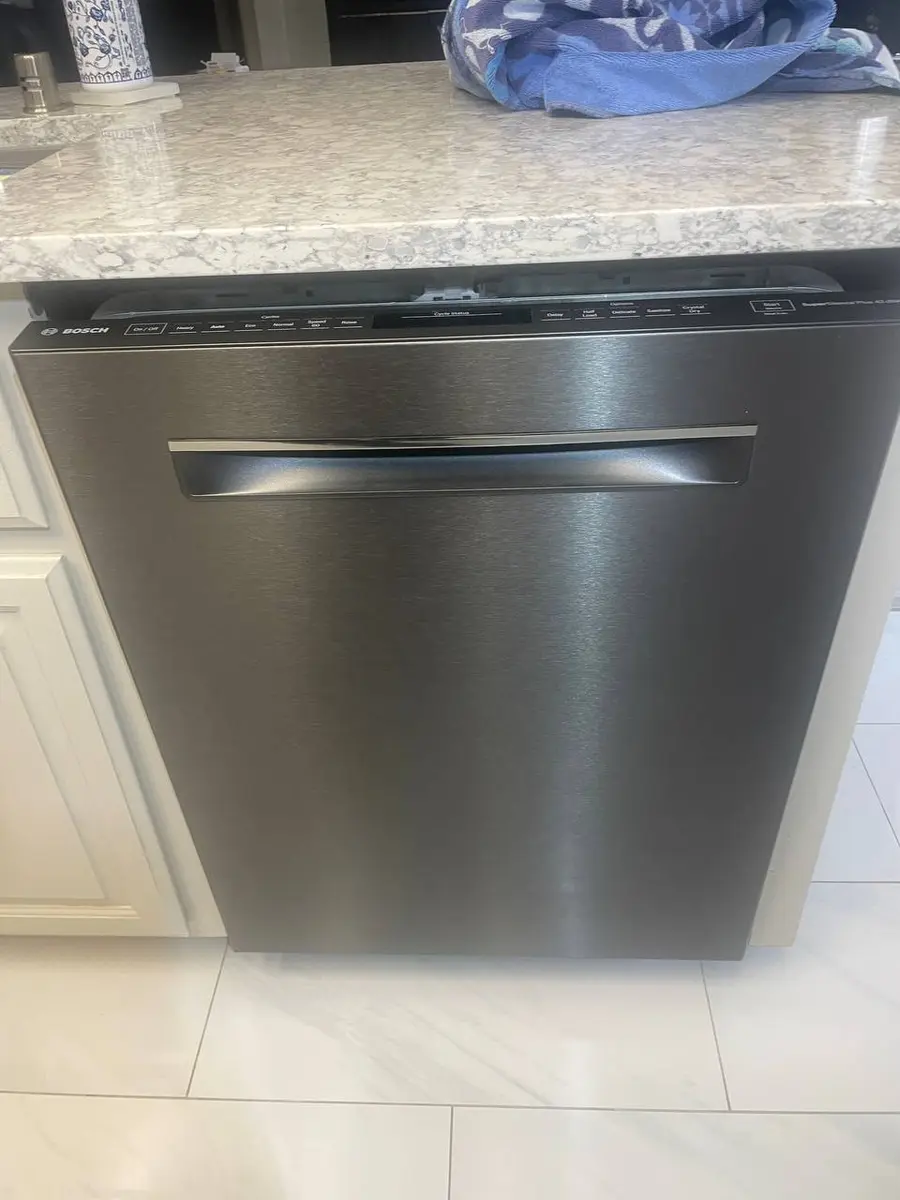
Miele dishwashers are built for a long service life. Even so, error codes still appear. Miele uses an "F" prefix system with two-digit numbers displayed on the control panel or through LED blink sequences on models without a digital readout. This guide covers the common Miele dishwasher fault codes with their causes, diagnostic steps, and fixes.
How Miele dishwasher error codes work
On G 5000, G 7000, and newer models with a digital display, the F-code appears directly on the panel. On older Classic models (G 4000 series), the Intake/Drain indicator light blinks a specific number of times to indicate the error — count the blinks and match to the F-code number. To reset any Miele dishwasher error, hold the Start/Stop button for 5 seconds until the display clears, then power-cycle the unit.
Diagnostic mode (service test): the entry sequence and its numbered test programs are given in the service documentation for your model — it is a technician's tool, not an owner reset.
F11 — drainage error
The dishwasher cannot drain water after the wash or rinse cycle.
Common causes:
- Triple filter assembly clogged with food debris (by far the most common cause)
- Drain hose kinked, crushed, or installed without a high loop
- Drain pump impeller blocked by glass shards, seeds, or broken dish fragments
- Drain hose connection to garbage disposal still has factory knockout plug in place
- Drain pump motor failure
How to fix:
- Remove the lower spray arm (twist counterclockwise) and the triple filter assembly. Clean all three filter layers — the micro-fine mesh, the coarse filter, and the flat drain cover underneath.
- Switch off the dishwasher at its breaker (or unplug it) before you reach into the pump cavity. Inspect the drain pump cavity (visible after removing the flat filter cover). Remove any debris from the pump impeller — use a flashlight and long-nose pliers.
- Check the drain hose for kinks or loops. The hose needs a high-loop installation (to the height your model's installation instructions give) to prevent backflow. Sacramento homes with disposal connections often have the factory knockout plug still in place — check inside the disposal inlet.
- Restore power and run an empty hot cycle to test. If F11 persists, the drain pump motor needs replacement.
Diagnostic tip: A technician's drain test in the service mode separates the two cases: if the pump runs but water doesn't drain, the issue is the hose path; if the pump doesn't run at all, the pump motor is suspect. To check the motor yourself, switch off the breaker (or unplug the dishwasher) first, then measure continuity across the pump motor terminals and compare the reading with the value on your model's tech sheet.
F12 / F13 / F14 — water intake error
The dishwasher cannot fill with water within the expected time. F12 and its siblings F13 and F14 all mean the machine is not taking in water fast enough to reach the level it needs, so it pauses at the fill stage.
Common causes:
- Water shutoff valve (stopcock) not fully open — Miele uses a specific valve with a lever-style handle
- Inlet filter screen clogged with sediment or hard-water scale (very common in Sacramento and Bay Area homes with hard water)
- Water inlet valve solenoid failure
- Low water pressure (check the minimum in your model's installation instructions)
How to fix:
- Verify the shutoff valve behind the dishwasher is fully open. Miele's lever valve should be parallel to the water line.
- Turn off the water supply. Disconnect the inlet hose at the dishwasher end. Remove and clean the mesh screen filter — soak in white vinegar for 30 minutes if calcium buildup is visible.
- Check household water pressure with a gauge on a nearby faucet. If it is below the minimum in your model's installation instructions, the issue is your plumbing, not the dishwasher.
- If the supply and the inlet filter are fine and F12, F13 or F14 keeps returning, the water inlet valve is the part to suspect — have a technician replace it.
F24 / F25 — heating system fault
F24: The heating relay on the control board has failed. F25: The NTC temperature sensor reads an abnormal value.
Common causes:
- Heating relay on the EGPL electronic board has worn out
- Heating element (flow-through heater) has an open circuit or ground fault — Miele uses a continuous-flow heater
- NTC thermistor failure (F25) — its reading is off the value on your model's tech sheet
- Loose wiring connection between heater and control board
How to fix:
- A technician can run the heating test in the service mode and watch whether the heater activates — the water temperature should rise steadily. If no heat, the issue is confirmed.
- Measure the heating element resistance: disconnect power, access the element from the sump area, measure across terminals and compare the reading with the value on your model's tech sheet. Infinite resistance = open element.
- Measure the NTC sensor and compare the reading with the value on your model's tech sheet. If the reading is far off or "OL", replace the sensor.
- Inspect the wiring harness between the heater and EGPL board for burn marks or loose connectors.
F70 / F75 — leak detection / float switch
Water has been detected in the base pan of the dishwasher. Miele's Waterproof System (WPS) uses a float switch in the base that triggers immediately on contact with water.
Common causes:
- Door seal (gasket) degraded or dislodged
- Hose clamp loose on internal sump-to-pump connections
- Cracked sump or sump seal failure
- Spray arm bearing seal leak (especially on models with the AutoDos system where the upper spray arm has additional plumbing)
- Condensation buildup after repeated short cycles in humid environments (false trigger — less common)
How to fix:
- Immediately turn off the dishwasher at the breaker and close the water shutoff valve.
- Carefully tilt the dishwasher back slightly (have someone hold it) and use towels to absorb water from the base pan. Locate the source of the leak — check the door seal perimeter, hose connections, and sump area.
- Inspect the door gasket for tears, warping, or food debris preventing a complete seal. The gasket should be pliable — if it's stiff or cracked, it needs replacement.
- Check all internal hose clamps with a flashlight. Hand-tighten any that are loose.
- After drying the base pan completely, restore power and run a test cycle. If F70 returns within minutes, the leak source needs professional diagnosis.
Diagnostic tip: Place paper towels around the sump and spray arm areas before running a short test cycle. The wet towel pinpoints the leak location.
Rather have a pro handle it?
A vetted local technician can come out and diagnose your dishwasher at home.
F78 / F79 — circulation pump issues
The main wash pump cannot operate at the expected speed (F78) or is completely blocked (F79).
Common causes:
- Foreign object jamming the pump impeller (broken glass, fruit pits, toothpick fragments)
- Pump motor winding failure
- Capacitor failure on the pump motor (models with separate capacitor)
- Wash pressure sensor detecting no flow despite pump running
How to fix:
- Switch off the dishwasher at its breaker (or unplug it) before you start. Remove the lower spray arm and filter assembly. Look into the pump well for visible debris — a flashlight is essential here.
- On some models, the pump cover can be removed by turning the cover counterclockwise. Carefully clear any debris from the impeller blades.
- If the impeller spins freely but F78 persists, the motor or its capacitor may have failed. With the power still off, test motor resistance across the main winding terminals and compare it with the value on your model's tech sheet.
- A technician can run the circulation pump test in the service mode: if the pump buzzes but doesn't spin, it's seized; if silent, the wiring or motor is at fault.
F32 / F33 — detergent dispenser fault
The detergent dispenser mechanism cannot open (F32) or the AutoDos dosing system has malfunctioned (F33, on models with automatic detergent dispensing).
Common causes:
- Detergent residue buildup jamming the dispenser door mechanism
- Dispenser actuator motor failure
- AutoDos cartridge not seated properly (F33)
- Wiring fault between dispenser and control board
How to fix:
- Clean the dispenser compartment thoroughly — use hot water and a toothbrush to remove caked-on detergent. Gel and powder residue are the most common cause.
- Verify the dispenser door opens freely by hand when the latch is released.
- For AutoDos (F33): remove and reseat the PowerDisk cartridge. Clean the cartridge holder with warm water. If the error persists, the AutoDos unit may need replacement.
- Check the dispenser actuator by listening for a click when the cycle reaches the wash phase. No click = actuator failure.
F01 / F02 — temperature sensor (NTC)
F01: NTC temperature sensor short circuit. F02: NTC sensor open circuit (disconnected or broken).
Common causes:
- NTC thermistor failure — the most common single-component failure on Miele dishwashers after 8+ years
- Corroded wiring connector at the NTC sensor (moisture ingress over time)
- Control board input circuit failure (rare — usually the sensor itself)
How to fix:
- Access the NTC sensor — located in the sump area near the heating element. Disconnect power first.
- Measure resistance across the sensor terminals and compare it with the value on your model's tech sheet. F01 indicates near-zero ohms (shorted). F02 indicates infinite resistance (open).
- Inspect the connector for green corrosion. Clean with contact cleaner if corroded.
- Replace the NTC sensor if readings are abnormal. Straightforward DIY repair on most models.
F68 / F69 — circulation pump speed errors
F68: Pump running below expected RPM. F69: Pump completely stalled during a cycle.
Common causes:
- Partial blockage reducing pump flow (food debris, broken glass)
- Worn pump bearings causing drag
- Low voltage to pump motor
- Pump motor capacitor degrading (losing capacitance)
How to fix:
- For F69, first clear any debris from the pump (see F78/F79 above).
- For F68, the pump runs but slowly — this often indicates bearing wear. Listen for grinding or squealing sounds when the pump activates.
- Check that the power supply voltage to the dishwasher is within spec (120V ± 10%). Low voltage can cause pump speed errors.
- If bearings are worn (grinding noise), the pump motor needs replacement. Miele pump motors are not field-rebuildable.
Why Miele dishwashers are worth repairing
Miele dishwashers are a premium purchase engineered for a long service life, so a repair on a 10-year-old Miele usually makes more financial sense than a replacement. Their build quality means repairs are usually straightforward: it's typically a single component failure rather than cascading problems common in budget brands. Additionally, Miele parts availability is excellent — components for models going back 15+ years are generally still available from authorized suppliers.
Every technician on our platform is trained on major appliance brands and insured. We carry common Miele parts (NTC sensors, drain pumps, inlet valves) on our trucks for same-day repairs. Every repair includes a free diagnostic visit and is covered by the Provider's 90-day parts and labor warranty, claimed through EasyBear.
Schedule Your Free Miele Dishwasher Diagnosis →
For the complete Miele error code reference across all appliance types (dishwashers, washers, dryers, ovens), visit our Miele Error Codes Library.