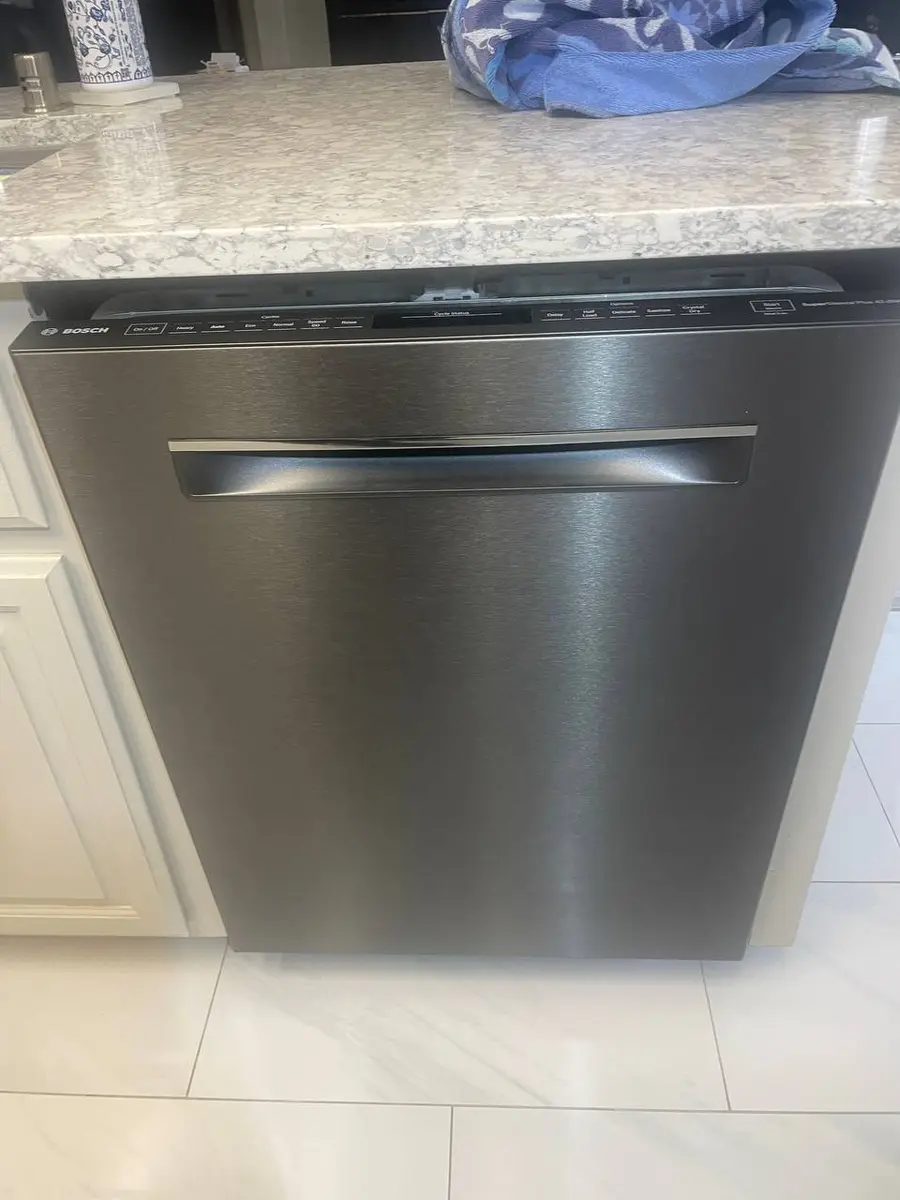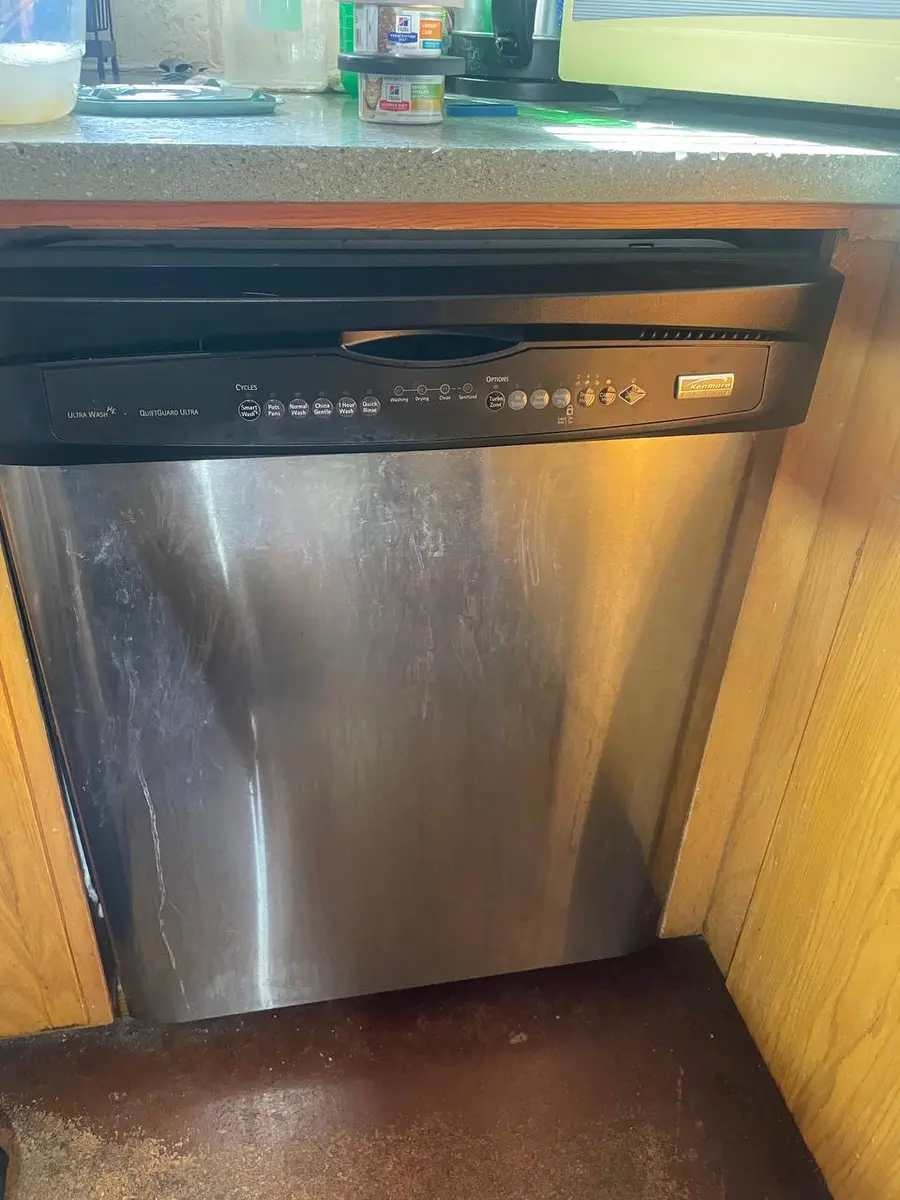
Most Likely Cause#
A Maytag dishwasher flashing or blinking its lights is almost never a random glitch — it is the control board spelling out a fault code. On MDB-series models without a text display, the number of blinks between pauses is the same F-number/E-number code a digital panel would print. Most blinking traces back to a door latch or door-switch fault (code F5-E1) or a control-board memory error (code F1-E1) after a power event.
Before you count anything, decide which kind of blinking you have. A single indicator winking once every few seconds usually just means a cycle is running or a Delay Wash is counting down — that is normal and needs no repair. A counted, repeating pattern with distinct pauses between groups is an error report, and that is what the rest of this guide decodes.
How to Read a Maytag Blink Code#
The pattern is a two-part number. Watch the indicator that is doing the blinking (usually the Clean or Complete light) and count in sequence:
- Count the first group of blinks — that number is the F, or function, part of the code.
- Wait through the short pause (roughly two seconds).
- Count the second group of blinks — that number is the E, or error, part.
- Note the longer pause (roughly five seconds), after which the whole pattern repeats so you can confirm your count.
For example, five blinks, a pause, then one blink, repeating, is code F5-E1. If the timing is hard to follow in real time, record the panel with your phone in slow-motion and count the frames back. Two people counting independently is the fastest way to be sure before you order a part.
Do You Have the Right Tools?
Water pressure gauge ($60), spray arm tester, float switch multimeter ($85), and drain inspection camera. Our technician arrives with $3,000+ in professional tools — your diagnostic is free.
Licensed & Insured · 90-Day Warranty · Same-Day Service
Maytag Blink-Code Cheat Sheet#
Match your counted pattern to the row below. The rows are ordered from the faults we see most often on Maytag dishwashers down to the rarer ones.
| Blink pattern | Code | What it is telling you | First thing to check |
|---|---|---|---|
| 5 + 1 | F5-E1 | Door switch or latch not confirming closed | Re-seat the door, inspect the latch hook and switch |
| 1 + 1 | F1-E1 | Control-board memory (EEPROM) fault, often after a surge | Cut power 5 minutes; replace board if it returns |
| 8 + 1 | F8-E1 | Slow or incomplete drain | Clean the filter, check the drain hose and disposal knockout |
| 6 + 1 | F6-E1 | No water detected entering the tub | Verify the supply valve is open and the inlet valve works |
| 2 + 1 | F2-E1 | Keypad or touchpad reading stuck/invalid | Dry out moisture behind the panel; replace membrane if stuck |
| 3 + 0 | F3-E0 | Temperature thermistor open circuit | Re-seat the sensor connector; replace the thermistor |
| 5 + 2 | F5-E2 | Motorized door lock cannot reach position | Inspect the door-lock motor and linkage |
| 8 + 4 | F8-E4 | Overfill — float tripped, water too high | Shut the supply off; check the float and inlet valve |
| 9 + 0 | F9-E0 | Diverter or wash-motor position out of range | Look for a jammed chopper; check the diverter motor |
A control-board variant, code F1-E2, points at the same memory chip as F1-E1 and is handled the same way. Always read the full two-part code — a lone group of blinks with no second group usually means you missed the pause, so watch it repeat.
Normal Blinking You Can Ignore#
Not every flash is a fault. Any of these is routine on MDB models:
- The Clean or Complete light winking once every few seconds while a cycle runs.
- The Start light flashing while a Delay Wash counts down.
- Every light glowing for a second when you press a button — that is just the panel acknowledging the touch.
- All lights flashing together for under a minute right after power is restored — the board is running its self-test.
If that post-power flashing keeps going past a minute, or a specific counted pattern appears, treat it as a real code and decode it above.
Safety First — Know the Risks
Live 120V wiring in a wet environment is one of the most dangerous DIY scenarios. Water + electricity = serious shock risk. Our techs are licensed and insured — let them handle the risk.
Licensed & Insured · 90-Day Warranty · Same-Day Service
Clearing a Code After You Fix the Cause#
Resetting alone will not repair anything — if the underlying fault is still there, the code comes back, often within the first minutes of the next cycle. Once you have actually addressed the cause:
- Switch the dishwasher off at the breaker for a full minute so the board fully discharges.
- Restore power, close the door, and press Cancel or Drain once to clear any leftover cycle state.
- Start a short cycle and watch. If the blinking returns, the root cause was not resolved and needs another look.
Safety: if the blinking lights come with a burning smell, visible sparking, or the household breaker tripping, stop immediately. Do not reset and retry — shut the power off at the breaker and have the machine inspected before it runs again.
Repair or Service Decision#
Latch, filter, hose, and float faults (F5-E1, F8-E1, F6-E1, F8-E4) are the most DIY-friendly and often cost only a part or nothing at all. Repeated control-board codes (F1-E1, F1-E2) are the ones worth pricing against the age of the machine, since a board is the single most expensive common part. If the same code recurs after you replace the indicated component, that points to a secondary fault or a wiring issue and is the right time to bring in a technician. You can book a diagnostic visit and have the stored code read for you.
The Real Cost of DIY
Average DIY attempt: $150-400 in tools you may use once, plus the risk of further damage. Our diagnostic visit costs $0 — we find the problem and give you an honest quote.
Licensed & Insured · 90-Day Warranty · Same-Day Service
Lead Appliance Repair Technician · 12 years experience
Experienced technician with 12 years specializing in washing machine and dryer repairs across all major brands.