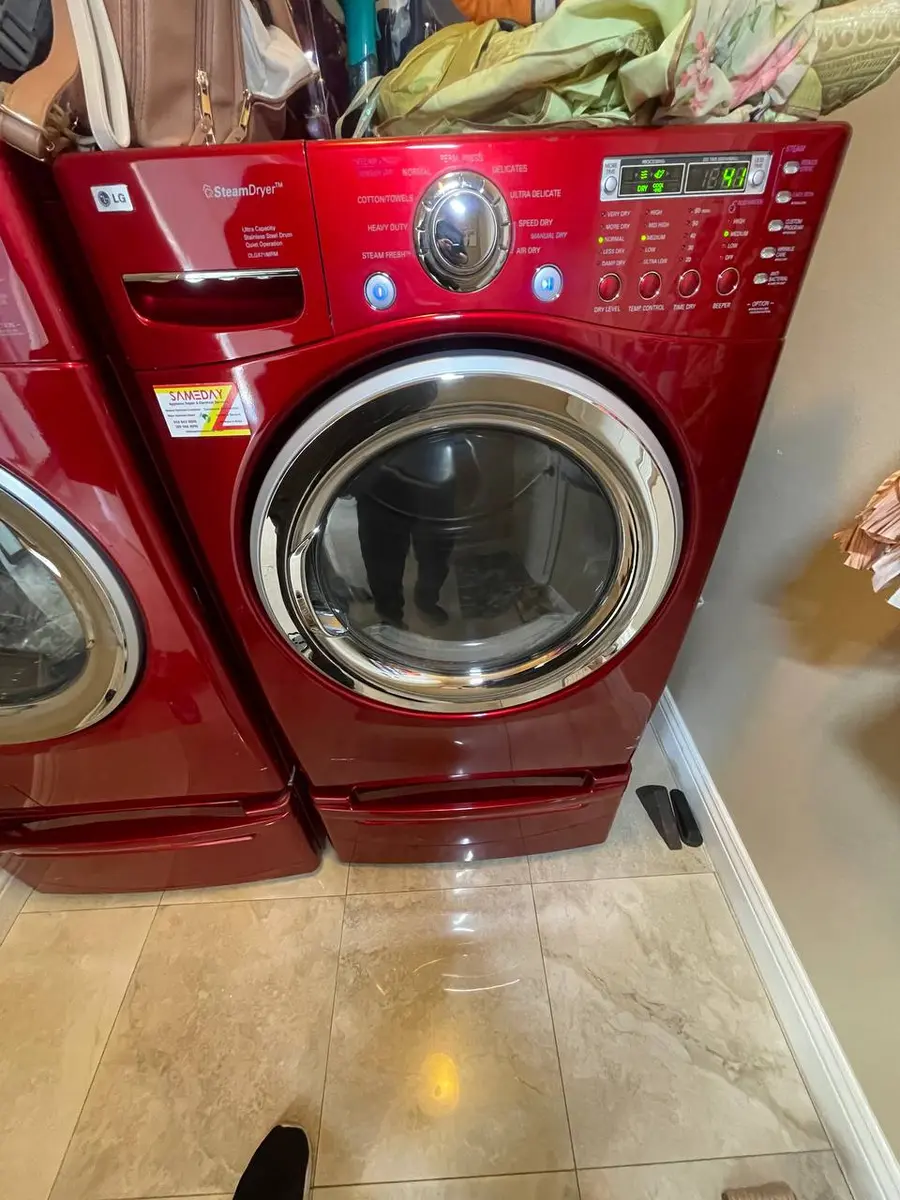
LG Dryer Heating Element
If your LG dryer has been showing d80, d90 or d95, it has been telling you the exhaust is restricted — and restriction is what burns elements out. Those are warnings rather than errors, so the machine keeps running and most people ignore them until the day there is no heat. Clean the vent and you often prevent the…
How these elements actually die#
The resistance wire inside the housing glows red-hot every cycle and cools between them. Over years that thermal cycling thins the wire, it sags, and eventually it breaks. Circuit open, no current, drum tumbles and blows cold air.
The less common version is the sagging wire touching the metal housing before it breaks, creating a ground fault that trips the breaker or takes out the thermal fuse.
Either way, restriction is the accelerant. When exhaust airflow is choked, drum temperature climbs to the thermostat setpoint slowly, so the element stays energised longer and runs hotter throughout. That is fatigue on the wire, cycle after cycle. The vent flow sensor sees it and posts d80, d90 or d95 long before the element gives up.
Gas LG dryers have no element — they use a gas valve and igniter. If PG&E serves your house, locate the gas shutoff before starting any work on one of those.
Check the chain in order#
Everything ahead of the element is cheaper and faster to test, so work down the list rather than jumping to the expensive part.
- Thermal fuse (6931EL3001F) — one-shot device. No continuity means blown, and it is the most common no-heat cause. Find out what blew it before fitting a new one; it is usually the vent.
- High-limit thermostat — safety cutoff. Test continuity, then reset or replace if open.
- Cycling thermostat (6931EL3003D) — regulates temperature. Cold, it should read closed.
- Heating element — test across the two terminals. Expect 10-20 ohms; infinite means burned out. Then test each terminal to the housing, where any reading at all means the element has grounded.
- Control board relay — the one people forget. If the relay that switches the element has burned, the element receives no power even though it tests perfectly.
Do You Have the Right Tools?
Gas leak detector ($130), thermal fuse tester ($95), belt tension gauge, and vent inspection camera ($180). Our technician arrives with $3,000+ in professional tools — your diagnostic is free.
Licensed & Insured · 90-Day Warranty · Same-Day Service
The replacement#
Disconnect power at both breaker poles — this is a 240V circuit. Take the rear panel off, typically 8-12 Phillips screws. The element housing is a metal can mounted vertically on the rear bulkhead.
You need a Phillips #2, a 1/4 inch nut driver for the housing screws, a multimeter, and needle-nose pliers for the wire terminals, which are tight.
Disconnect the 2-3 terminals at the housing, remove its 2-4 mounting screws and draw the housing out. Depending on how the part is supplied, the element may lift out of the housing on its own — held by ceramic insulators and clips — or the whole housing assembly may be the replacement unit. Fit the new part, reconnect, rebuild the rear panel.
Then run a timed dry for 10 minutes and check for genuinely hot air both at the exhaust vent and inside the drum. Older machines take 5301EL1001H rather than the current element, and aftermarket versions are available.
Do not skip the vent#
This is the difference between a repair that holds and one you repeat in 1-2 years. The vent restriction that killed the first element is still there when you fit the second one.
Clean the full run while the dryer is pulled out. If the d-codes were showing before the failure, treat that as confirmation rather than coincidence — and if they come back after the repair, the vent is still not clear.
On warranty, one common misconception: LG's 10-year coverage applies to the Direct Drive motor only. The heating element falls under the standard 1-year parts and labour warranty, so an out-of-warranty element is normal on a machine that still has motor coverage.
No heat and the thermal fuse tests good? Book now and we will work the rest of the chain.
Lead Appliance Repair Technician · 12 years experience
Experienced technician with 12 years specializing in washing machine and dryer repairs across all major brands.