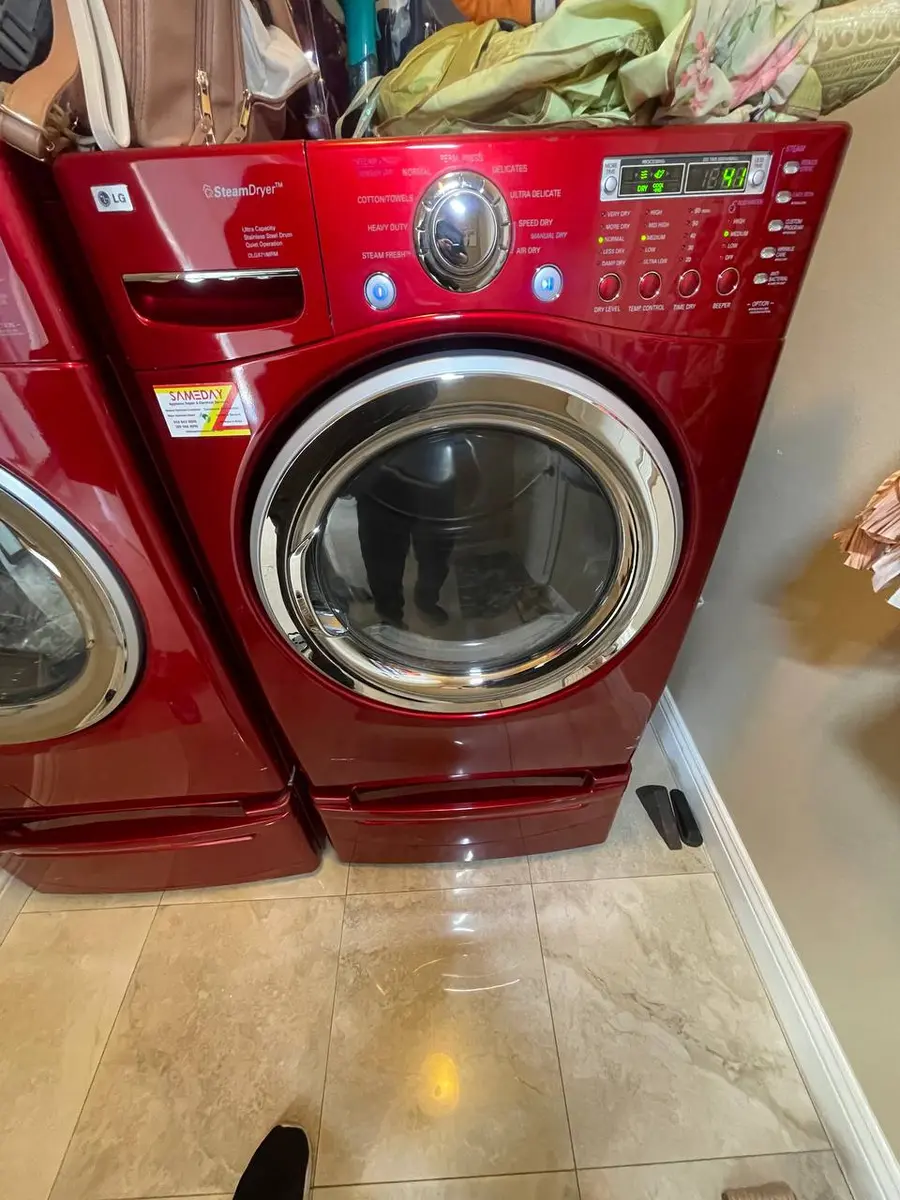
What is the LG Dryer tE1 error?#
tE1 on an LG dryer is a thermistor error — one of the temperature sensors that lets the board control the heat is reading out of range. You will see the dryer either not heating or overheating and shutting off, since the board cannot trust the temperature it is measuring. It is not an immediate hazard because the safety thermostats still protect the machine, but it needs attention. The useful clue is the suffix: tE1, tE2, and tE3 each point to a different sensor circuit.
tE1 on a LG Dryer: likely causes and repair cost#
On a LG Dryer, the tE1 code signals: thermistor error.
| Likely cause | Typical likelihood |
|---|---|
| Thermistor failure | Most common |
| Wiring issue | Common |
Typical professional repair: $130–$250 · Difficulty: moderate · usually a technician job
Symptoms that often accompany tE1: Dryer not heating; Dryer overheating and shutting off; Inconsistent drying temperatures; Error appears after dryer runs for 10-15 minutes
Technician diagnostic sequence for tE1:
- Identify which thermistor has faulted — tE1 is the inlet thermistor, tE2 is the outlet thermistor, tE3 is the gas valve area thermistor (gas models only)
- Access the appropriate thermistor by removing the top panel (inlet) or lower front panel (outlet) and disconnect the wire leads
- Test with a multimeter — LG dryer thermistors should read approximately 10k ohms at room temperature (77F/25C)
- Check the wire harness for heat damage — dryer thermistor wiring runs near high-temperature zones and insulation can degrade over time
- If the thermistor reads within spec, the issue may be the main control board ADC circuit — swap a known-good thermistor from another position to confirm
Parts a technician may check or replace: Thermistor — inlet; Thermistor — outlet; High-Limit Thermostat
Field note: LG dryers use multiple thermistors for precise heat control. The tE1/tE2/tE3 suffix tells you exactly which circuit failed. On dual-fuel (gas) models, tE3 monitors the gas burner area independently — if only tE3 faults, check the gas valve wire harness routing near the burner assembly first.
Do You Have the Right Tools?
Gas leak detector ($130), thermal fuse tester ($95), belt tension gauge, and vent inspection camera ($180). Our technician arrives with $3,000+ in professional tools — your diagnostic is free.
Licensed & Insured · 90-Day Warranty · Same-Day Service
How to troubleshoot the tE1 error yourself#
tE1 is mostly a diagnostic code for owners, since the thermistors sit inside the machine. Start with a power reset — unplug the dryer for about ten minutes, then restore power and run a timed-dry to see whether the fault was a momentary read error. Note exactly which suffix appears, because tE1, tE2, and tE3 tell the technician which thermistor circuit failed and, on gas models, the tE3 sensor watches the burner area independently. Make sure the vent is clear too, since chronic overheating from a blocked exhaust can stress a thermistor. Beyond that, an owner cannot safely reach or test the sensors. Stop and call a technician if tE1 returns after a reset: the affected thermistor or its wiring has failed and has to be metered against temperature and replaced.
Is the LG Dryer tE1 error worth fixing?#
tE1 is worth fixing on a sound dryer. A professional repair runs $130–$250 to replace the failed thermistor and, if needed, the high-limit thermostat — modest against a new dryer and well under half its price. A thermistor job never approaches my repair-or-replace line on its own. The only time I raise replacement is when the dryer is old and the sensor fault joins drum, bearing, or motor problems, at which point the combined repairs deserve comparison against a new machine.
Safety First — Know the Risks
Gas dryers carry carbon monoxide and explosion risk. Even electric dryers involve 240V circuits that can deliver a fatal shock. Our techs are licensed and insured — let them handle the risk.
Licensed & Insured · 90-Day Warranty · Same-Day Service
LG Dryer tE1: frequently asked questions#
What does the tE1 error mean on a LG Dryer?#
tE1 is a thermistor error — a temperature sensor is reading out of range, so the board cannot control the heat correctly. The dryer may not heat or may overheat and shut off.
Is it safe to keep using a LG Dryer that shows the tE1 error?#
Briefly, since the safety thermostats still guard against overheating, but the dryer will not regulate temperature properly. Have the thermistor checked before relying on it.
Can I clear the tE1 error myself, or do I need a technician?#
You can reset the dryer and confirm the vent is clear. If tE1 returns, the thermistor or its wiring has failed and needs a technician to meter and replace it.
How much does it cost to repair the tE1 error on a LG Dryer?#
A professional tE1 repair typically runs $130–$250, covering the failed thermistor and, if needed, the high-limit thermostat.
Which parts usually fail when a dryer throws the tE1 code?#
The inlet or outlet thermistor is the usual failure, sometimes with damaged sensor wiring or a stressed high-limit thermostat.
Is a LG Dryer with the tE1 error worth repairing?#
Yes. At $130–$250 the repair is well under the cost of a new dryer, so unless the machine is failing elsewhere, fixing tE1 is worthwhile.
Why does thermistor failure trigger the tE1 error?#
The thermistor reports drum temperature to the board so it can cycle the heat. When the sensor drifts out of range or its wiring opens, the board cannot trust the reading and posts tE1.
Lead Appliance Repair Technician · 12 years experience
Experienced technician with 12 years specializing in washing machine and dryer repairs across all major brands.