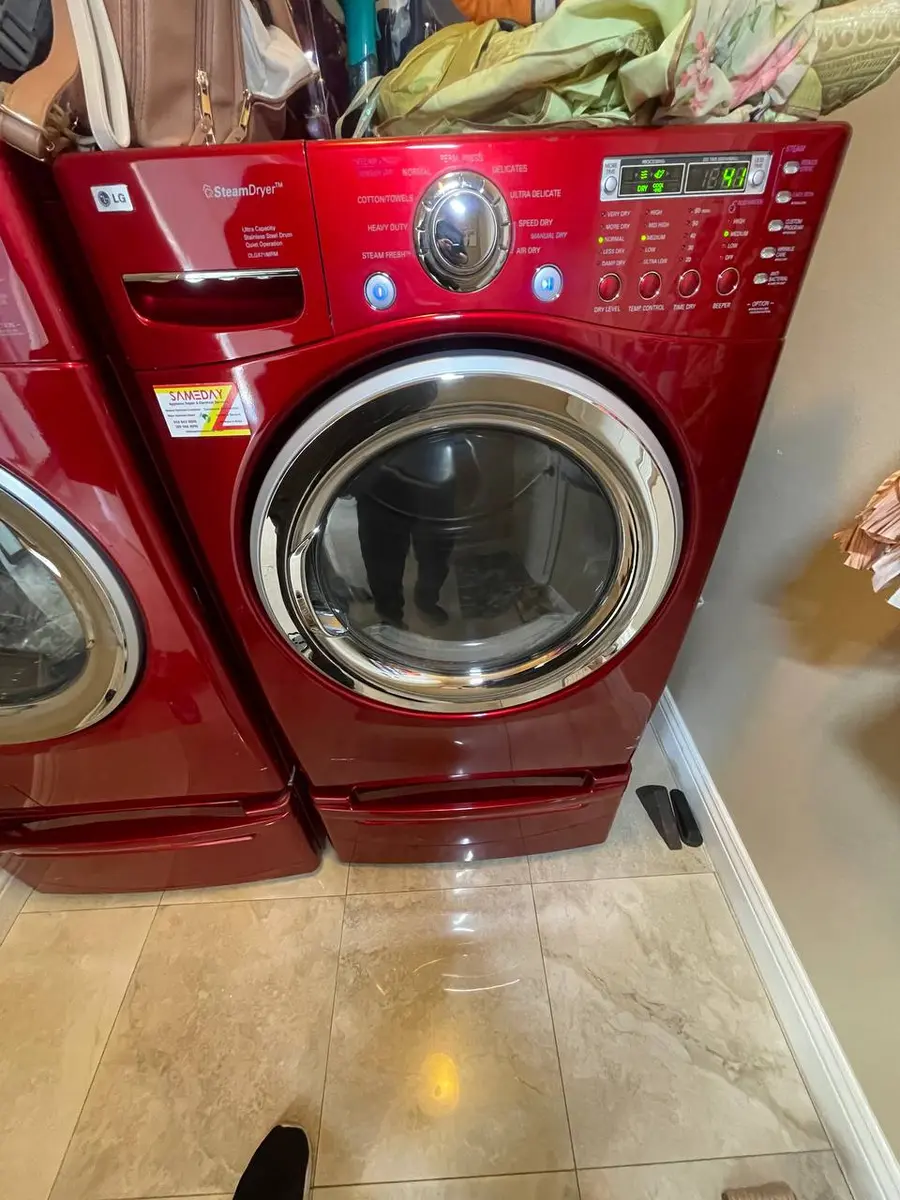
What is the LG Dryer PF error?#
PF on an LG dryer means power failure — the dryer lost power during a cycle and is letting you know the run was interrupted, not that a part has broken. It is safe, and in the ordinary case it is free to clear. The first thing I check is the electrical side — the breaker, the outlet, the cord — because a house or laundry-circuit outage during the cycle is the whole cause of a PF.
PF on a LG Dryer: likely causes and repair cost#
On a LG Dryer, the PF code signals: power failure.
| Likely cause | Typical likelihood |
|---|---|
| A house or laundry-circuit outage during the cycle | Most common |
| One 240-volt leg dropping out intermittently | Common |
| An arcing plug breaking contact under heat | Less common |
Typical professional repair: up to $90 · Difficulty: easy · often owner-fixable
Fastest thing to try first: Restart cycle.
Symptoms that often accompany PF: Dryer stopped mid-cycle; Display reset to default; Clock showing incorrect time
Technician diagnostic sequence for PF:
- Press Power, select the desired cycle, and press Start to resume drying after power is restored
- Check if the power interruption was a house-wide outage or localized to the laundry circuit
- Inspect the dryer power cord and outlet connection for signs of arcing or heat damage that could indicate an intermittent connection
- If PF appears without a known outage, the 240V circuit may be losing one leg intermittently — have an electrician check the breaker and wiring
Field note: Unlike washers, LG dryers do not automatically resume after power restoration — the PF code requires manual acknowledgment. If you have frequent brief outages (common in older Sacramento neighborhoods during summer), a surge protector rated for 30A/240V can help stabilize the supply.
Do You Have the Right Tools?
Gas leak detector ($130), thermal fuse tester ($95), belt tension gauge, and vent inspection camera ($180). Our technician arrives with $3,000+ in professional tools — your diagnostic is free.
Licensed & Insured · 90-Day Warranty · Same-Day Service
How to troubleshoot the PF error yourself#
PF is usually a no-tools, no-cost clear. Press Start or cycle the dryer off and on to acknowledge the code and resume, then restart your load. If PF keeps returning, the issue is the supply rather than the dryer: a dryer runs on a 240-volt circuit, so check that both legs are live by confirming the breaker is fully on — a half-tripped double breaker is a classic cause — and that the cord is firmly seated at the outlet. Make sure no one is sharing that heavy circuit with another appliance. Only if PF persists on a known-good, fully-seated 240-volt outlet would I suspect the dryer's own wiring, and that is the point to call a technician instead of resetting again.
Is the LG Dryer PF error worth fixing?#
PF rarely warrants a paid repair, so worth-fixing usually comes down to whether the power problem is inside or outside the dryer. In the normal case it costs nothing — you reset and carry on — which is why the range begins at $0. If PF recurs and a technician has to trace an intermittent supply connection or a loose internal terminal, the visit runs up to $90, still minor against a new dryer. On its own PF is never a reason to replace the machine; I would only factor a chronic PF into a replace decision on a dryer already failing elsewhere.
Safety First — Know the Risks
Gas dryers carry carbon monoxide and explosion risk. Even electric dryers involve 240V circuits that can deliver a fatal shock. Our techs are licensed and insured — let them handle the risk.
Licensed & Insured · 90-Day Warranty · Same-Day Service
LG Dryer PF: frequently asked questions#
What does the PF error mean on a LG Dryer?#
PF means power failure — the dryer lost electrical power mid-cycle and flags that the run was interrupted. It is a notice about the supply, not a broken part.
Is it safe to keep using a LG Dryer that shows the PF error?#
Yes, it is safe. PF simply reports a power interruption; there is no heat or shock hazard implied by the code.
Can I clear the PF error myself, or do I need a technician?#
You can clear PF yourself by restarting the dryer and checking the breaker and plug. Only a PF that persists on a good 240-volt outlet needs a technician.
How much does it cost to repair the PF error on a LG Dryer?#
Clearing PF normally costs nothing. If it recurs and a tech must trace an intermittent connection, expect up to $90.
Which parts usually fail when a dryer throws the PF code?#
Usually no part fails — PF is a power-interruption notice. A repeat PF on a solid outlet points to a loose internal terminal or the power cord.
Is a LG Dryer with the PF error worth repairing?#
On its own PF is not worth paying to repair — you just reset it. Only a persistent PF on a dryer with other age-related faults would enter a replace decision.
Why does a house or laundry-circuit outage during the cycle trigger the PF error?#
When one leg of the 240-volt supply drops at a half-tripped breaker, or the household power blips mid-cycle, the dryer records the interruption and shows PF. Restoring solid power clears it.
Appliance Repair Technician · 8 years experience
Experienced technician with 8 years specializing in dishwasher repairs and European appliance brands including Bosch and Thermador.