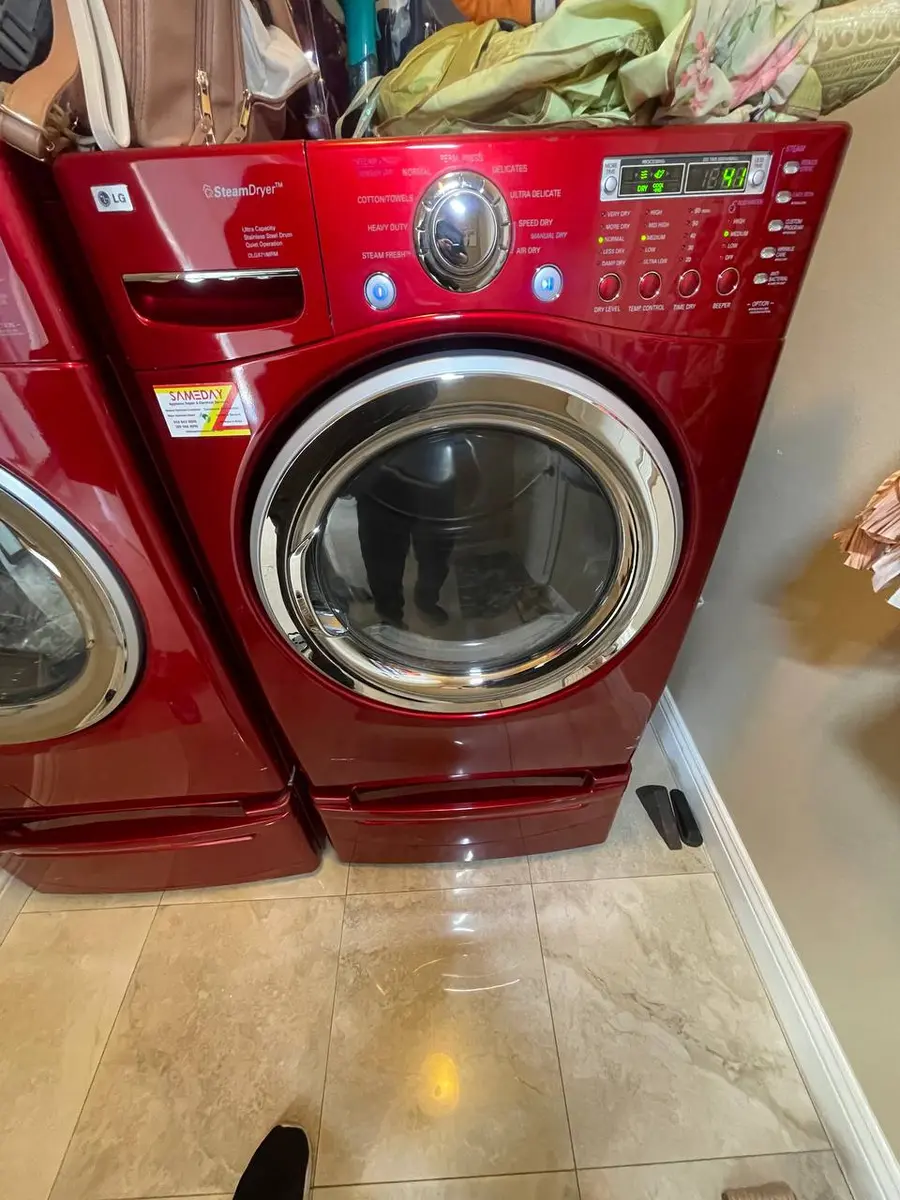
Cycle not completing has a handful of usual causes on LG dryers. This guide ranks them by likelihood so you can narrow it down fast instead of swapping parts at random.
Quick diagnosis#
Most likely: restricted exhaust vent. The number one cause of LG dryer cycle problems. LG dryers with FlowSense technology actively monitor exhaust duct resistance. If that checks out, look next at moisture sensor bar contamination.
Do You Have the Right Tools?
Gas leak detector ($130), thermal fuse tester ($95), belt tension gauge, and vent inspection camera ($180). Our technician arrives with $3,000+ in professional tools — your diagnostic is free.
Licensed & Insured · 90-Day Warranty · Same-Day Service
The usual suspects#
The table below ranks what typically drives this, with the tell for each:
| Likely cause | How common | What you'll notice / what to check |
|---|---|---|
| Restricted Exhaust Vent | 35% of cases | The number one cause of LG dryer cycle problems. |
| Moisture Sensor Bar Contamination | 25% of cases | The two metal sensor bars inside the LG dryer drum become coated with fabric softener deposits, dryer sheet… |
| Heating Element or Gas Igniter Failure | 15% of cases | If the heat source quits mid-cycle (element burns out, gas igniter weakens below valve threshold, or thermal fuse… |
| Thermistor/Temperature Sensor Failure | 15% of cases | LG dryers use an NTC thermistor to monitor drum outlet temperature. |
| Control Board Logic Failure | 10% of cases | The main control board processes sensor data, thermistor input, and FlowSense data to determine cycle progression. |
Checks you can do first#
Work these from most to least likely so you do not chase a rare fault first.
1. Restricted Exhaust Vent (35% of cases)#
Under the hood, the number one cause of LG dryer cycle problems. LG dryers with FlowSense technology actively monitor exhaust duct resistance. When the duct is partially blocked (lint buildup, crushed vent hose, bird nest in exterior cap), the dryer's moisture sensing gets unreliable as humid air cannot escape the drum efficiently. Pull and clean the filter; a clogged one chokes airflow and is the first thing to rule out.
2. Moisture Sensor Bar Contamination (25% of cases)#
The two metal sensor bars inside the LG dryer drum become coated with fabric softener deposits, dryer sheet waxy buildup, and lint film. This insulating layer prevents the bars from accurately detecting moisture in the clothing. The control board receives a "dry" signal even though clothes are still wet, terminating the cycle early. A drifted sensor reports the wrong value to the board, so compare its resistance to the service spec before replacing.
3. Heating Element or Gas Igniter Failure (15% of cases)#
Put simply, if the heat source quits mid-cycle (element burns out, gas igniter weakens below valve threshold, or thermal fuse trips), the dryer continues tumbling but without heat. On LG Sensor Dry models, the lack of temperature rise eventually sets off cycle termination since the control board's algorithm expects specific temperature-time curves. Without heat, the temperature curve doesn't match any valid drying profile. With power off, test the heating component for continuity; an open reading means no heat is being produced.
4. Thermistor/Temperature Sensor Failure (15% of cases)#
The Sensor Dry algorithm relies on temperature data to determine drying progress. If the thermistor reads incorrectly (drifted from spec), the control board misinterprets the drying status and terminates cycles at wrong times. LG dryers use an NTC thermistor to monitor drum outlet temperature. A drifted sensor reports the wrong value to the board, so compare its resistance to the service spec before replacing.
5. Control Board Logic Failure (10% of cases)#
In practice, the main control board processes sensor data, thermistor input, and FlowSense data to determine cycle progression. If the board's logic gives out (corrupted firmware, compromised component), cycle timing turns erratic — either ending too early or running indefinitely. Symptoms: Random cycle lengths for the same settings, no error codes, Timed Dry works correctly but Sensor Dry is erratic, or all automatic cycles terminate at the same wrong time regardless of load. Try a hard reset first — unplug for a minute — then look for scorched spots or swollen parts on the board.
Safety First — Know the Risks
Gas dryers carry carbon monoxide and explosion risk. Even electric dryers involve 240V circuits that can deliver a fatal shock. Our techs are licensed and insured — let them handle the risk.
Licensed & Insured · 90-Day Warranty · Same-Day Service
Recap before you start#
Boiled down, check these in sequence:
- Restricted Exhaust Vent — 35% of the time; clear the filter and vent path fully — restricted airflow drives many of these symptoms.
- Moisture Sensor Bar Contamination — 25% of the time; unplug and measure the sensor’s resistance against spec.
- Heating Element or Gas Igniter Failure — 15% of the time; check the element or igniter for visible damage and continuity before replacing it.
- Thermistor/Temperature Sensor Failure — 15% of the time; unplug and measure the sensor’s resistance against spec.
- Control Board Logic Failure — 10% of the time; reseat the board’s connectors and inspect for burned relays.
What fixing it usually involves#
Once the cause is confirmed, the fix is usually straightforward for a tech — access the part, replace it, and test under a real cycle before closing up. Because restricted exhaust vent tops the list, that is often the first thing pulled and checked.
The Real Cost of DIY
Average DIY attempt: $150-400 in tools you may use once, plus the risk of further damage. Our diagnostic visit costs $0 — we find the problem and give you an honest quote.
Licensed & Insured · 90-Day Warranty · Same-Day Service
Keeping it from coming back#
A little routine care goes a long way: keep the dryer clean, level, and free of buildup, and this symptom is far less likely to return.
When professional service makes sense#
Call a technician if the symptom persists after the checks above, if the repair means reaching power, gas, or sealed components, or if your LG dryer is still under warranty — DIY work can void it. Cost tracks the underlying part and the labor to reach it; an on-site diagnosis pins it down before you commit.
Rather not open it up yourself? Schedule an EasyBear visit for a grounded diagnosis and an up-front quote on your LG dryer.
Senior Appliance Repair Technician · 15 years experience
EPA-certified technician with 15 years of experience specializing in refrigerator and cooling system repairs.