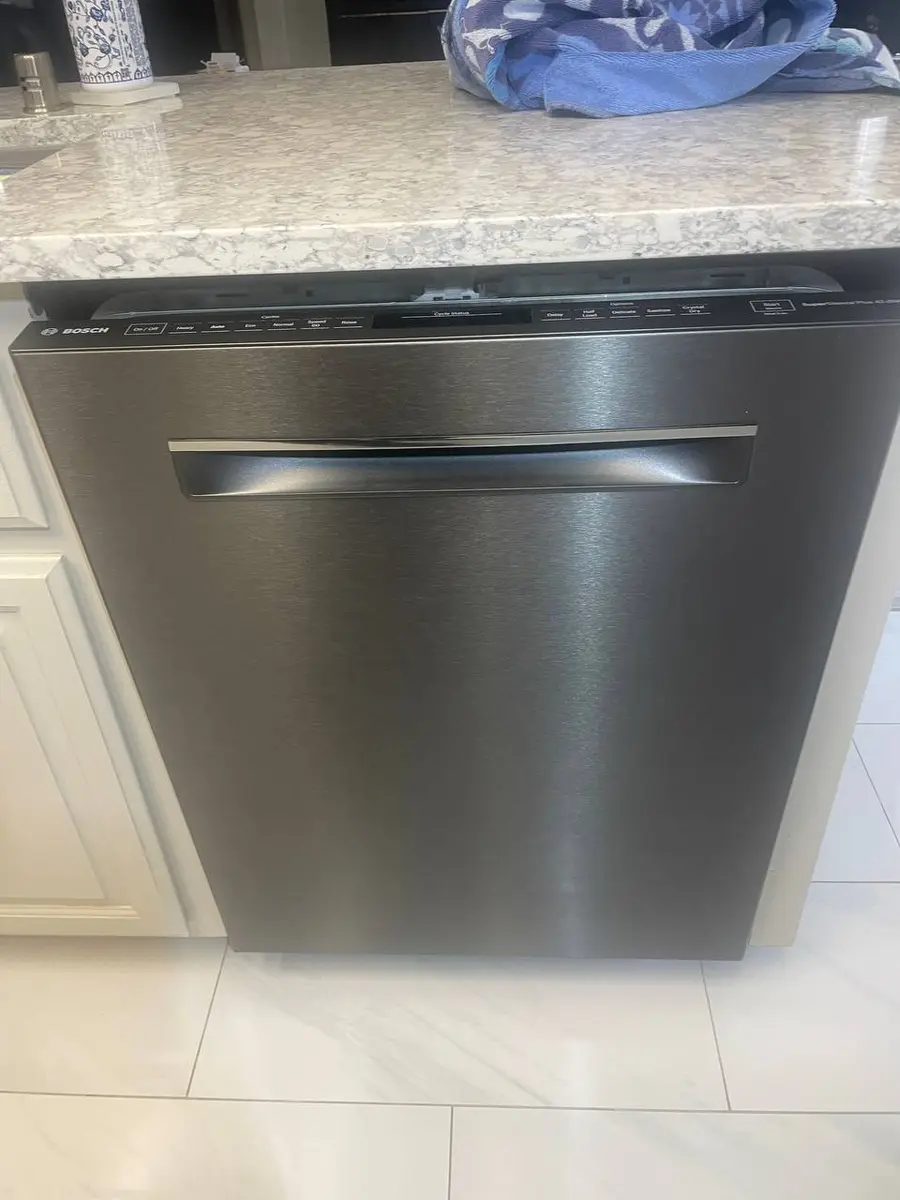
What is the KitchenAid Dishwasher F9E1 error?#
F9E1 on a KitchenAid dishwasher means drain time exceeded: the machine is draining, but far too slowly, so water lingers in the tub and the bottom rack comes out dirty from the backwash. The classic cause — and the first thing I check on any new installation — is a garbage-disposal knockout plug that was never punched out. That single oversight blocks the drain and it is the reason to look at the install before ever suspecting the pump.
F9E1 on a KitchenAid Dishwasher: likely causes and repair cost#
On a KitchenAid Dishwasher, the F9E1 code signals: drain time exceeded.
| Likely cause | Typical likelihood |
|---|---|
| Kinked drain hose | Most common |
| Disposal knockout not removed | Common |
| High loop not installed | Less common |
| Weak drain pump | Occasional |
Typical professional repair: $75–$225 · Difficulty: moderate · often owner-fixable
Fastest thing to try first: Check drain path.
Symptoms that often accompany F9E1: Water drains very slowly; Standing water remains after cycle; Gurgling from drain area; Bottom rack dishes not clean from dirty backwash
Technician diagnostic sequence for F9E1:
- Check the drain hose under the sink for kinks at the garbage disposal connection
- Verify the garbage disposal knockout plug was punched out during installation
- Ensure the drain hose has a proper high loop or air gap to prevent backflow
- Clean the drain filter inside the tub and inspect the sump area
Parts a technician may check or replace: Drain Pump; Drain Hose Kit
Field note: The most common cause of F9E1 on KitchenAid dishwashers is the garbage disposal knockout plug. When a new disposal is installed, the drain inlet plug must be removed. If forgotten, water backs up into the dishwasher. Always check this first before diagnosing the pump.
Do You Have the Right Tools?
Water pressure gauge ($60), spray arm tester, float switch multimeter ($85), and drain inspection camera. Our technician arrives with $3,000+ in professional tools — your diagnostic is free.
Licensed & Insured · 90-Day Warranty · Same-Day Service
How to troubleshoot the F9E1 error yourself#
Start under the sink. Follow the dishwasher drain hose to the garbage disposal and check that the knockout plug was removed when the disposal went in — if a new disposal was installed and the plug is still in place, water has nowhere to go and F9E1 is guaranteed. Next, look for kinks in the drain hose, which is the most common cause in the table above, and confirm the hose has a proper high loop or air gap so drained water cannot flow back in. Finally, clean the drain filter inside the tub and check the sump. These are all safe homeowner checks. If the hose is clear, the knockout is out, the high loop is correct, and it still drains slowly, the drain pump is weak and a technician should test it.
Is the KitchenAid Dishwasher F9E1 error worth fixing?#
More often than not F9E1 is an installation fix — a knockout plug or a kinked hose — and costs nothing in parts. Even when a weak pump is the real cause, the professional repair range in the table above sits well below a new KitchenAid. This is never a replace-the-machine fault on its own. Sort the drain path first, replace the pump only if it is genuinely tired, and keep the dishwasher running.
Safety First — Know the Risks
Live 120V wiring in a wet environment is one of the most dangerous DIY scenarios. Water + electricity = serious shock risk. Our techs are licensed and insured — let them handle the risk.
Licensed & Insured · 90-Day Warranty · Same-Day Service
KitchenAid Dishwasher F9E1: frequently asked questions#
What does the F9E1 error mean on a KitchenAid Dishwasher?#
It means drain time exceeded — the water is draining too slowly, so it stands in the tub and the lower dishes are left dirty by the backwash.
Is it safe to keep using a KitchenAid Dishwasher that shows the F9E1 error?#
There is no hazard, but standing dirty water and poor rinsing make it unpleasant and ineffective. Clear the drain path before running it again.
Can I clear the F9E1 error myself, or do I need a technician?#
Usually yes — check the disposal knockout, unkink the hose, confirm the high loop, and clean the filter. Only a genuinely weak pump needs a technician.
How much does it cost to repair the F9E1 error on a KitchenAid Dishwasher?#
Often free if it is the knockout or a kink. A pump replacement falls in the professional repair range shown in the table above.
Which parts usually fail when a dishwasher throws the F9E1 code?#
Frequently no part — a kinked hose or a disposal knockout plug left in place. A missing high loop or a weak drain pump round out the list.
Is a KitchenAid Dishwasher with the F9E1 error worth repairing?#
Yes — it is usually a free installation fix, and even a pump swap is cheap next to a new machine, so repair is the clear choice.
Why does kinked drain hose trigger the F9E1 error?#
A kink throttles the outflow, so the tub empties too slowly. The board times the drain, sees it run long, and posts F9E1.
Lead Appliance Repair Technician · 12 years experience
Experienced technician with 12 years specializing in washing machine and dryer repairs across all major brands.