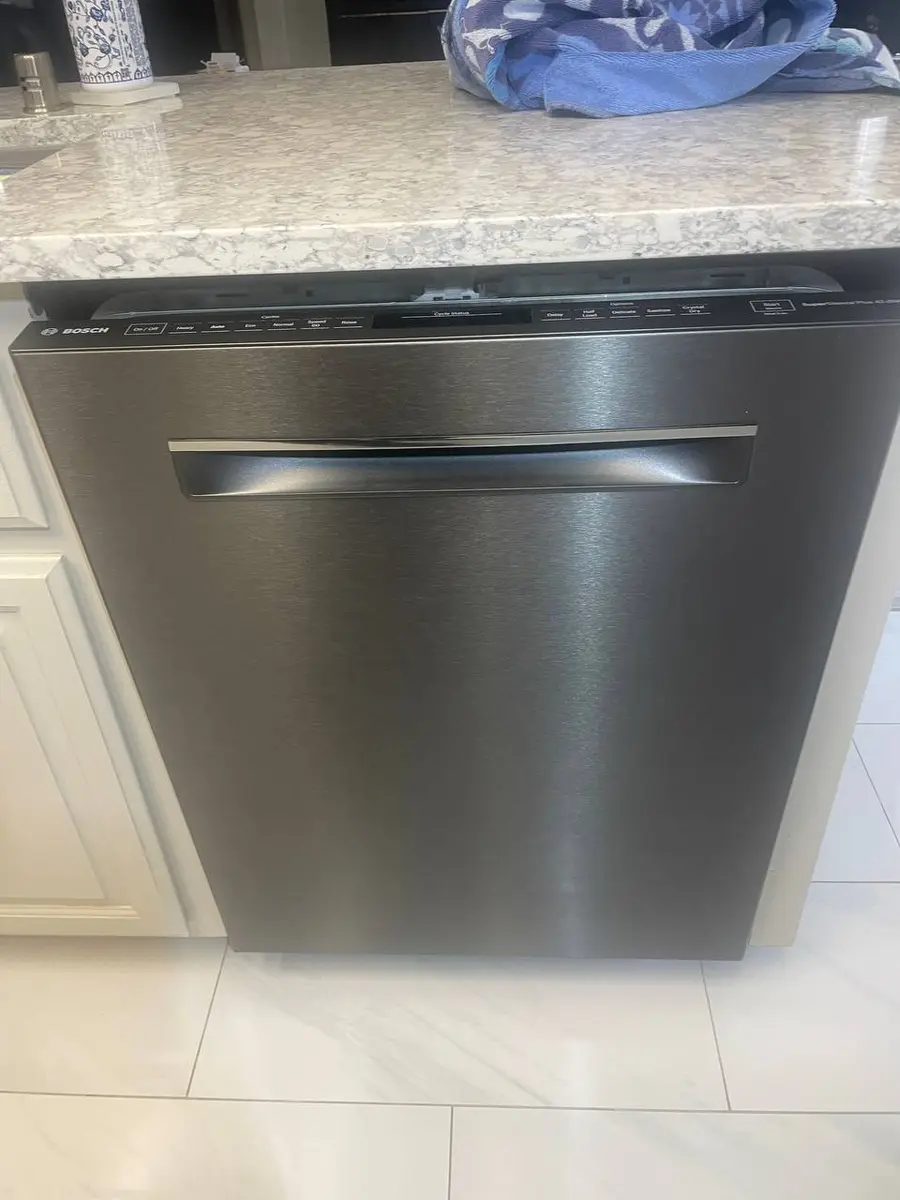
What is the KitchenAid Dishwasher F8E4 error?#
F8E4 on a KitchenAid dishwasher is a drain-pump fault: water is not leaving the tub, so you find standing water after a cycle and often a foul smell with it. The code names the pump, but the pump is not usually what is wrong — a clogged drain filter is the most common cause behind it, and it is something you clear yourself in a few minutes with the lower rack out.
What this page is really for is the next step. Once the filter and the sump are clean and F8E4 comes back, you need to know whether you are looking at a jammed impeller, a dead motor, or a blockage further down the line — and those are three different repairs at three different prices. You do not need a meter to tell them apart. You need to stand next to the machine during the drain phase and listen, because a KitchenAid drain pump sounds completely different in each of those three states.
F8E4 after the filter: what the drain phase sounds like#
Run a cycle with the room quiet and stand beside the machine when it reaches the drain. Sound is the whole test here, and it separates three faults that all present as standing water.
| What you hear during the drain phase | What it points at | What it rules out |
|---|---|---|
| A steady hum, and no water moving at all | The impeller is jammed or broken — the motor is turning against something | A dead motor; something is plainly being driven |
| Complete silence where the pump should run | The pump motor is not being driven — a failure on the electrical side | Every blockage; nothing has tried to move |
| The pump runs, water audibly moves, and the tub is still part-full at the end | A restriction past the pump: the check valve, the drain hose, or the disposal connection | The pump itself, which is doing its job |
| A short run, a pause, then another attempt, repeated | The control is aborting the drain — a partial blockage or a sensing problem | A clean mechanical failure; a dead pump does not retry |
| Grinding or rattling as the pump spins up | Hard debris loose in the sump — glass is the classic on the KDTM and KDTE series | A soft clog; lint and food do not rattle |
| Normal sound, and the tub empties once you have bailed it and cleaned the filter | The filter was the entire fault | Everything below it in the drain path |
Rows one and five are worth a torch in the sump before anyone is called. Row two is the only one on this list that is a pump replacement by itself.
Where these rows come from: the four steps of this page's own diagnostic sequence — filter removal, filter cleaning, sump inspection, and the silence-means-a-dead-motor test — plus the field note's split between a humming pump and a silent one, and its warning about glass on the KDTM and KDTE series. They are keyed on sound because sound is what a homeowner has and a meter is not. The likelihood words in the table above rank the causes rather than measure them, and no row here states a share.
Do You Have the Right Tools?
Water pressure gauge ($60), spray arm tester, float switch multimeter ($85), and drain inspection camera. Our technician arrives with $3,000+ in professional tools — your diagnostic is free.
Licensed & Insured · 90-Day Warranty · Same-Day Service
F8E4 on a KitchenAid Dishwasher: likely causes and repair cost#
On a KitchenAid Dishwasher, the F8E4 code signals: drain pump fault.
| Likely cause | Typical likelihood |
|---|---|
| Drain filter clogged | Most common |
| Drain pump impeller blocked | Common |
| Pump motor failed | Less common |
| Check valve stuck | Occasional |
Typical professional repair: $100–$250 · Difficulty: moderate · often owner-fixable
Fastest thing to try first: Clean drain filter and check sump.
Symptoms that often accompany F8E4: Standing water in tub after cycle; Dirty water backs up during wash; Foul odor from dishwasher; Drain pump runs but water remains
Technician diagnostic sequence for F8E4:
- Remove the lower rack and spray arm to access the drain filter
- Twist the filter counterclockwise to remove, then clean all debris thoroughly
- Check the sump below the filter for broken glass, food labels, or foreign objects
- If the pump is silent during drain cycle, the motor has failed and needs replacement
Parts a technician may check or replace: Drain Pump Motor; Drain Hose Kit
Field note: On KitchenAid models, a humming pump with no water flow means the impeller is jammed or broken. Complete silence means the pump motor has failed. Check for broken glass in the sump — it wedges between the impeller and housing on KitchenAid KDTM and KDTE series.
How to troubleshoot the F8E4 error yourself#
Start by getting the standing water out of the way: bail the tub down with a cup and a sponge so you can see what you are doing and so the filter comes out without flooding the floor. Then pull the lower rack, lift off the spray arm, and twist the filter counter-clockwise to release it. Wash it properly under a tap — the fine mesh holds a grey film that looks like nothing and restricts a great deal.
With the filter out, put a torch into the sump underneath it. What you are hunting for is small and hard: a chip of glass, a soaked bottle label, a fruit sticker, a fragment of bone. Those are the objects that reach the impeller and wedge against the housing, and on the KDTM and KDTE series glass in particular is a known offender.
Then refit everything, start a cycle, and let it reach the drain phase with the room quiet. This is the actual diagnostic. A pump that hums steadily while nothing moves is turning against a jam or turning a broken impeller. A pump that makes no sound at all is not being driven, which is a motor or a supply problem rather than a blockage. And a pump that runs, moves water, and still leaves the tub part-full is being defeated somewhere past its own outlet. Clearing an impeller is within reach on some models; a silent pump is a technician's replacement.
Safety First — Know the Risks
Live 120V wiring in a wet environment is one of the most dangerous DIY scenarios. Water + electricity = serious shock risk. Our techs are licensed and insured — let them handle the risk.
Licensed & Insured · 90-Day Warranty · Same-Day Service
Is the KitchenAid Dishwasher F8E4 error worth fixing?#
Most F8E4 calls never become a bill at all: the filter and sump clean-out is free, and it accounts for the largest share of the cases in the table above. When it does come to a part, a professional drain-pump repair runs $100 to $250, which is a small fraction of what a KitchenAid dishwasher costs to replace, and a drain fault is not a reason to retire a machine that washes properly.
The distinction worth drawing before you spend is between a pump that is blocked and a pump that is worn. A jammed impeller cleared once tends to stay cleared, especially if the glass that caused it is gone. A motor that has failed on an older machine is often accompanied by other tired parts, and that is the only situation where the arithmetic starts favouring replacement — not because the repair is expensive, but because it is unlikely to be the last one. On a sound unit, clean the filter, listen to the drain, replace the pump if it is genuinely silent, and keep the dishwasher.
KitchenAid Dishwasher F8E4: frequently asked questions#
What does the F8E4 error mean on a KitchenAid Dishwasher?#
It is a drain-pump fault — water is not being pumped out, leaving standing water in the tub and often an odor from stagnant water.
Is it safe to keep using a KitchenAid Dishwasher that shows the F8E4 error?#
Not really, though the risk is water rather than anything electrical. The tub is holding dirty water it could not pump out, and running another cycle adds a fresh fill on top of it, which is how a stalled drain becomes a floor to mop. Bail it out, clear the filter and sump, and only then run it again.
Can I clear the F8E4 error myself, or do I need a technician?#
Yes for the common case — remove and clean the drain filter and check the sump for glass. If the pump motor is silent and dead, a technician should replace it.
How much does it cost to repair the F8E4 error on a KitchenAid Dishwasher?#
Often free if it is just the filter. A pump replacement falls in the professional repair range shown in the table above.
Which parts usually fail when a dishwasher throws the F8E4 code?#
The drain filter leads by a wide margin and is not a failure at all, only a clean-out. Behind it come a blocked or broken pump impeller, a pump motor that has stopped being driven, and a check valve that has stuck. The sound of the drain phase sorts those three faster than any inspection does: a hum with no water, silence, and normal running that still leaves the tub full each point somewhere different.
Is a KitchenAid Dishwasher with the F8E4 error worth repairing?#
Yes — most cases are a simple filter clean, and even a pump swap costs far less than a new machine. Replacement only makes sense on an old, multi-fault unit.
Why does drain filter clogged trigger the F8E4 error?#
A blocked filter starves the pump of flow, so the board never sees the water level drop in time. It reads the drain as failed and posts F8E4.
Can I keep using the dishwasher while I wait for a pump to arrive?#
Not usefully, and not without a mop. The tub is holding water it could not pump out, and starting another cycle adds a fresh fill on top of standing water — which is how a drain fault becomes a puddle on the kitchen floor. If you have to leave it for a few days, bail the tub down with a cup and a sponge, take out the filter and let the sump dry, and prop the door slightly open. The smell that people associate with this code is stagnant water rather than anything mechanical, and an empty tub does not develop one.
The Real Cost of DIY
Average DIY attempt: $150-400 in tools you may use once, plus the risk of further damage. Our diagnostic visit costs $0 — we find the problem and give you an honest quote.
Licensed & Insured · 90-Day Warranty · Same-Day Service
Why glass in particular, and how it gets past the filter#
The field note on this fault singles out broken glass rather than food, and it is worth understanding why, because it changes how you look in the sump.
A chip off a wine glass or a tumbler is thin, hard and edge-on. Lint mats and food softens, and both are caught by mesh that a sliver of glass passes straight through — it arrives at the filter side-on and slides between the mesh like a card through a slot. Once through, it reaches the impeller chamber, where it is not soft enough to be chewed and not light enough to be flushed on. It wedges between a blade tip and the housing wall and the pump stalls against it.
That is also why this fault so often follows a specific incident by a load or two rather than immediately. The glass goes through with one wash, sits in the sump through another, and reaches the impeller when a spray-arm surge finally moves it.
So when you look, look for something small, bright and edge-on rather than for a clog. A torch held at a low angle across the sump picks up glass far better than one held straight down, because the edge catches the light. Fish anything you find out with needle-nose pliers rather than fingers.
And if a glass has broken in the machine in recent weeks, take the filter out and check the sump even on a dishwasher that is currently working. A sliver that has not yet reached the impeller is a two-minute job; the same sliver after it arrives is this whole page.
Senior Gas Appliance Specialist · 18 years experience
AGA-certified gas appliance specialist with 18 years of experience in residential and commercial oven, range, and cooktop repairs.