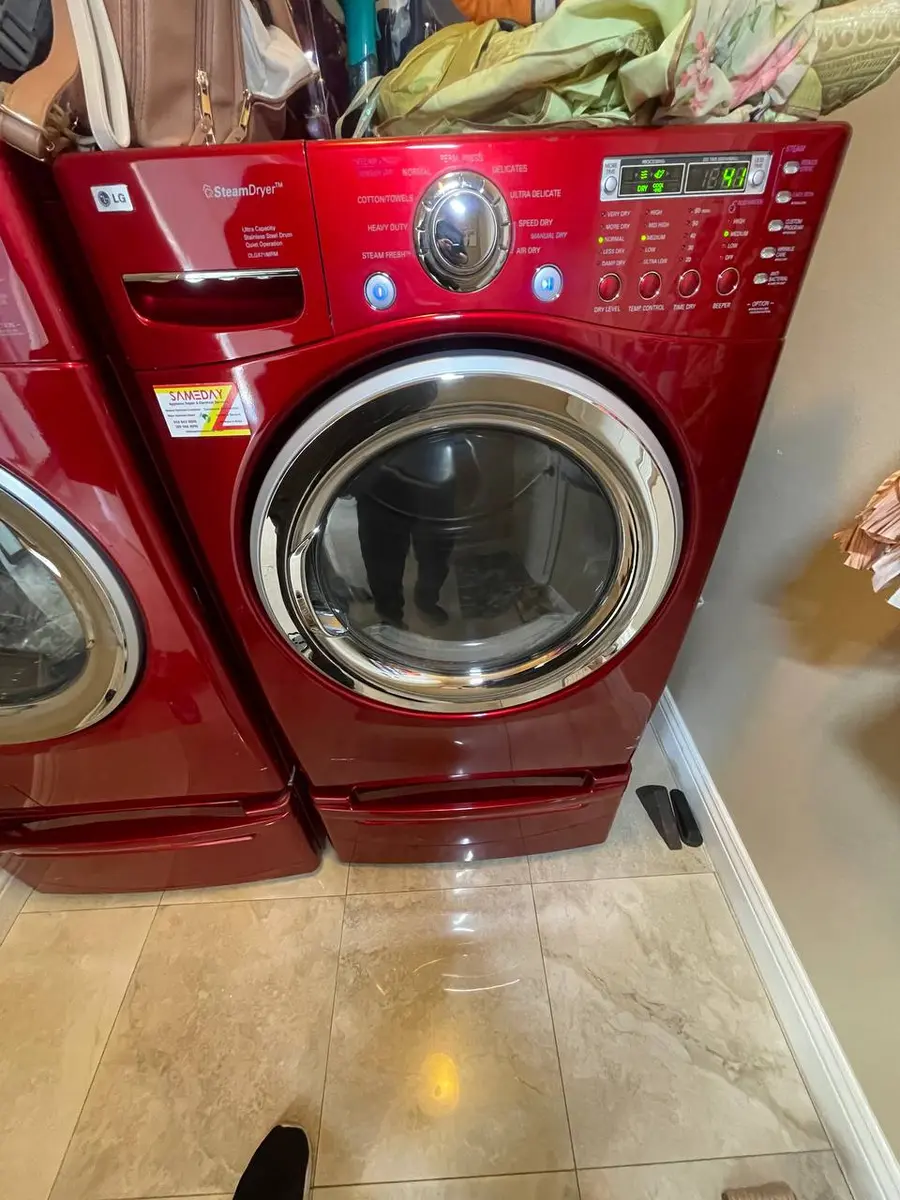
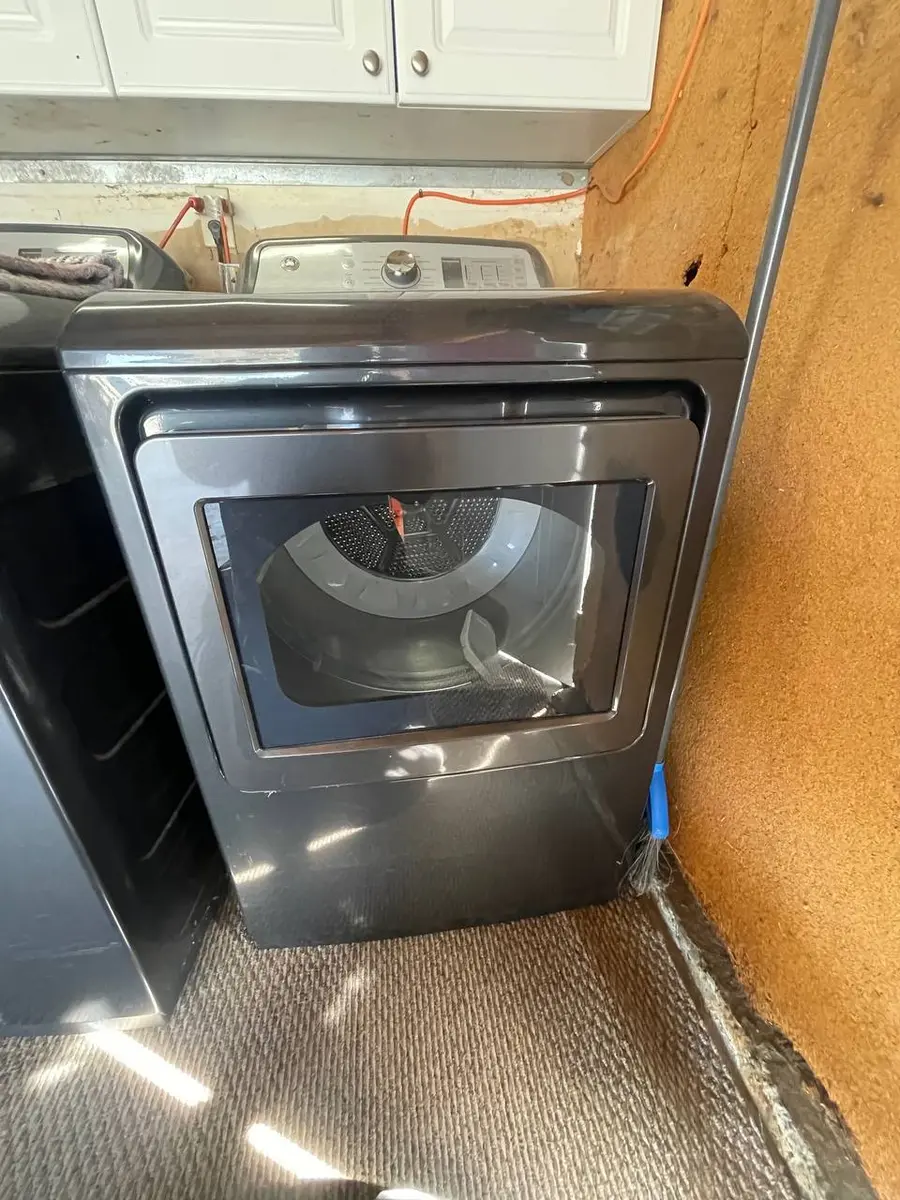
Kenmore Dryer Not Heating — Troubleshooting Guide
A Kenmore dryer that tumbles but produces no heat is the single most common dryer complaint we see from Sacramento-area homeowners. Because Kenmore dryers are manufactured by Whirlpool (model prefix 110), Electrolux (prefix 417), LG (prefix 796), or Samsung (prefix 402), the heating system architecture and failure points differ by platform. Diagnosing correctly requires knowing which company actually built your machine.
Decode Your Kenmore Dryer Manufacturer
Locate the model number on the sticker inside the door frame or on the back panel. The first three digits identify the manufacturer:
- 110.xxxxx — Whirlpool-built (by far the most common Kenmore dryer, uses a coil heating element in a can-style housing)
- 417.xxxxx — Electrolux/Frigidaire-built (uses a nichrome coil element in an open-frame housing)
- 796.xxxxx — LG-built (uses a duct-style element, less common in dryers than washers)
- 402.xxxxx — Samsung-built (uses a radiant element assembly)
The Whirlpool 110-series constitutes roughly 70% of Kenmore dryers still in service, so this guide emphasizes that platform while covering the alternatives.
Do You Have the Right Tools?
Gas leak detector ($130), thermal fuse tester ($95), belt tension gauge, and vent inspection camera ($180). Our technician arrives with $15K+ in professional tools — your diagnostic is free.
Licensed & Insured · 90-Day Warranty · Same-Day Service
Safety First — Dryer-Specific Hazards
- Electric dryers (240V): Unplug from the 30-amp outlet OR turn off BOTH breakers in the panel. A 240V dryer uses two 120V legs — turning off only one breaker still leaves lethal voltage present.
- Gas dryers: Shut off the gas valve behind the dryer (quarter-turn valve perpendicular to the pipe = off). If you smell gas at any point, evacuate and call your gas utility.
- Never bypass thermal fuses or thermostats — they exist to prevent house fires. A blown thermal fuse means your vent system has a problem that must also be fixed.
- 110-series Kenmore dryers have the heating element on the right-rear in a cylindrical can. Do not reach in without confirming power is disconnected — the element terminals carry 240V.
Most Common Causes (Ranked by Likelihood)
1. Thermal Fuse Blown — All Platforms (30% of cases)
The thermal fuse is a one-time safety device that permanently breaks the heating circuit if exhaust temperature exceeds a safe threshold (typically 250-300°F). Once blown, it cannot reset — the dryer tumbles but produces zero heat. This is by far the most common no-heat cause across all Kenmore dryer platforms.
Critical Kenmore-specific detail: On 110-series (Whirlpool-built) dryers, the thermal fuse is located on the blower housing at the rear-right of the machine. On 417-series (Electrolux-built) dryers, it is mounted on the heating element housing itself. Location matters because accessing the fuse requires different disassembly paths.
Root cause warning: A blown thermal fuse is always a symptom of excessive exhaust temperature. Before simply replacing the fuse, check your dryer vent for blockage. Sacramento homes with dryer vents running through the attic are especially prone to lint accumulation in the longer duct runs.
DIY Difficulty: Easy Parts Cost: $5–$15 Professional Repair Cost: $100–$180 (includes vent inspection)
Repair Steps (110-series Whirlpool platform):
- Unplug the dryer from the 240V outlet.
- Pull the dryer away from the wall and remove the rear panel (6 screws on most 110-series models).
- Locate the thermal fuse on the blower housing — it is a small white or gray plastic component with two wire terminals, approximately 1.5 inches long.
- Disconnect both wires from the fuse terminals (note or photograph which wire goes where).
- Test with a multimeter set to continuity: a good fuse reads near-zero ohms; a blown fuse reads open (OL).
- If blown, remove the single mounting screw and install the new fuse (Whirlpool part 3392519).
- Reconnect wires, reinstall rear panel.
- Before restoring power — disconnect and inspect the entire dryer vent duct from the dryer to the exterior wall cap. Remove all lint buildup.
- Plug in and test with a timed dry cycle.
2. Heating Element Burned Out — 110 & 417 Series (25% of cases)
Electric Kenmore dryers use a resistive heating element — essentially a nichrome wire coil that glows red-hot when current flows through it. Elements have a finite lifespan (typically 8-15 years) and eventually break from thermal fatigue.
110-series (Whirlpool-built): The element is housed in a cylindrical metal can (part 279838 for most models) located at the rear-right. The can slides out once you remove the rear panel and disconnect two wires.
417-series (Electrolux-built): The element is in an open rectangular frame (part 5300622034) mounted behind the drum. You must remove the front panel and drum to access it.
How to confirm: With the dryer unplugged, disconnect one wire from the element and test continuity across the element terminals. Infinite resistance (OL) = the coil has broken and the element must be replaced.
DIY Difficulty: Moderate (110-series is easier due to rear access; 417-series requires more disassembly) Parts Cost: $25–$65 Professional Repair Cost: $150–$300
Repair Steps (110-series):
- Unplug the dryer and remove the rear access panel.
- Locate the element housing — cylindrical metal can on the right side.
- Disconnect the two wires from the element terminals (pull straight off the spade connectors).
- Remove the single screw at the bottom of the element housing.
- Slide the element can straight out of its mounting bracket.
- Install the new element (verify correct wattage for your specific model — typically 4400W or 5400W).
- Reconnect wires, reinstall rear panel, and run a heat test.
3. Gas Valve Solenoid Coils — 110-Series Gas Dryers (15% of gas dryer cases)
Kenmore gas dryers (almost all are 110-series built by Whirlpool) use two or three solenoid coils mounted on the gas valve to control gas flow. These coils develop intermittent failures: the dryer heats initially, then the coils cannot hold open and the flame dies. The dryer may restart heating if you let it rest and try again — this intermittent pattern is the hallmark of failing gas valve coils.
Kenmore-specific note: Whirlpool uses the same gas valve coil set (part 279834) across nearly all their dryer platforms from 1995 to present. If you have a Kenmore gas dryer with prefix 110, this is the correct part regardless of specific model.
DIY Difficulty: Moderate Parts Cost: $15–$35 (coil set) Professional Repair Cost: $130–$230
Repair Steps:
- Unplug the dryer and shut off the gas supply valve.
- Remove the lower front panel (two screws at the bottom on most 110-series gas dryers).
- Locate the gas valve assembly — it is at the lower-front with the gas supply line connected.
- The solenoid coils are the cylindrical components mounted on top of the valve body.
- Disconnect the wire harness from each coil.
- Pull each coil straight off the valve body (they are held by friction and a retaining clip).
- Install the new coils, reconnect the wire harness.
- Reinstall the lower panel, turn on gas, plug in, and run a heat cycle.
- Verify the flame ignites and stays lit for the entire cycle without cycling off prematurely.
4. High-Limit Thermostat — All Platforms (10% of cases)
The high-limit thermostat is a cycling safety device that opens the heating circuit if the internal temperature exceeds a set point. Unlike the thermal fuse (which is one-time), the thermostat is designed to reset. However, after many cycles of tripping and resetting (from a partially blocked vent), the thermostat's bimetallic disc fatigues and fails in the open position permanently.
110-series location: On the element housing can, adjacent to the thermal fuse. 417-series location: On the element frame bracket.
DIY Difficulty: Easy (same access as thermal fuse) Parts Cost: $10–$25 Professional Repair Cost: $100–$180
5. Igniter Failure — Gas Dryers (8% of gas dryer cases)
Gas Kenmore dryers use a flat silicon carbide igniter (glow bar) that must reach approximately 2,500°F to trigger the gas valve. The igniter is fragile and cracks from thermal cycling. When it fails, the gas valve never opens because the igniter never reaches the threshold resistance that signals the control to energize the gas valve coils.
How to confirm: Watch through the lower front panel opening. When you start the dryer, the igniter should glow bright orange within 30-60 seconds. If it glows dimly or not at all, it needs replacement. If it glows brightly but gas never ignites, the problem is the gas valve coils (see #3 above).
DIY Difficulty: Moderate Parts Cost: $20–$50 Professional Repair Cost: $120–$220
6. Cycling Thermostat — All Platforms (5% of cases)
The cycling thermostat regulates normal operating temperature by cycling the element or gas valve on and off. If it sticks in the open position, the dryer gets no heat. If it sticks closed, the dryer overheats (which then blows the thermal fuse or high-limit thermostat, circling back to cause #1).
DIY Difficulty: Easy Parts Cost: $10–$20 Professional Repair Cost: $100–$160
7. Broken Wire or Corroded Connection (4% of cases)
On older Kenmore dryers (15+ years), the high-current connections at the heating element or terminal block corrode from heat cycling. The 240V terminal block at the rear of the dryer is especially prone to arcing damage on 110-series models where the plug connection has been loose over the years. Visible blackening or melted plastic around terminals indicates this failure.
DIY Difficulty: Moderate to Advanced (wire repair and terminal replacement) Parts Cost: $10–$30 Professional Repair Cost: $120–$200
8. Control Board (Timer) — All Platforms (3% of cases)
On mechanical-timer Kenmore dryers (most 110-series), the timer contacts that energize the heating circuit can burn out from years of arcing. The dryer tumbles for the entire cycle but the element never receives power. Test by listening for the element relay click when you advance the timer through its positions. On electronic-control models (most 796 and newer 417-series), the relay on the main control board can fail.
DIY Difficulty: Moderate Parts Cost: $40–$120 (timer) or $100–$250 (electronic board) Professional Repair Cost: $180–$380
Safety First — Know the Risks
Gas dryers carry carbon monoxide and explosion risk. Even electric dryers involve 240V circuits that can deliver a fatal shock. Our techs are licensed and insured — let them handle the risk.
Licensed & Insured · 90-Day Warranty · Same-Day Service
The Vent Problem Behind Most Kenmore Dryer No-Heat Calls
In our experience, 60-70% of Kenmore dryer no-heat service calls trace back to a vent restriction that caused the thermal fuse to blow. Sacramento homes with the following configurations are at highest risk:
- Dryer vent runs through the attic (long runs + heat expansion loosens joints → lint escapes and accumulates)
- Flex vent material (ribbed surface traps lint far more than smooth rigid duct)
- Vent termination with a screening/cage (intended to keep birds out, but traps lint)
- Dryer vents exceeding 25 feet equivalent length without a booster fan
When you replace a thermal fuse, always inspect and clean the entire vent run. Otherwise the new fuse will blow within weeks.
Kenmore-Specific Parts Cross-Reference
| Component | Kenmore Label Price | OEM Part Number | OEM Price | Savings |
|---|---|---|---|---|
| Thermal Fuse (110) | $25–$35 | Whirlpool 3392519 | $5–$12 | 60-70% |
| Heating Element (110) | $80–$120 | Whirlpool 279838 | $25–$50 | 50-65% |
| Gas Valve Coils (110) | $45–$60 | Whirlpool 279834 | $15–$30 | 50-60% |
| Heating Element (417) | $90–$130 | Frigidaire 5300622034 | $35–$65 | 50-60% |
Same-Day Appliance Repair
Fixed or It's Free
$89 → $0 Service Call & Diagnosis — offer ends May 25
The Real Cost of DIY
Average DIY attempt: $150-400 in tools you may use once, plus the risk of further damage. Our diagnostic visit costs $0 — we find the problem and give you an honest quote.
Licensed & Insured · 90-Day Warranty · Same-Day Service
DIY vs Professional Repair
| Issue | DIY? | Parts Cost | Professional Cost |
|---|---|---|---|
| Thermal Fuse | Yes | $5–$15 | $100–$180 |
| Heating Element | Yes (110) / Moderate (417) | $25–$65 | $150–$300 |
| Gas Valve Coils | Moderate | $15–$35 | $130–$230 |
| High-Limit Thermostat | Yes | $10–$25 | $100–$180 |
| Igniter | Moderate | $20–$50 | $120–$220 |
| Cycling Thermostat | Yes | $10–$20 | $100–$160 |
| Wiring/Connections | Moderate | $10–$30 | $120–$200 |
| Timer/Control Board | Moderate | $40–$250 | $180–$380 |
Prevention Tips
- Clean the lint screen before every load — a clogged screen restricts airflow and raises exhaust temperature.
- Professionally clean the dryer vent duct annually — especially critical for Sacramento homes with attic-routed vents.
- Use rigid metal duct instead of flexible foil duct — the smooth interior reduces lint accumulation by 80%.
- Check the exterior vent flap quarterly to ensure it opens freely and has no bird nesting material.
- Do not over-dry loads — using moisture sensor settings instead of timed-dry reduces thermal cycling on the element.
Don't Void Your Warranty
Opening your appliance yourself may void the manufacturer warranty. Our repair comes with a 90-day guarantee, and we document everything for warranty compliance.
Licensed & Insured · 90-Day Warranty · Same-Day Service
FAQ
Q: My Kenmore dryer tumbles but has no heat at all — what is the most likely cause?
A blown thermal fuse (30% of cases). This is a $5-15 part that takes 15 minutes to replace on a 110-series Whirlpool-platform dryer. But always clean your vent before restoring to service — the restricted vent caused the fuse to blow in the first place.
Q: My gas Kenmore dryer heats for 10 minutes then stops — what is happening?
This intermittent pattern is the classic symptom of failing gas valve solenoid coils. They work when cold but lose holding force as they heat up. Replace the entire coil set (Whirlpool 279834, approximately $20).
Q: Can I use Whirlpool parts in my Kenmore 110-series dryer?
Yes — your Kenmore 110 dryer IS a Whirlpool dryer with a Kenmore badge. Whirlpool OEM parts are identical and typically 50-70% cheaper than Kenmore-labeled equivalents from Sears Parts Direct.
Q: Is it safe to run my Kenmore dryer without the thermal fuse?
Absolutely not. The thermal fuse prevents dryer fires. Running without it means a vent blockage can cause the exhaust to reach ignition temperature for lint (around 480°F). Dryer fires cause an estimated 2,900 house fires annually in the US.
Q: My Kenmore dryer model starts with 417 — how do I access the heating element?
Electrolux-platform (417) dryers require front-panel removal to access the element. Remove the lower kick panel, disconnect the door switch wires, remove the front panel screws (typically hidden under a trim piece), then the drum can be lifted out to expose the element frame behind it.
Kenmore dryer not heating? Our technicians carry thermal fuses, heating elements, and gas valve coils for all Kenmore platforms. We also perform full vent system inspection as part of every no-heat service call. Book same-day repair →