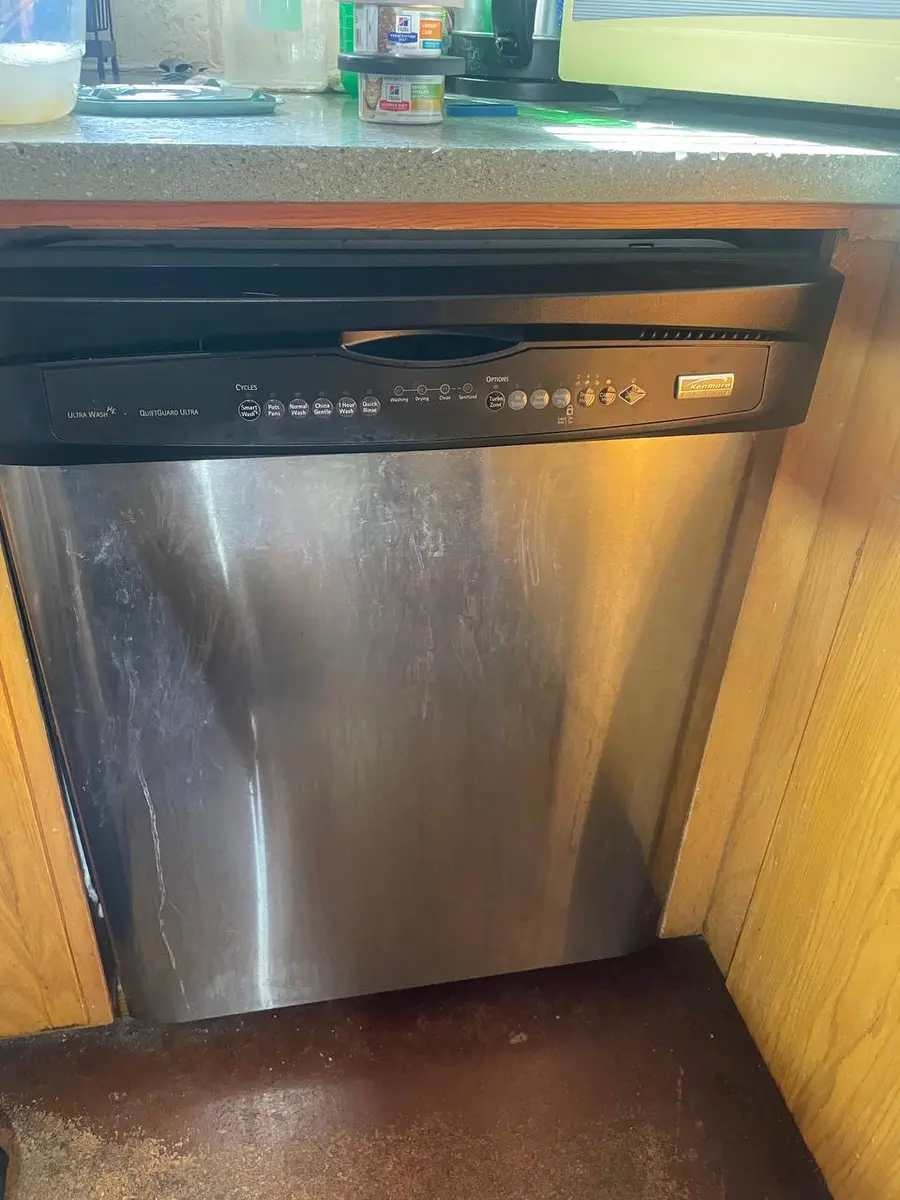
Why does my Kenmore dishwasher trip the circuit breaker?#
A Kenmore dishwasher that trips the breaker is telling you an electrical component is either leaking current to ground or drawing too much of it — most often the heating element on Whirlpool-built (665) models. This is the one dishwasher symptom worth treating as a safety issue: knowing the likely fault helps you describe it to a technician, but the repair itself is electrical work.
Kenmore dishwasher breaker trips: ranked causes#
Breakers trip two ways — an overcurrent, when a seized motor or shorted heater pulls more than the circuit's 15A or 20A rating, or a ground fault, when current leaks to the grounded tub and a GFCI breaker catches even a tiny 5mA leak. When the trip happens tells you a lot.
| Likely cause | Share | Tell-tale timing |
|---|---|---|
| Heating-element ground fault (Whirlpool 665 platform) | 40% | Trips during the heat or dry phase, 10 to 15 minutes in |
| Circulation-motor winding short | 25% | Trips right as the wash motor starts |
| Door / harness wiring damage (Kenmore adapter) | 15% | No cycle-phase pattern; trips when the door is shut firmly |
| Water reaching live connections | 10% | Started after some minor leaking; water stains inside the door |
| Control-board short | 10% | Trips instantly the moment you reset the breaker |
Safety first — this matters: do not repeatedly reset the breaker, because each trip arcs the contacts and weakens it; never swap in a higher-rated breaker to force it to hold, which is a fire hazard on the existing wire; and treat a breaker-tripping appliance as a job for a pro.
Do You Have the Right Tools?
Water pressure gauge ($60), spray arm tester, float switch multimeter ($85), and drain inspection camera. Our technician arrives with $3,000+ in professional tools — your diagnostic is free.
Licensed & Insured · 90-Day Warranty · Same-Day Service
How to narrow down a Kenmore dishwasher breaker trip#
You can safely gather clues before the technician arrives.
- Note exactly when it trips. Holding through fill and drain but tripping once the heater comes on points squarely at the heating element.
- To confirm the element, cut power, drop the kick panel, disconnect both element wires, and meter between each terminal and the tub frame. A good element reads infinite resistance to ground — any continuity means a ground fault and a new element.
- Tripping the instant the wash motor starts points at the circulation motor; a winding-to-frame short trips immediately.
- An immediate trip the moment you reset the breaker, before any cycle, means an always-energized short — usually the control board. Disconnect the board's main power harness; if the breaker then holds, the board is the fault.
- A trip with no cycle pattern, especially when the door is shut hard, points at chafed door-harness wiring grounding against the frame.
Element and harness work is moderate DIY for the electrically confident; motor and board faults are technician territory.
Is it worth repairing a Kenmore dishwasher that trips the breaker?#
Usually yes — a heating element or a wiring repair is a modest fix and restores safe operation. A circulation motor or control board is the pricier end, so on an older machine weigh it against replacement. Either way, don't keep resetting it in the meantime. For a same-day diagnosis, book a repair.
Safety First — Know the Risks
Live 120V wiring in a wet environment is one of the most dangerous DIY scenarios. Water + electricity = serious shock risk. Our techs are licensed and insured — let them handle the risk.
Licensed & Insured · 90-Day Warranty · Same-Day Service
Kenmore dishwasher tripping the breaker: frequently asked questions#
Is it safe to keep resetting the breaker?#
No. Every trip arcs the breaker's contacts and wears it out, and a weakened breaker may not trip on a more serious fault later. Leave it off and get the fault found.
Why does it only trip once the dishwasher heats up?#
That's the classic heating-element ground fault. As the element's insulation breaks down it leaks current to the grounded tub, and a GFCI breaker trips the moment the heater energizes, 10 to 15 minutes in.
Could it be the house wiring instead of the dishwasher?#
It can be. If the breaker still trips with the dishwasher's control board unplugged, the short is upstream in the house wiring or junction box, not the appliance — that's an electrician's call.
Appliance Repair Technician · 11 years experience
Experienced technician with 11 years specializing in Frigidaire and Electrolux refrigerator and dryer repair with a focus on safety.