How to Service a Bosch Dishwasher Circulation Pump (BSH 00442548)
The circulation pump is the heart of your Bosch dishwasher — it pressurizes water and forces it through the spray arms during wash and rinse cycles. When it weakens or fails, dishes come out dirty despite running full cycles, spray arms barely spin, or you hear unusual grinding/humming sounds during operation. On newer Bosch models (2014+), the circulation pump integrates with the flow-through heater in a single assembly (BSH 00442548), making it the most expensive single component in the dishwasher.
Before replacing this $150-$280 assembly, servicing the pump can often restore performance. Common issues that servicing resolves: debris in the impeller, worn pump seals causing pressure loss, and mineral buildup restricting flow.
Before You Start
- Tools needed: Torx T20 driver, Torx T15 driver, needle-nose pliers, multimeter, soft brush, food-grade silicone grease, towels, moving blanket, helper (for tipping)
- Parts needed: Pump seal kit (
$15-$25 if replacing seals), or full pump assembly BSH 00442548 ($150-$280 if motor is dead) - Time required: 45-75 minutes
- Difficulty: Intermediate to Advanced
- Safety warning: Disconnect power at the circuit breaker and close the water supply. This repair requires tipping the dishwasher — secure it properly to prevent it falling. The circulation pump motor carries 120V when energized — never work on it with power connected. The integrated heater draws 1800W — verify zero voltage before touching any terminals.
Do You Have the Right Tools?
Water pressure gauge ($60), spray arm tester, float switch multimeter ($85), and drain inspection camera. Our technician arrives with $15K+ in professional tools — your diagnostic is free.
Licensed & Insured · 90-Day Warranty · Same-Day Service
Step-by-Step Instructions
Step 1: Diagnose Before Disassembly
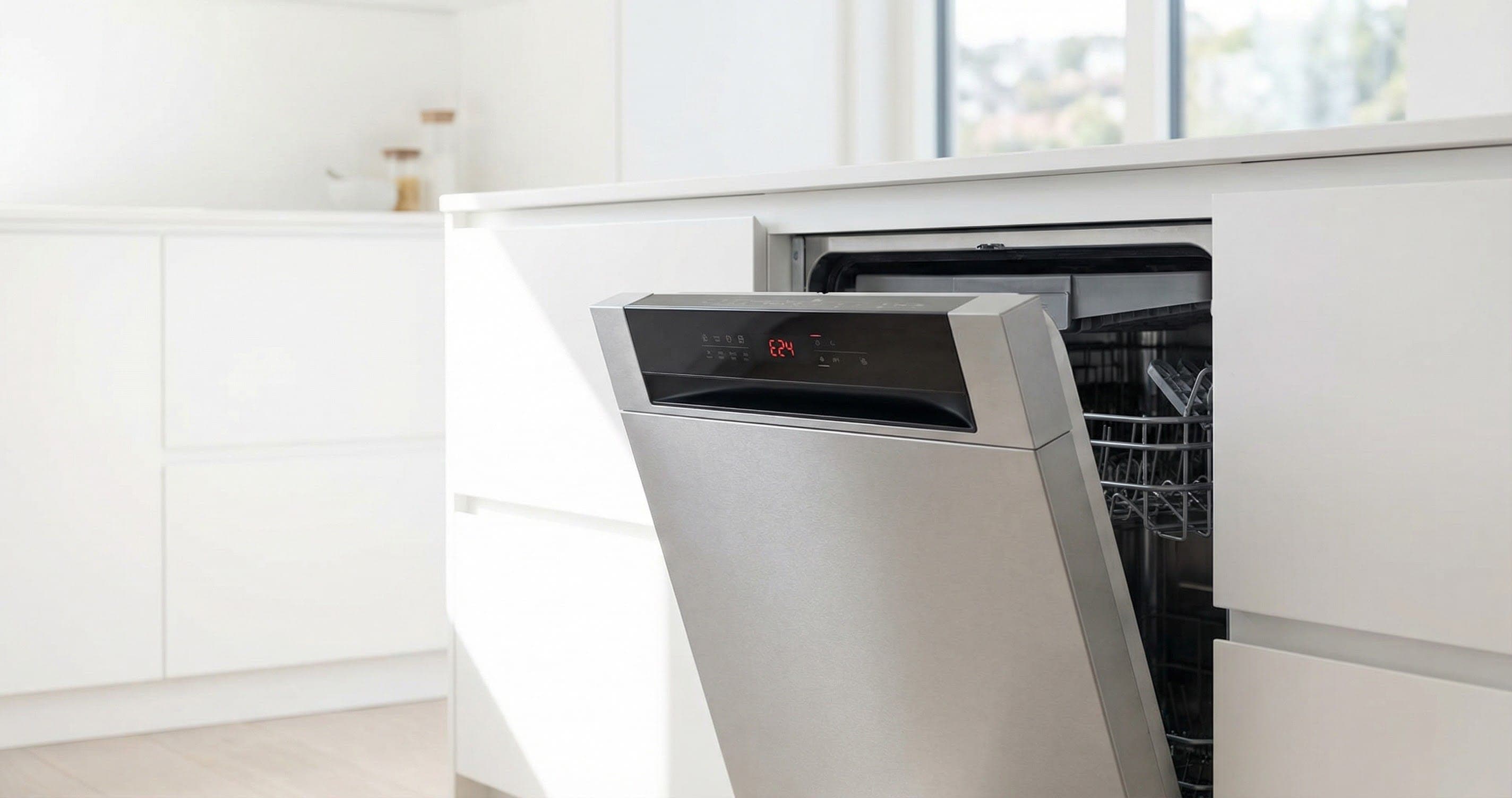
Run a Quick Wash cycle and observe: open the door mid-cycle (this pauses the pump) and check the spray arms. If the upper arm barely drips while the lower sprays weakly, the pump has lost pressure. Listen during the cycle — a healthy pump produces a steady hum, while a failing one makes grinding, clicking, or variable-speed sounds. Check for error E21 (circulation pump timeout) on the display.
Step 2: Prepare the Dishwasher
Disconnect power at the breaker. Close the water supply valve. Remove racks, spray arms, and the triple-filter assembly. Sponge out any standing water from the sump. Remove the kick plate (2 Torx T20 screws). Disconnect the countertop mounting screws (2 Torx T20 from inside the door opening). Disconnect the water supply line (10mm wrench, catch water with towel). Pull the unit forward.
Step 3: Tip the Dishwasher onto Its Back
With a helper, carefully lower the dishwasher onto its back on a moving blanket placed on the floor. The base plate now faces upward. Remove the 4-6 Torx T20 screws around the base plate perimeter and lift it off. The circulation pump is the large assembly at the center — it is the biggest component under the unit, typically gray or black, with multiple hose connections.
Step 4: Identify the Circulation Pump Assembly
The circulation pump on Bosch models integrates: the pump motor (brushless DC on newer models), the impeller housing, the flow-through heater tube, and the pump seal assembly. It connects to: the sump (via large inlet), the spray arm distributor (via outlet), the drain pump (via branch), and the wiring harness (multi-pin connector plus heater power wires). Photograph everything before disconnecting.
Step 5: Remove the Pump for Servicing
Disconnect the wiring harness connector (press release tab). Disconnect heater power terminals (pull spade connectors straight off). Squeeze spring clamps on each hose and slide back, then pull hoses off. Remove the mounting ring (rotate counterclockwise 20 degrees on bayonet mount) or bracket screws (3-4 Torx T15). Carefully lift the assembly out — it weighs 3-5 lbs.
Step 6: Inspect the Impeller
The impeller is visible through the pump inlet opening. Check for: debris wrapped around the shaft (hair, food membrane, glass shards), calcium buildup on the impeller blades reducing efficiency, and cracks or chips in the impeller that reduce pumping power. Clear any debris. If the impeller is heavily calcified, soak the inlet end of the assembly in white vinegar for 30 minutes. Spin the impeller by hand — it should rotate smoothly with minimal resistance.
Step 7: Check the Pump Seal
The pump seal prevents water from leaking along the motor shaft into the motor housing. Signs of a failed seal: rust-colored water drips from the motor housing, or grinding noise from the shaft bearing. The seal is located between the impeller housing and the motor. Some models allow seal replacement without replacing the entire pump — check if a seal kit is available for your model number.
Step 8: Test the Motor Windings
With the pump removed, measure resistance across the motor terminals with a multimeter. Expected readings vary by model, but generally: 5-30 ohms for the motor winding (brushless types may have 3 terminals — measure between each pair). Open circuit means a burned winding (pump replacement needed). Also check for continuity to ground (any terminal to the pump housing) — should read open (infinity). Any continuity to ground indicates a short and requires replacement.
Step 9: Clean and Reassemble
If the motor tests good and the impeller is clear, apply a thin coat of food-grade silicone grease to the seal area and the O-ring. Reinstall the pump assembly: align mounting tabs, engage the bayonet lock (clockwise rotation until click), or install bracket screws. Reconnect all hoses (fully seated on barbs, spring clamps in position). Reconnect electrical: motor harness and heater terminals.
Step 10: Reinstall and Test
Replace the base plate. Return the dishwasher to upright position with your helper. Reconnect water supply (hand-tight plus 1/4 turn). Push back under counter. Reinstall countertop screws and kick plate. Replace filter, spray arms, and racks inside. Open water supply. Restore power. Run a Normal cycle and check: spray arms should spin vigorously, door should feel warm after 15 minutes, and no leaks should appear under the unit.
Signs the Pump Needs Full Replacement (Not Just Service)
| Symptom | Diagnosis | Action |
|---|---|---|
| Motor does not run (silent during wash) | Check wiring first; if wiring good, motor burned | Replace assembly |
| Grinding from motor bearing | Seal failure allowed water into bearing | Replace assembly |
| Impeller shaft wobbles when pushed | Bearing worn | Replace assembly |
| E21 error immediately at cycle start | Motor not responding to control signal | Test motor; likely replace |
| Pump runs but zero water at spray arms | Impeller separated from shaft | Replace assembly |
Safety First — Know the Risks
Live 120V wiring in a wet environment is one of the most dangerous DIY scenarios. Water + electricity = serious shock risk. Our techs are licensed and insured — let them handle the risk.
Licensed & Insured · 90-Day Warranty · Same-Day Service
When to Call a Professional
Consider professional service if:
- The integrated heater portion of the assembly has also failed (E09) — replacing the combined pump/heater requires careful electrical work with high-current connections
- You cannot safely tip the dishwasher (90+ lbs) or lack a helper
- The motor windings test good but the pump still does not move water — the electronic pump controller (on brushless DC models) may be the issue, not the motor itself
- Your dishwasher is an 800 series with Zeolite — the circulation system routing is more complex
Same-Day Appliance Repair
Fixed or It's Free
$89 → $0 Service Call & Diagnosis — offer ends May 25
Cost Comparison: DIY vs Professional
| DIY (Service) | DIY (Replace) | Professional | |
|---|---|---|---|
| Parts | $0-$25 | $150-$280 | $150-$280 |
| Labor | $0 | $0 | $200-$380 |
| Time | 45-75 min | 60-90 min | 45-60 min |
| Risk | Moderate | Moderate-High | Warranty included |
The Real Cost of DIY
Average DIY attempt: $150-400 in tools you may use once, plus the risk of further damage. Our diagnostic visit costs $0 — we find the problem and give you an honest quote.
Licensed & Insured · 90-Day Warranty · Same-Day Service
Need Professional Help?
FAQ
Q: Why are Bosch circulation pumps so expensive compared to other brands? A: Bosch integrates the flow-through heater into the circulation pump housing on models from 2014 onward. This design improves heating efficiency and reduces the number of components, but means replacing the pump also replaces the heater — hence the $150-280 price. Older Bosch models with separate heaters have cheaper pump-only replacements.
Q: Can I replace just the impeller or seal without buying the whole assembly? A: On some older Bosch models (pre-2014), yes — BSH sold seal kits and individual impellers. On newer integrated pump/heater assemblies, BSH only sells the complete assembly. Check your model number against the BSH parts catalog — if only the full assembly is listed, you must buy the complete unit.
Q: How do I know if the problem is the circulation pump vs a clogged spray arm? A: Remove the spray arms and run a cycle. Look down at the sump area through the filter opening during the wash phase — you should see water being forcefully pumped up through the spray arm mounting posts. If water barely trickles, the pump is the problem. If water jets up forcefully but spray arms were not spinning, the spray arm bearings or holes are clogged.
Q: Is a noisy Bosch dishwasher always a pump problem? A: Not always. Common noise sources: spray arm hitting a dish (rhythmic clicking), hard water deposits in the sump (gritty sound), drain pump activating briefly between phases (short buzzing), or items vibrating on the racks. A failing circulation pump specifically makes a grinding or humming sound that is constant throughout the wash phase, not intermittent.
Need a certified technician? Book same-day repair →