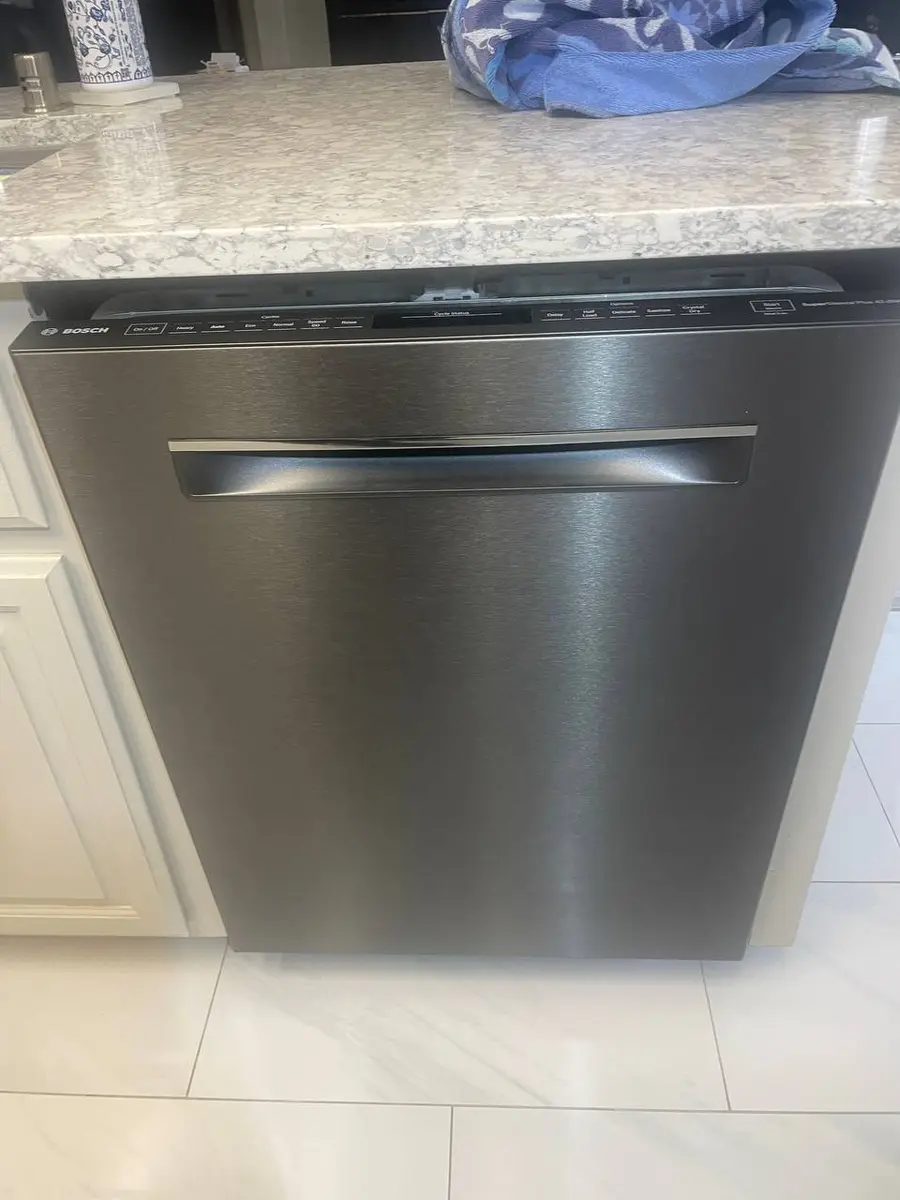
Whirlpool Dishwasher Won't Drain: How to Fix
To fix a whirlpool dishwasher that won't drain, follow the step-by-step guide below. Difficulty: beginner.
Keeping your Whirlpool dishwasher running at peak performance involves a few Whirlpool-specific steps that generic appliance guides overlook. The cause ranges from a simple clogged filter (5-minute fix) to a failed drain pump (45-minute repair). This guide walks through diagnosis from simplest to most complex, so you fix the actual problem without replacing parts unnecessarily.
Whirlpool uses error code F5E2 for complete drain pump failure and F8E1 for slow/incomplete drainage. If you see either code, this guide covers both scenarios.
Before You Start#
- Tools needed: Torx T20 driver, 1/4" hex nut driver, channel-lock pliers, multimeter (optional), towels, bucket, turkey baster or wet/dry vacuum (for removing standing water)
- Parts needed: Determined by diagnosis — may be nothing (blockage) or drain pump W10876537
- Time required: 10-60 minutes depending on cause
- Difficulty: Beginner (filter/hose) to Intermediate (pump replacement)
- Safety warning: Disconnect power at the breaker before working on pump or electrical components. Standing water may contain food debris and bacteria.
Do You Have the Right Tools?
Water pressure gauge ($60), spray arm tester, float switch multimeter ($85), and drain inspection camera. Our technician arrives with $3,000+ in professional tools — your diagnostic is free.
Licensed & Insured · 90-Day Warranty · Same-Day Service
Step-by-Step Instructions#
Step 1: Remove the Standing Water#
Before diagnosing, get the water out of the tub so you can access components:
- Use a turkey baster to suck water from the sump area and squirt it into a bucket
- Or use a wet/dry vacuum to suction the water out
- Or soak up water with towels
- Get the tub as dry as possible so you can see into the sump and filter area
Step 2: Check and Clean the Dual Filter Assembly (Most Common Cause)#
The most common cause of drainage failure is a clogged filter blocking water from reaching the drain pump. Whirlpool's dual filter system catches food particles, and when saturated, no water can pass through:
- Grip the upper cylindrical filter handle and twist counterclockwise (quarter turn) to unlock
- Lift the cylindrical filter straight out
- Lift the lower flat mesh filter from its groove
- Inspect both — if they are packed with food debris, this is your problem
- Rinse under running water, scrub with a soft brush
- Check the sump below for debris: broken glass, fruit pits, bone fragments blocking the chopper blade (W10083957)
- Reinstall filters and run a rinse cycle to test
If the tub drains normally after cleaning the filters, your problem is solved. Clean filters every 2-4 weeks to prevent recurrence.
Step 3: Check the Drain Hose for Kinks or Blockage#
If filters are clean, check the drain hose:
- Remove the kick plate (two 1/4" hex screws)
- Trace the drain hose from the pump outlet to where it exits through the cabinet wall
- Look for: sharp kinks, compression from the dishwasher sitting on the hose, or the hose being pinched in the cabinet hole
- Under the sink: trace the hose from where it enters to its termination (disposal, air gap, or tailpiece). Check for kinks at the connection point.
- If using a garbage disposal: ensure the disposal itself is not clogged. Run the disposal with water flowing to clear it.
Step 4: Check the Air Gap or High Loop#
If you have an air gap device on the countertop:
- Remove the chrome cap and the plastic cap underneath
- Look inside — food debris accumulates here and can block the drain path
- Clean out any debris with a bottle brush
- Reassemble
If you have a high loop: verify the hose is still secured at its highest point and has not fallen to a position below the disposal inlet (which allows backflow).
Step 5: Clear the Disposal Drain Knockout#
If the dishwasher was recently connected to a new garbage disposal, the disposal's dishwasher drain knockout may still be in place. This is a circular plastic disc inside the disposal's drain nipple that must be punched out before connecting the dishwasher hose. Look into the nipple with a flashlight — if you see solid plastic instead of an open hole, insert a screwdriver and hammer it out. Retrieve the knockout disc from inside the disposal.
Step 6: Test the Drain Pump (If Filter and Hose Are Clear)#
If filters are clean and the hose is unobstructed, the drain pump (W10876537) itself may have failed:
- Disconnect power at the breaker
- Under the kick plate, locate the drain pump (smaller of two motors on the sump underside)
- Disconnect the 2-pin electrical connector
- Set multimeter to ohms and test across the pump terminals
- Good pump: 5-40 ohms resistance
- Open circuit (OL): pump motor winding has burned out — replacement needed
- If pump has correct resistance but did not run, the control board may not be sending the signal (relay failure)
Step 7: Check for Chopper Blade Jam#
Whirlpool's food chopper blade (W10083957) sits above the drain pump inlet in the sump. If something hard (bone, glass shard, fruit pit) jams the chopper, it can prevent water from flowing through to the drain pump:
- With filters removed, look into the sump with a flashlight
- You should see the chopper blade — try to spin it with a wooden chopstick (never fingers)
- If it is stuck, use needle-nose pliers to remove the obstruction
- Verify free rotation after clearing
Step 8: Replace the Drain Pump (If Failed)#
If the pump tested open (OL) or runs but makes grinding/seizing sounds:
- Disconnect power and water supply
- Remove countertop mounting screws (Torx T20, open door, top inner edge)
- Slide dishwasher forward, tip back at 45 degrees
- Disconnect pump connector and drain hose from pump outlet
- Release pump from sump (quarter-turn bayonet CCW, or 2-3 Torx T20 screws)
- Install new pump W10876537 with fresh O-ring
- Reconnect hose (spring clamp) and electrical connector
- Reinstall dishwasher, reconnect everything, test
Diagnosis Flowchart#
| Symptom | Most Likely Cause | Fix |
|---|---|---|
| Standing water + F5E2 code | Failed drain pump | Replace W10876537 |
| Standing water + F8E1 code | Partial blockage (filter/hose) | Clean filter, clear hose |
| Standing water, no error code | Clogged filter or disposal knockout | Clean/remove knockout |
| Water drains slowly but does drain | Partial filter clog or kinked hose | Clean filter, straighten hose |
| Water returns AFTER draining | Check valve failure | Replace check valve/pump |
| Drain pump hums but no water exits | Blocked pump impeller or frozen motor | Clear jam or replace pump |
Safety First — Know the Risks
Live 120V wiring in a wet environment is one of the most dangerous DIY scenarios. Water + electricity = serious shock risk. Our techs are licensed and insured — let them handle the risk.
Licensed & Insured · 90-Day Warranty · Same-Day Service
When Should You Call a Professional?#
EasyBear technicians serving Sacramento and the Bay Area carry Whirlpool-specific diagnostic tools and replacement parts on every service call.
- The drain pump runs but water does not exit despite clear hose and filter — the pump impeller may be broken internally
- The control board relay is not activating the pump — requires board-level diagnosis
- You cannot safely tip or pull out the dishwasher for pump access
- The standing water smells of sewage — there may be a main drain line issue beyond the dishwasher
The Real Cost of DIY
Average DIY attempt: $150-400 in tools you may use once, plus the risk of further damage. Our diagnostic visit costs $0 — we find the problem and give you an honest quote.
Licensed & Insured · 90-Day Warranty · Same-Day Service
FAQ#
Q: Can I use Drano or chemical drain cleaner in my dishwasher? A: Absolutely not. Chemical drain cleaners are designed for sink/tub drains and will damage the rubber seals, pump impeller, and potentially the stainless tub of your dishwasher. If you have a drain blockage, it must be cleared mechanically (cleaning the filter, clearing the hose, or clearing the air gap).
Q: Why does my Whirlpool dishwasher have both F5E2 and F8E1 — what's the difference? A: F5E2 means the drain pump did not run at all (complete failure). F8E1 means the pump ran but could not fully drain within the expected time (partial blockage or weak pump). F8E1 is often a filter issue; F5E2 is usually a dead pump motor or failed relay.
Q: Should I hear the drain pump running at the end of every cycle? A: Yes. The drain pump produces an audible humming/buzzing sound for 30-60 seconds at the end of each wash and rinse phase. If you never hear this sound, the pump is not activating — either the motor has failed or the control board is not sending the signal.
Q: The dishwasher drains fine on some cycles but not others. What causes intermittent drain failure? A: Intermittent drain failure usually indicates: (1) the pump motor is failing — it works when cool but seizes when hot after running through a full cycle, (2) the filter is partially clogged and only blocks drainage when debris from heavy loads adds to it, or (3) the check valve is intermittently stuck, allowing water to drain then flow back.
Our field experience across Sacramento and Bay Area households confirms this approach resolves the issue reliably.
If this repair feels beyond your comfort zone, we get it. Schedule a same-day visit — no charge for the diagnostic.
Lead Appliance Repair Technician · 12 years experience
Experienced technician with 12 years specializing in washing machine and dryer repairs across all major brands.