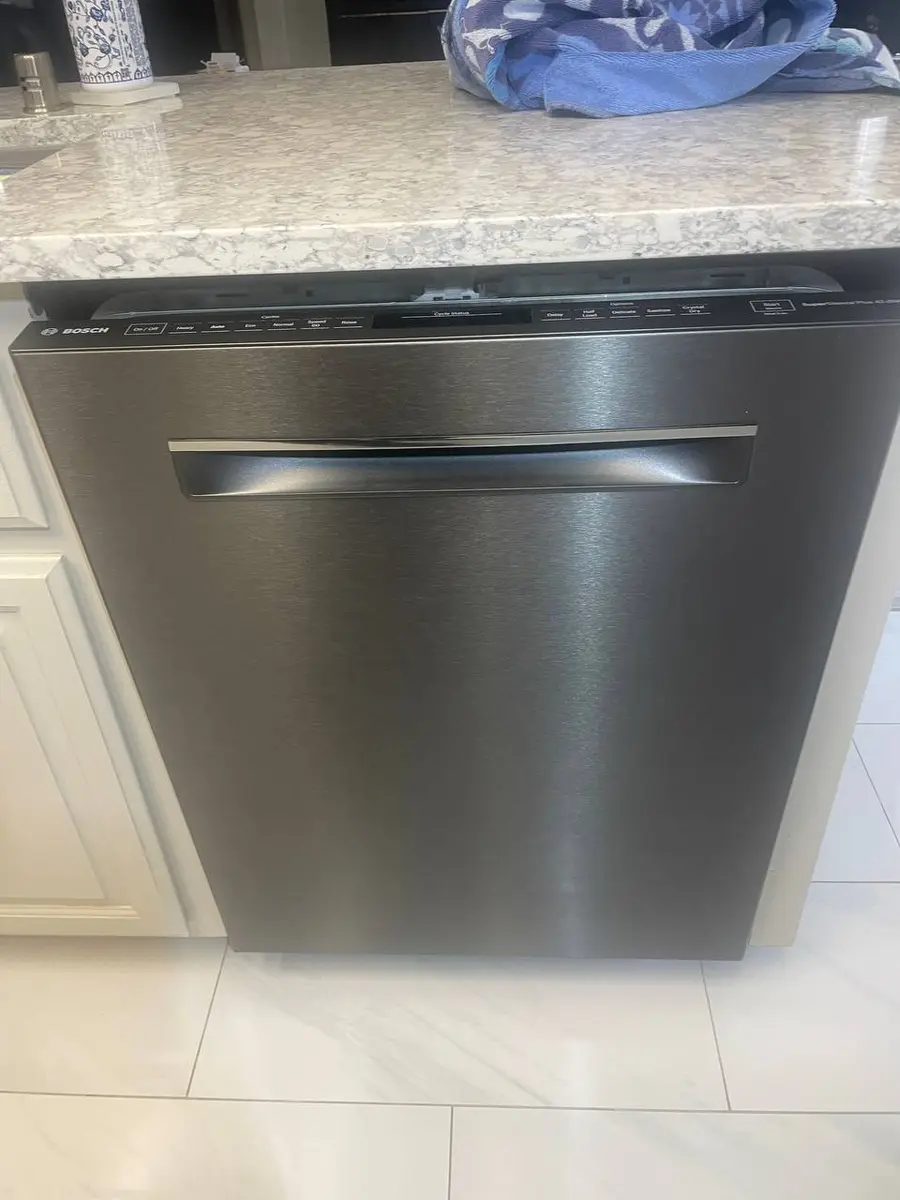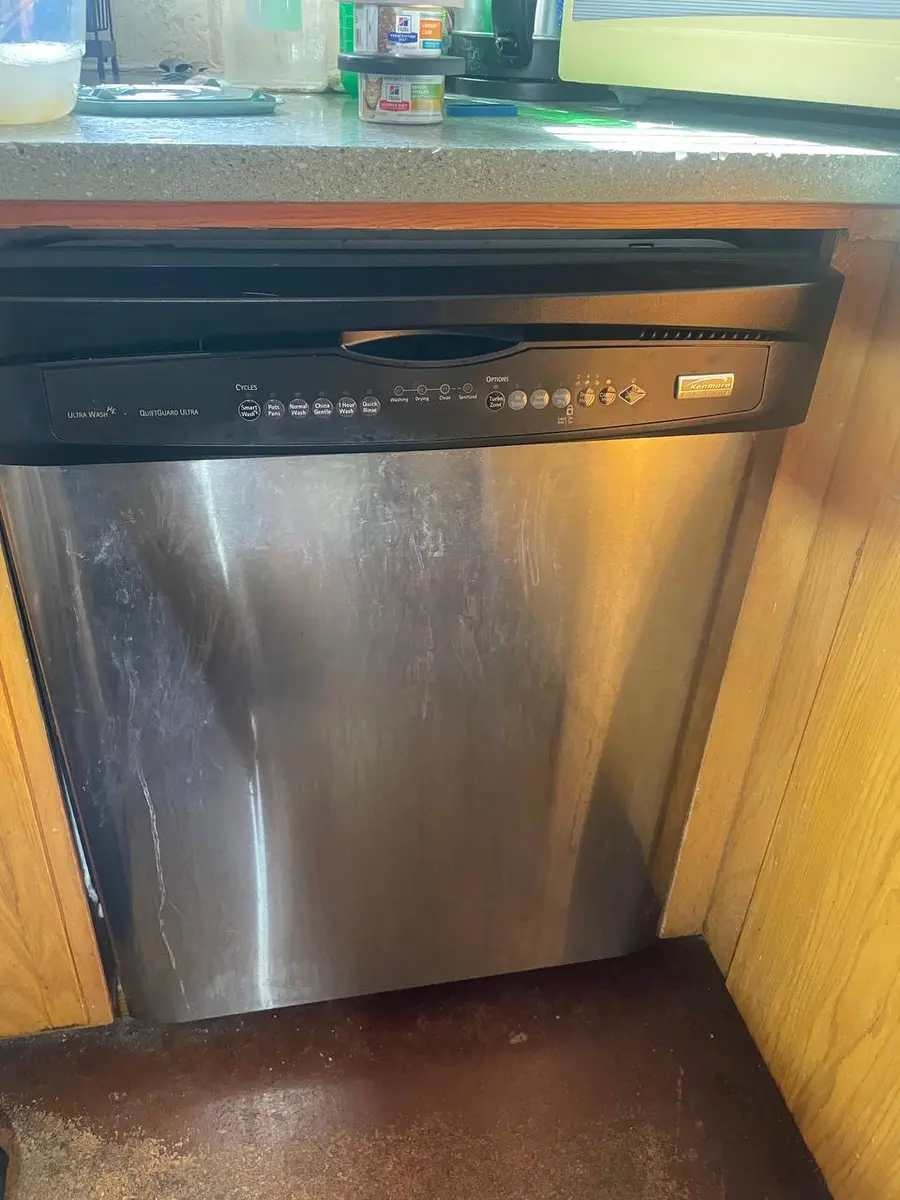
Whirlpool Dishwasher Not Drying: Causes & Fix
A Whirlpool dishwasher that cleans perfectly but leaves everything wet has a break in one of three places, and they sit in series: the control board relay, the thermal fuse, and the heating element itself. The circuit runs board relay to thermal fuse to element to neutral, and any one open link kills heated dry.…
Safety. The element carries 120V during the dry phase. Breaker off, and verify zero volts before a probe touches anything.
First, know what you are testing#
The same element that heats the wash water radiates heat during dry, so a machine that also washes in cold water has an element that has failed outright for both jobs. Wet dishes with hot wash water is the more interesting case, and that is what the tests below separate.
Take the two 1/4-inch hex screws out of the kick plate and drop the lower panel. The element terminals are the two metal posts coming through the tub floor, with their wiring alongside.
Do You Have the Right Tools?
Water pressure gauge ($60), spray arm tester, float switch multimeter ($85), and drain inspection camera. Our technician arrives with $3,000+ in professional tools — your diagnostic is free.
Licensed & Insured · 90-Day Warranty · Same-Day Service
The three tests, in order#
| Component | How to test | Healthy | Failed |
|---|---|---|---|
| Heating element | Pull both spade connectors, meter across the terminals | 10-30 ohms, and Whirlpool units usually land at 15-20 | OL means open; under 5 ohms means shorted and it will trip the breaker |
| Element to tub | Meter each terminal against bare tub metal | OL | Any reading at all means it is grounding to the tub |
| Thermal fuse | Small oblong part with two wires, on the terminal block or near the sump. Disconnect one wire, check continuity | Near zero ohms | OL means blown, and the element is starved of power |
If both pass, the relay on the control board is the remaining suspect. That needs live testing: reconnect the element, restore power, enter diagnostic mode with Heated Dry, Normal, Heated Dry pressed within 4 seconds, advance to the dry phase and listen for the relay to click. No click means the board has failed. Kill the power the moment you have your answer.
Replacing a blown fuse — and finding out why it blew#
The fuse itself is trivial: disconnect its two wires, release the screw or clip, fit the new one in the same place, reconnect, close up.
The part people skip is the cause. A thermal fuse blows because something overheated. Check that the element is not shorted to ground, that the tub vent is clear so steam can escape, and that the drying fan is turning if your model has one. Fit a fuse without fixing that and you will be doing this again within weeks.
Safety First — Know the Risks
Live 120V wiring in a wet environment is one of the most dangerous DIY scenarios. Water + electricity = serious shock risk. Our techs are licensed and insured — let them handle the risk.
Licensed & Insured · 90-Day Warranty · Same-Day Service
Replacing the element#
This one earns its time estimate. Disconnect the terminal wires at the kick plate, remove the Torx T20 countertop mounting screws, disconnect the water supply and drain hose, then pull the machine out and tip it back for underside access. The terminal lock nuts come off from below; from inside the tub, take out the lower rack and spray arm and lift the element up through the tub floor holes. Fit the new one with fresh gaskets and grommets, secure the terminals from below, reconnect everything and reinstall.
Verify properly#
Run a Normal cycle with heated dry selected. Around 45-55 minutes in, the dry phase should radiate warmth you can feel with your hand near the bottom of the door. At the end, dishes and tub should be warm and dry — and if you replaced the element, check underneath for leaks.
The Real Cost of DIY
Average DIY attempt: $150-400 in tools you may use once, plus the risk of further damage. Our diagnostic visit costs $0 — we find the problem and give you an honest quote.
Licensed & Insured · 90-Day Warranty · Same-Day Service
If you are deferring the repair#
Fill the rinse aid dispenser to maximum so water sheets off rather than beading, open the door the moment the cycle ends and let residual heat do the evaporating, and use air dry or energy saver if your model offers it. These are workarounds, not fixes, and they will not restore the sanitize cycle, which needs verified water temperature.
Fuse blowing repeatedly, a failed board relay, or an element that passes on the bench but only heats intermittently? Book a diagnostic — hairline element cracks that open under load need live testing to catch.
Appliance Repair Technician & Diagnostics Specialist · 10 years experience
Electronics and diagnostics specialist with 10 years of experience in modern smart appliance repair, specializing in LG and Samsung.