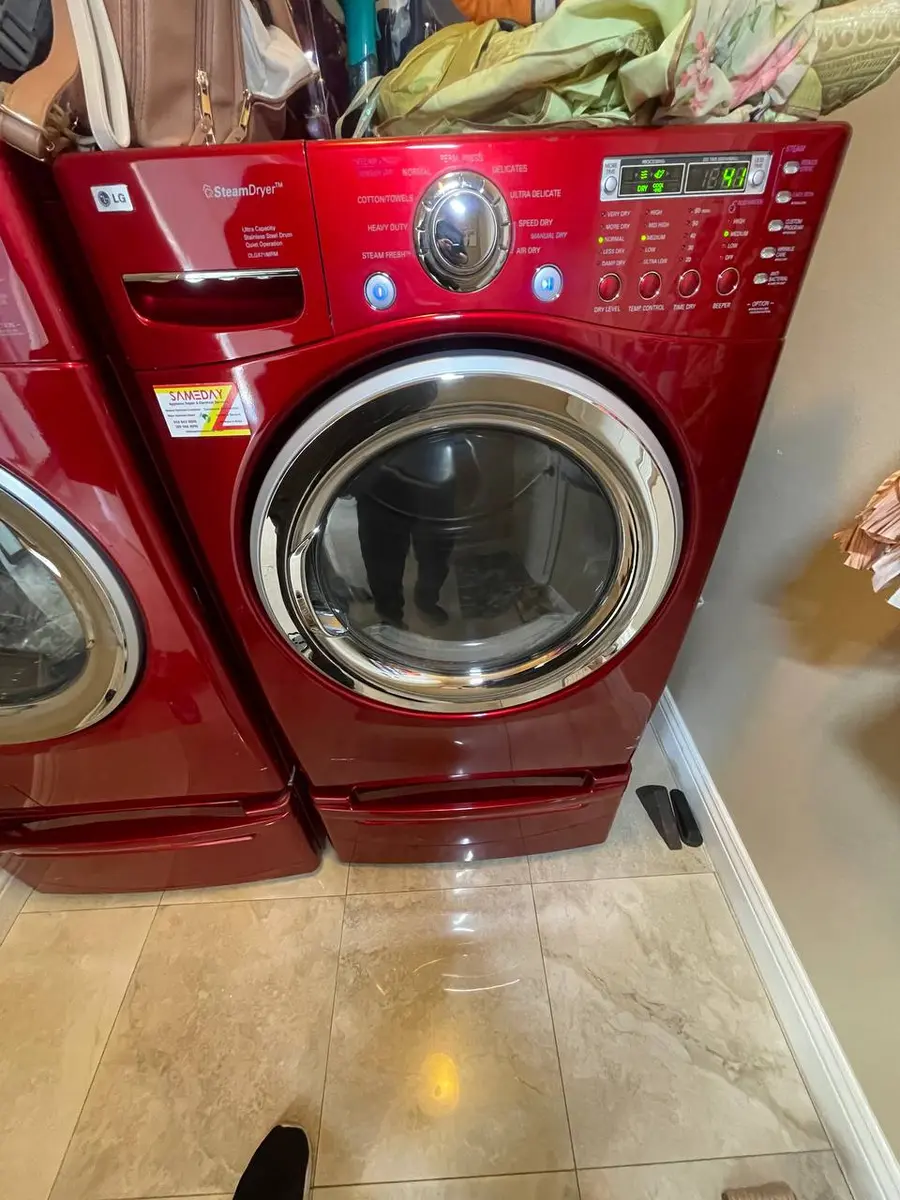
How to Replace an LG Dryer Power Cord
Swapping an LG electric dryer between a 3-prong (NEMA 10-30) and a 4-prong (NEMA 14-30) cord is a beginner-level job of about 15-20 minutes: you move three or four wires on the terminal block and either add or remove the neutral-to-frame ground strap to match the new cord. Because the block is a live 240V connection,…
Why the cord has to match the outlet#
LG builds both cord styles around the same terminal block, so the dryer itself does not care which one you fit — the outlet decides. A 4-prong NEMA 14-30 cord carries a dedicated green ground wire that stays separate from the white neutral. A 3-prong NEMA 10-30 cord has no separate ground; its neutral doubles as the ground path, an older arrangement that current code no longer permits on new circuits but still allows on existing ones. The single part that switches the dryer between the two schemes is the ground strap linking the center (neutral) terminal to the metal frame.
Tools, parts, and safety#
| Item | Detail |
|---|---|
| Screwdriver | Phillips #2 or 1/4-inch nut driver for the terminal cover |
| Wrench | Adjustable wrench for the terminal nuts |
| Part | Matching NEMA 14-30 (4-prong) or NEMA 10-30 (3-prong) dryer cord |
| Time | 15-20 minutes |
| Skill | Beginner — but the block is a live 240V connection |
Before touching anything, pull the plug and turn the dryer's breaker OFF. Confirm the outlet is dead with a voltage tester before handling the cord.
Do You Have the Right Tools?
Gas leak detector ($130), thermal fuse tester ($95), belt tension gauge, and vent inspection camera ($180). Our technician arrives with $3,000+ in professional tools — your diagnostic is free.
Licensed & Insured · 90-Day Warranty · Same-Day Service
Step-by-step#
1. Open the terminal block#
The block sits behind a small metal cover plate on the center-rear of the cabinet. Back out the cover screw and set it aside. Inside are three posts — left is Line 1 (hot), center is Neutral, right is Line 2 (hot) — plus a ground screw on the frame beside them.
2a. Wiring a 4-prong (NEMA 14-30) cord#
A 4-prong cord brings four wires. Land the red wire on the left post (Line 1), the black wire on the right post (Line 2), and the white wire on the center post (Neutral). Fasten the green wire under the frame ground screw. Critically, remove the ground strap that ties the center neutral post to the frame — with a 4-prong cord, neutral and ground must stay independent. Keep the strap in case you ever revert.
2b. Wiring a 3-prong (NEMA 10-30) cord#
A 3-prong cord brings three wires. Land the two outer wires on the left and right posts and the center wire on the center Neutral post. This time install (or leave in place) the ground strap between the center neutral post and the frame, because on a 3-prong circuit the neutral is what grounds the chassis.
3. Tighten and strain-relief the cord#
Snug every terminal nut firmly, but stop short of forcing them — the posts are brass and strip easily. Feed the cord through the strain-relief clamp on the rear panel and tighten the clamp so a tug on the cord cannot reach the terminals.
4. Close it up and test#
Reinstall the terminal cover plate so nobody can touch a live post. Switch the breaker back on, plug the cord into the outlet (it should seat without force), and run a short timed cycle to confirm the drum turns and the dryer heats.
5. Prove the ground#
With the dryer plugged in but off, set a multimeter between the metal cabinet and a known ground — the ground pin of a nearby grounded outlet works. You want a reading close to zero volts. Any meaningful voltage there means the ground is wrong; stop and recheck the wiring.
If something is off#
- Breaker trips the instant you restore power: a strand is shorting to the frame, or a loose nut is bridging two terminals — reopen the block and inspect.
- Drum spins but no heat: on a 240V dryer each hot leg feeds half the heat circuit, so a hot wire on the wrong post or a loose connection starves the element.
- Intermittent running: a loose terminal nut arcs and drops the connection; retighten all of them.
Safety First — Know the Risks
Gas dryers carry carbon monoxide and explosion risk. Even electric dryers involve 240V circuits that can deliver a fatal shock. Our techs are licensed and insured — let them handle the risk.
Licensed & Insured · 90-Day Warranty · Same-Day Service
When to call a pro#
Bring in a licensed electrician — or an EasyBear technician across Sacramento and the Bay Area — when the outlet type is unclear or non-standard, when the receptacle is scorched or sparking, or when the outlet itself needs upgrading from 3-prong to 4-prong (that is outlet work, not cord work).
Lead Appliance Repair Technician · 12 years experience
Experienced technician with 12 years specializing in washing machine and dryer repairs across all major brands.