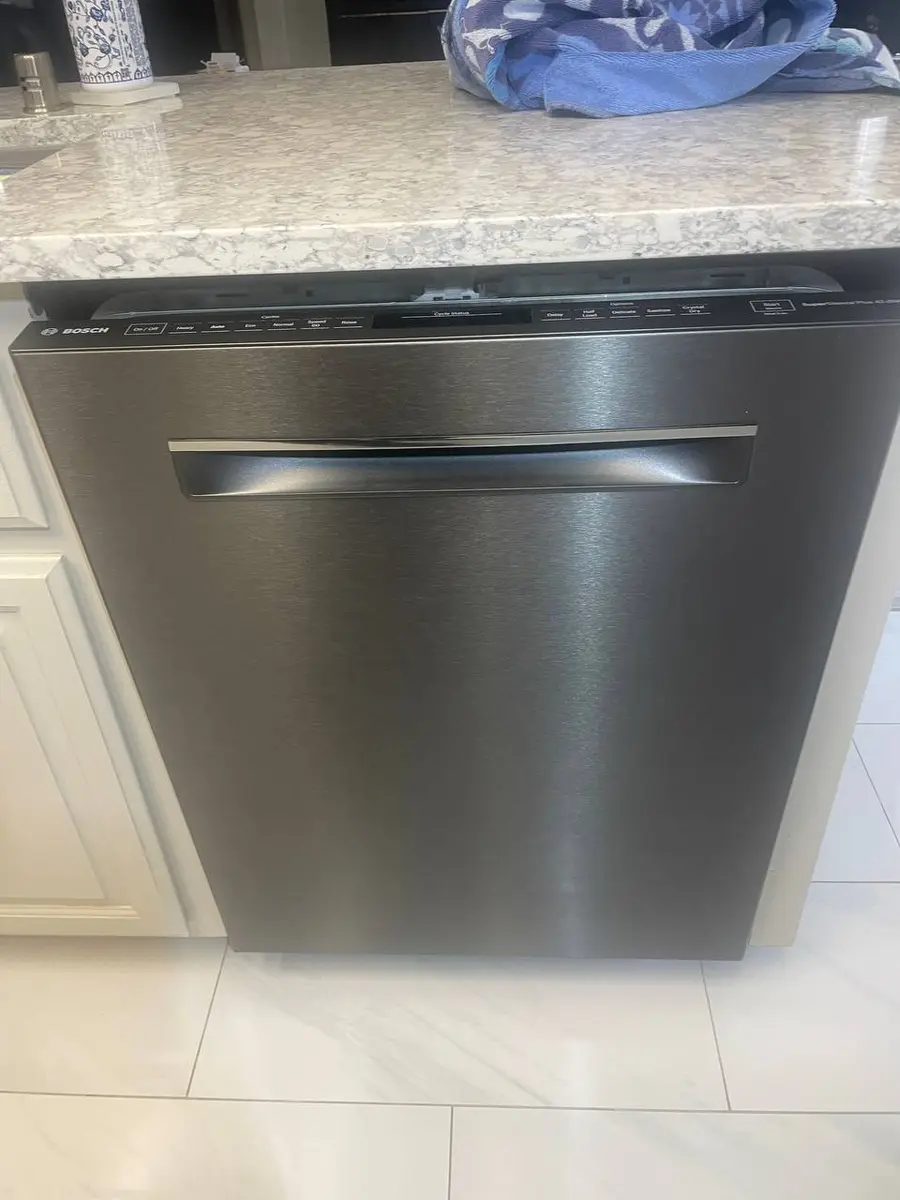
How to Replace a Bosch Dishwasher Temperature Sensor (NTC Thermistor)
The temperature sensor (NTC thermistor) in a Bosch dishwasher monitors water temperature and tells the control board when to activate or deactivate the flow-through heater. When this sensor fails, the dishwasher cannot regulate water temperature — resulting in either cold washes (sensor reads artificially high, so the board thinks water is already hot) or overheating (sensor reads artificially low, so the heater never shuts off). Bosch displays error E01 (heating timeout) when the expected temperature is not reached within the programmed time.
The good news: the NTC sensor is inexpensive ($12-$30) and accessible from inside the tub without tipping the dishwasher. This makes it one of the more straightforward Bosch repairs.
Before You Start
- Tools needed: Torx T15 driver, multimeter, towels, flashlight
- Parts needed: NTC temperature sensor (~$12-$30, model-specific — verify BSH part number for your model)
- Time required: 20-30 minutes
- Difficulty: Beginner to Intermediate
- Safety warning: Disconnect power at the circuit breaker. The sensor is near the heating element area — if the dishwasher recently ran, wait 20 minutes for the sump area to cool. The sensor itself carries low voltage (5V) but you will be reaching into an area with high-current heater connections nearby.
Do You Have the Right Tools?
Water pressure gauge ($60), spray arm tester, float switch multimeter ($85), and drain inspection camera. Our technician arrives with $15K+ in professional tools — your diagnostic is free.
Licensed & Insured · 90-Day Warranty · Same-Day Service
Step-by-Step Instructions
Step 1: Confirm the Sensor Is Faulty
Before replacing, test the existing sensor. Disconnect power at the breaker. Remove the lower rack, lower spray arm (lift straight up), and triple-filter assembly. The NTC sensor is a small cylindrical probe mounted in the sump area (bottom of tub) — usually a black or gray plastic dome about the size of a thimble. Test with a multimeter set to ohms: at room temperature (about 25C/77F), a healthy NTC sensor reads approximately 50,000 ohms (50K). If it reads open circuit (OL), zero ohms, or a fixed value that does not change when warmed, the sensor has failed.
Step 2: Locate the Sensor in the Sump
With the filter removed, look at the base of the tub near the sump drain area. The NTC sensor is typically mounted on the sump housing near where the circulation pump connects — it needs to be in direct contact with wash water. On most Bosch 300/500/800 series, it is a small protruding cylinder held by a press-fit clip or a single retaining screw. It has 2 wires leading to a connector underneath the tub.
Step 3: Access the Wiring Connector
The sensor wires run through the tub base and connect underneath. To access the connector: remove the kick plate (2 Torx T20 screws). Look up behind the kick plate area — you should see a 2-pin connector attached to wiring that runs up to the sensor location. Alternatively, on some models, the connector is accessible by reaching through the sump opening inside the tub.
Step 4: Disconnect the Sensor Connector
Press the release tab on the 2-pin connector and pull apart. Note the connector orientation for reinstallation. If the connector is stiff from heat exposure and corrosion, use a gentle rocking motion — do not yank by the wires.
Step 5: Remove the Old Sensor
From inside the tub, the sensor is held by either: a press-fit grommet (pull straight out with firm even pressure), a twist-lock (quarter-turn counterclockwise then pull), or a small retaining clip/screw (Torx T15). Once the retainer is released, the sensor slides or pops out of its mounting hole. An O-ring or rubber grommet seals the sensor to the sump — note its position and condition.
Step 6: Inspect the Mounting Hole and O-Ring
Check the O-ring seal (if separate from the sensor). If it is cracked, hardened, or deformed, replace it — even a new sensor will leak if the seal is compromised. Clean any scale or debris from the mounting hole with a soft cloth. The sensor must sit flush against the sump wall with the sensing tip protruding into the water flow.
Step 7: Install the New Sensor
Insert the new NTC sensor into the mounting hole. If press-fit: push firmly until the retaining ridge clicks into place. If screw-mounted: insert and secure with the Torx T15 screw. Verify the O-ring is properly seated and the sensor sits flush. Connect the 2-pin connector underneath — push until it clicks.
Step 8: Test the Installation
Before full reassembly, measure resistance across the new sensor terminals at the connector to verify it reads correctly (~50K ohms at room temperature). Reassemble the triple-filter, spray arm, and rack. Restore power. Run a Hot wash cycle — the dishwasher should heat water properly (door feels warm after 15-20 minutes) and complete the cycle without E01 errors.
How the NTC Sensor Works in a Bosch Dishwasher
The NTC (Negative Temperature Coefficient) thermistor decreases in resistance as temperature increases:
| Water Temperature | Expected Resistance |
|---|---|
| 25C (77F) — room temp | ~50,000 ohms |
| 40C (104F) — warm wash | ~25,000 ohms |
| 55C (131F) — normal wash | ~12,000 ohms |
| 65C (149F) — hot wash | ~7,500 ohms |
| 75C (167F) — sanitize | ~4,500 ohms |
The control board reads this resistance and calculates water temperature. If the reading does not change over time while the heater is active, the board assumes a sensor failure and throws E01.
Safety First — Know the Risks
Live 120V wiring in a wet environment is one of the most dangerous DIY scenarios. Water + electricity = serious shock risk. Our techs are licensed and insured — let them handle the risk.
Licensed & Insured · 90-Day Warranty · Same-Day Service
Troubleshooting After Sensor Replacement
- E01 persists with new sensor: The heater itself may have failed (test heater resistance — should be 10-15 ohms). Or the control board's temperature measurement circuit is faulty.
- Dishes come out scalding hot: New sensor may have lower resistance than spec — verify at room temperature. Wrong part number is the most common cause.
- Cycle runs much longer than before: This is often normal after replacing a degraded sensor — the old sensor was reading high, causing the board to under-heat. The new accurate sensor allows proper heating, which takes more time.
When to Call a Professional
Consider professional help if:
- Error E09 (heater relay) accompanies E01 — this suggests the control board itself has a relay failure, not just a sensor issue
- The sensor mounting hole is damaged or corroded, preventing a watertight seal
- You cannot reach the wiring connector through the kick plate area (some installation configurations route wires differently)
- The dishwasher is an 800 series with Zeolite drying — the Zeolite system has an additional temperature sensor with different specifications
Same-Day Appliance Repair
Fixed or It's Free
$89 → $0 Service Call & Diagnosis — offer ends May 25
The Real Cost of DIY
Average DIY attempt: $150-400 in tools you may use once, plus the risk of further damage. Our diagnostic visit costs $0 — we find the problem and give you an honest quote.
Licensed & Insured · 90-Day Warranty · Same-Day Service
Cost Comparison: DIY vs Professional
| DIY | Professional | |
|---|---|---|
| Parts | $12-$30 | $12-$30 |
| Labor | $0 | $100-$180 |
| Time | 20-30 min | 15-20 min |
| Risk | Low | Warranty included |
Need Professional Help?
Don't Void Your Warranty
Opening your appliance yourself may void the manufacturer warranty. Our repair comes with a 90-day guarantee, and we document everything for warranty compliance.
Licensed & Insured · 90-Day Warranty · Same-Day Service
FAQ
Q: How do I know if my Bosch dishwasher's temperature sensor has failed vs the heater? A: Test both. The NTC sensor should read ~50K ohms at room temperature (varies with ambient temp). The heater should read 10-15 ohms. If the sensor reads open circuit or zero ohms, replace the sensor first — it is much cheaper ($12-30 vs $85-280 for the heater assembly). If the sensor tests normal but the heater reads open, the heater has failed.
Q: Can a bad temperature sensor cause my Bosch dishwasher to not dry dishes? A: Indirectly, yes. If the sensor reads high (making the board think water is hotter than it actually is), the final rinse cycle will not reach the temperature needed for effective drying. Bosch condensation drying depends on hot dishes and cool tub walls — without sufficient heat, moisture does not evaporate properly.
Q: Is the temperature sensor the same as the turbidity sensor? A: No. The NTC temperature sensor measures water temperature. The turbidity sensor (found on 500/800 series ActiveWater models) measures water clarity to determine how dirty the water is and adjust cycle length. They are different parts in different locations, though both mount in the sump area. The turbidity sensor looks like a small clear dome, while the NTC is opaque.
Q: How long does a Bosch NTC temperature sensor last? A: Typically 8-15 years. NTC thermistors are passive components with no moving parts, so they have long lifespans. Failure is usually caused by thermal cycling stress (expansion/contraction) or water ingress through a degraded O-ring seal. If your sensor failed in under 5 years, check that the O-ring seal is intact.
Need a certified technician? Book same-day repair →