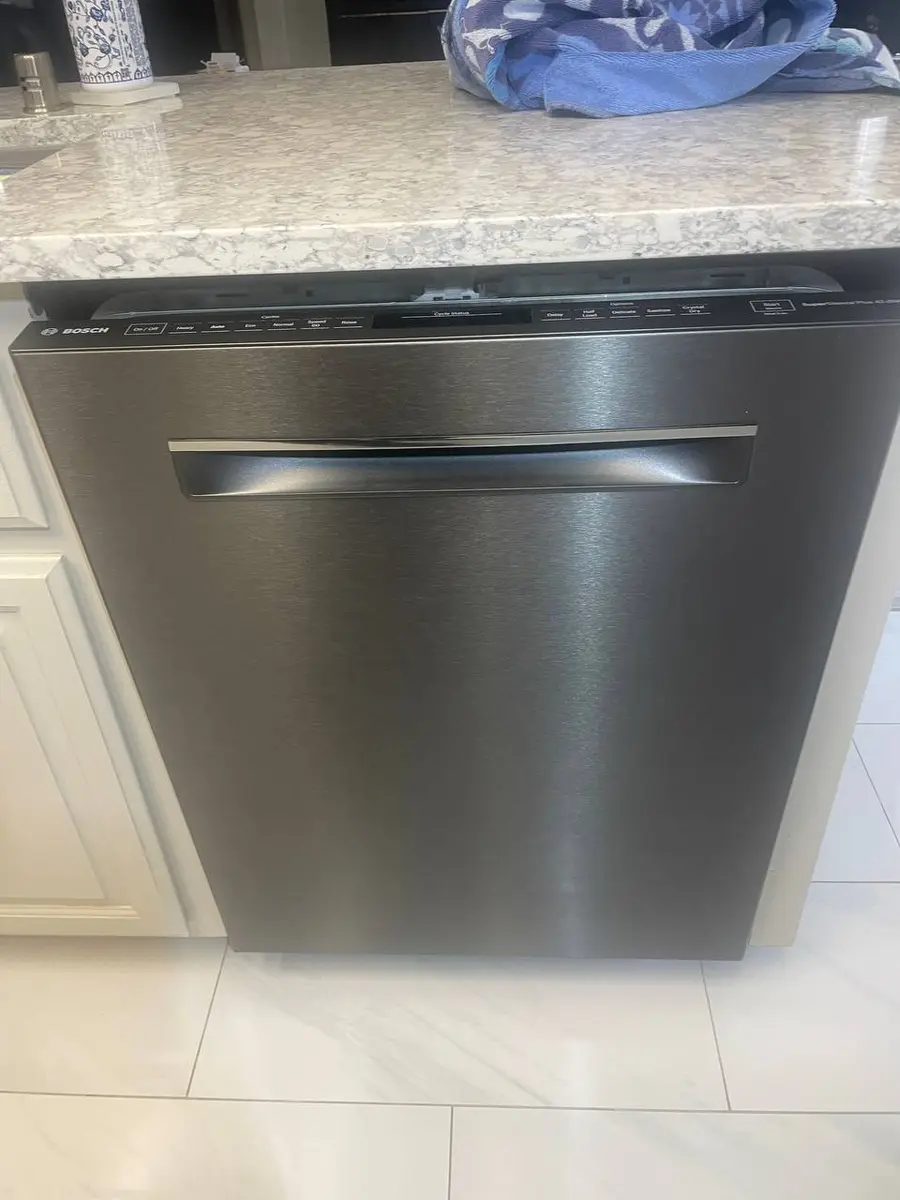
Bosch Dishwasher E17: Replace the Inlet Valve
A Bosch dishwasher that will not fill, showing E17, has three candidates: the supply valve under the sink, a calcified inlet screen, or the dual-solenoid inlet valve itself. Meter each coil for 700-1500 ohms — open circuit condemns it — and only then order BSH 00622058. The good news is access: the valve sits behind…
Tools: Torx T20 driver, 10mm socket or wrench, needle-nose pliers, adjustable pliers, multimeter, towels and a small bucket.
Safety. Breaker off, supply valve closed under the sink. The supply line holds water under pressure, so the bucket goes underneath before anything is loosened. If the valve had stuck open and water reached the base pan, AquaStop may have tripped and the pan needs draining as part of this job.
Confirm before ordering#
Start with the free check: is the supply valve under the sink fully open? A partially closed one imitates a failed inlet valve exactly.
Then listen during a fill. A working valve buzzes or hums audibly when it energises. Silence means either the solenoid has failed or the board is not powering it, and the meter separates those — 700-1500 ohms across each coil is healthy, open circuit is not.
| Code | Meaning | How the valve is involved |
|---|---|---|
| E17 | Water intake failure | Valve not opening: failed solenoid, clogged screen, or closed supply |
| E15 | Leak detected by AquaStop | Valve stuck open and overfilling, water reaching the base pan float |
| E03 | Fill timeout | The older-model equivalent of E17 |
Do You Have the Right Tools?
Water pressure gauge ($60), spray arm tester, float switch multimeter ($85), and drain inspection camera. Our technician arrives with $3,000+ in professional tools — your diagnostic is free.
Licensed & Insured · 90-Day Warranty · Same-Day Service
Getting it out#
Disconnect the brass supply line fitting at the valve with the 10mm wrench and let it drain into the bucket. Then take the 2 Torx T20 screws out of the kick plate and slide the panel forward and down. The valve is at the lower left as you face the machine, directly behind where the supply enters. Do not confuse it with the AquaStop control box, which lives at the faucet end of the hose.
This is a dual-solenoid valve, so each coil has its own 2-wire spade connector and they are not interchangeable. Photograph or label them before either comes off. Pull each connector straight off, gripping the connector body rather than the wire if it needs pliers.
On the outlet side, a rubber hose runs from the valve to the tub fill point, held by a spring clamp. Squeeze, slide it back, pull the hose off, and have a towel ready. The valve itself is held by 1-2 Torx T15 screws on its bracket, or snapped into a plastic clip.
Look at the screen before you commit#
Inside the inlet fitting, where the supply line lands, sits a small wire mesh filter. Mineral scale on that screen produces slow filling that looks exactly like a dying valve, and if it is badly calcified the screen alone may be your whole repair. Some replacement valves include a new one; if yours does not, transfer the old screen along with any rubber washers.
Safety First — Know the Risks
Live 120V wiring in a wet environment is one of the most dangerous DIY scenarios. Water + electricity = serious shock risk. Our techs are licensed and insured — let them handle the risk.
Licensed & Insured · 90-Day Warranty · Same-Day Service
Fitting and leak-testing#
Mount the new valve in the same orientation, secure the Torx T15 screws or snap it into the clip, then push the internal hose fully onto the outlet barb and slide the spring clamp back over it. Reconnect the solenoid connectors to the correct coils using your photograph. The supply line goes hand-tight plus a quarter turn with the 10mm wrench — no more, because the brass fitting seals against a rubber washer and overtightening ruins that seal.
Refit the kick plate loosely without screws. Open the supply valve slowly and watch the fitting for drips. Restore power, start a Quick Wash, and watch both the supply connection and the internal hose through the kick plate opening for the first 5 minutes. Dry after that, and the Torx T20 screws go back in.
A word on AquaStop#
Machines with AquaStop use a flood-protection hose carrying its own shutoff solenoid and leak sensor between the faucet and the inlet valve. Replacing the inlet valve does not require replacing that hose unless the AquaStop itself has tripped, and on some older models it is single-use. If the AquaStop valve stays shut even with power applied, it needs replacing too (BSH 00667327).
Active E15 with water in the base pan, coils that test good on a valve that still will not open, or a supply fitting that leaks with a new washer all point past this repair — book a diagnostic.
Appliance Repair Technician · 8 years experience
Experienced technician with 8 years specializing in dishwasher repairs and European appliance brands including Bosch and Thermador.