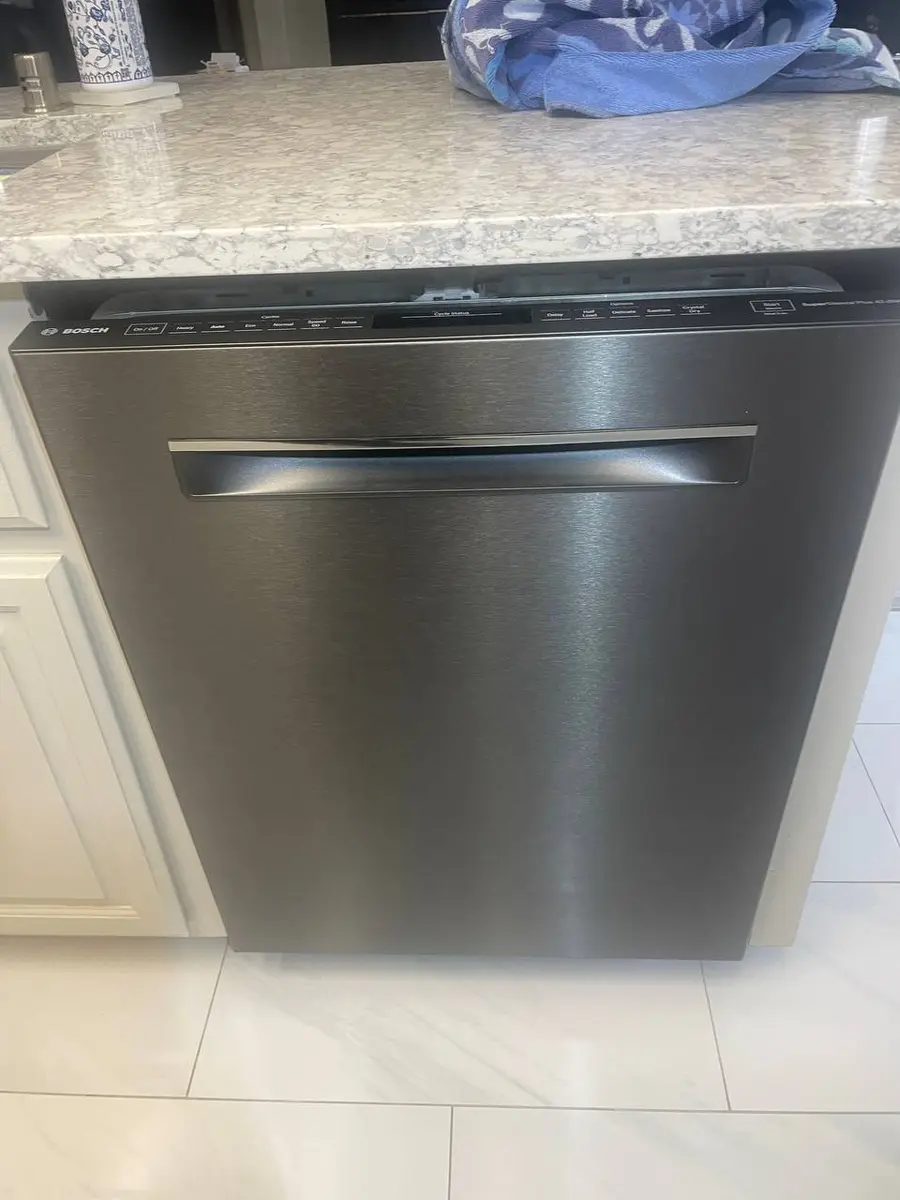
How to Replace a Bosch Dishwasher Heating Element
On a Bosch dishwasher the heater is a tube inside the pump casing, so a failed element usually means replacing the whole pump/heater assembly. It is an advanced 60-90 minute job on a high-current circuit — verify zero voltage before you touch a terminal.
Unlike an old exposed coil in the tub floor, Bosch heats water as it flows through a tubular element in the pump. That is efficient, but it ties the heater to the pump, and the giveaways of a bad one are cold, greasy dishes, undissolved detergent, an E09 or E01 code, and a Sanitize cycle that never gets hot.
Tools and parts#
- Tools: Torx T20 driver, Torx T15 driver, 10mm wrench, needle-nose pliers, multimeter, a moving blanket, towels, a helper for tipping
- Part: the integrated pump/heater assembly (model-specific), or a standalone heater tube on some pre-2014 models
- Time: 60-90 minutes
- Difficulty: Advanced
- Safety warning: The heater circuit draws 15+ amps at 120V (1800W). Disconnect power at the breaker AND verify with multimeter that no voltage is present before touching heater terminals. Allow 20+ minutes cooling if the dishwasher recently ran. Heater connections use thick gauge wire — reconnect securely to prevent arcing and fire hazard.
Do You Have the Right Tools?
Water pressure gauge ($60), spray arm tester, float switch multimeter ($85), and drain inspection camera. Our technician arrives with $3,000+ in professional tools — your diagnostic is free.
Licensed & Insured · 90-Day Warranty · Same-Day Service
Step 1 — Confirm the heater failed#
Before buying an assembly, meter it. Pull the kick plate (2 Torx T20 screws), find the two thick heater wires (12-14 gauge) on spade terminals at the pump housing, and disconnect one. Across the heater terminals a healthy flow-through element reads 10-15 ohms; OL means a broken element and under 2 ohms means a short. Also check for a ground fault by metering between a terminal and the metal pump housing — that should read infinity, and any resistance means a short to ground.
Step 2 — Identify your heater style#
Check the model number inside the door. Machines from 2014 on use the integrated pump/heater (replace as an assembly); 2008-2013 models may have a separate flow-through tube you can replace on its own; pre-2008 units may hide an exposed element in the tub base and need a different procedure. This guide follows the integrated assembly.
Safety First — Know the Risks
Live 120V wiring in a wet environment is one of the most dangerous DIY scenarios. Water + electricity = serious shock risk. Our techs are licensed and insured — let them handle the risk.
Licensed & Insured · 90-Day Warranty · Same-Day Service
Step 3 — Prep and disconnect#
Kill the breaker and close the water. Pull the racks, spray arms, and triple filter, and sponge out standing water. Remove the kick plate, back out the two Torx T20 countertop mounting screws inside the door, disconnect the water line (10mm wrench, catch the water), release the drain hose, and slide the dishwasher all the way out.
Step 4 — Lay it on its back#
With a helper, lower the machine onto its back on a blanket so the base plate faces up. Remove the 4-6 Torx T20 screws around the base-plate perimeter and lift it off — the pump/heater is the big central component with several hose and wire connections.
The Real Cost of DIY
Average DIY attempt: $150-400 in tools you may use once, plus the risk of further damage. Our diagnostic visit costs $0 — we find the problem and give you an honest quote.
Licensed & Insured · 90-Day Warranty · Same-Day Service
Step 5 — Photograph every connection#
Before you unplug anything, shoot clear photos from above and each side. You should see the multi-pin motor harness, the two thick heater spade wires, the sump inlet hose, the spray-arm outlet hose, and maybe a small sensor lead. Tape-label anything the photos leave unclear.
Step 6 — Disconnect the wiring#
Release the motor harness (press its tab, pull straight), then pull each heater spade off by gripping the metal connector, not the wire, rocking it gently with pliers if it sticks. Unplug any NTC temperature-sensor lead from the pump housing.
Don't Void Your Warranty
Opening your appliance yourself may void the manufacturer warranty. Our repair comes with a 90-day guarantee, and we document everything for warranty compliance.
Licensed & Insured · 90-Day Warranty · Same-Day Service
Step 7 — Pull the hoses#
Squeeze each spring clamp and slide it back, then work each hose off its barb — the sump inlet, the spray-arm outlet, a small drain branch, and sometimes an overflow hose. Each releases water, so keep towels down, and note the barb each one came from since diameters differ.
Step 8 — Release the assembly#
The pump/heater mounts to the sump on a bayonet twist ring (most 2014-plus) or a bracket with 3-4 Torx T15 screws (older). For a bayonet, grip the body and rotate it 15-20 degrees counterclockwise until the tabs clear, then pull it straight down and support its 3-5 lbs. The sump O-ring should come with the new part.
Is It Worth Your Time?
Dishwasher issues overlap between drain pump, wash motor, inlet valve, and control board. DIY diagnosis averages 3-5 hours. Our technician diagnoses the issue in about 30 minutes — same-day appointments available.
Licensed & Insured · 90-Day Warranty · Same-Day Service
Step 9 — Fit the new assembly#
Smear a thin film of silicone grease on the new O-ring, line the assembly up with the sump opening to match your photos, push it up onto the bayonet tabs, and rotate clockwise to the lock detent. Reconnect every hose to its original barb with the clamps over the ridges, then the electrical — motor harness clicked home, heater spades pushed fully on, sensor lead seated.
Step 10 — Reassemble and test#
Refit the base plate, return the machine upright with your helper, reconnect the water and drain, slide it back under the counter, drive the mounting screws, and refit the kick plate before reloading the filter, spray arms, and racks. Open the water, restore power, and run the Sanitize cycle (its 75C/167F target). By 15 minutes the door should feel distinctly warm, the cycle should finish with no E09 or E01 error, and there should be no leaks at any pump joint.
The Risk of Getting It Wrong
A wrong diagnosis often turns a simple fix into a costly replacement. Without proper diagnostic tools, you might replace the wrong part — or cause additional damage. Our free diagnostic eliminates the guesswork.
Licensed & Insured · 90-Day Warranty · Same-Day Service
When to call a professional#
This is one of the more involved Bosch repairs. Get help if you are not confident verifying zero voltage on a high-current circuit, if you cannot safely tip a 75-90 lb dishwasher with a helper, if your model is an 800 series with Zeolite drying (its canister ties into the pump routing), if the sump mounting ring is damaged, or if multiple codes (E09 with E15 and E21) suggest a cascading failure.
Not up for tipping it on its back? Book a same-day Bosch dishwasher repair.
Appliance Repair Technician & Diagnostics Specialist · 10 years experience
Electronics and diagnostics specialist with 10 years of experience in modern smart appliance repair, specializing in LG and Samsung.