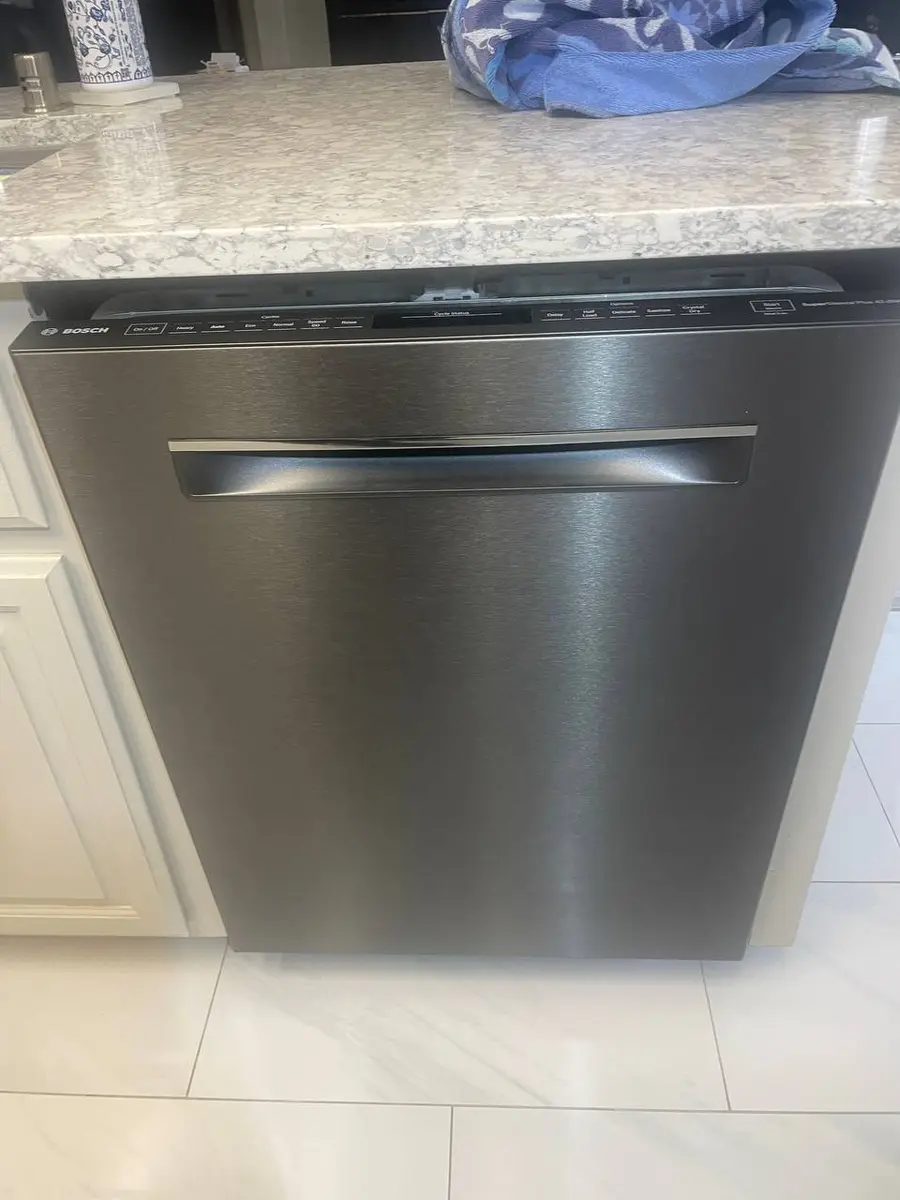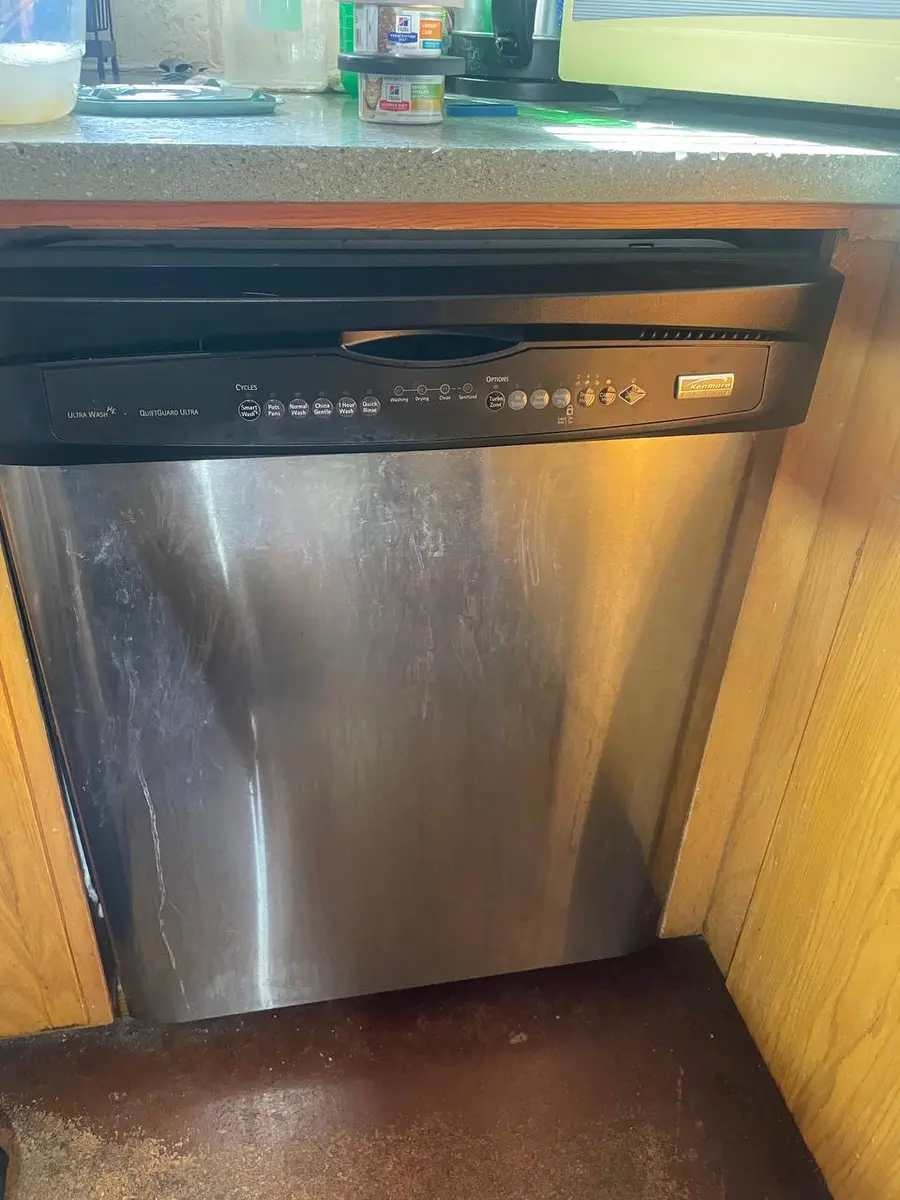
How to Remove a Built-In Whirlpool Dishwasher
Kill the dishwasher's breaker and confirm it dead, close the hot-water supply under the sink, and drop the kick plate to reach the junction box, supply line, and drain hose. Disconnect all three, back out the two Torx T20 screws holding the unit to the countertop, retract the leveling legs for clearance, and slide it…
Working on a Whirlpool dishwasher follows a sequence built to keep it safe and the result reliable. This applies to all Whirlpool WDT and WDF series built-in dishwashers; portable and countertop models disconnect differently.
Tools, Parts, and Safety First#
- Tools needed: Torx T20 driver, 1/4" hex nut driver, adjustable wrench or channel-lock pliers, flathead screwdriver, non-contact voltage tester, towels, shallow pan, cardboard or moving blanket (floor protection)
- Parts needed: None for removal; wire nuts and electrical tape for capping wires if replacing the unit
- Time required: 20-30 minutes
- Difficulty: Beginner to Intermediate (depends on hardwired vs plug-in electrical)
- Safety warning: Disconnect power at the circuit breaker AND verify with a non-contact voltage tester before touching any wiring. Turn off the water supply valve completely.
Do You Have the Right Tools?
Water pressure gauge ($60), spray arm tester, float switch multimeter ($85), and drain inspection camera. Our technician arrives with $3,000+ in professional tools — your diagnostic is free.
Licensed & Insured · 90-Day Warranty · Same-Day Service
Step-by-Step Instructions#
Step 1 — Kill power at the breaker#
Find the breaker dedicated to the dishwasher — typically a 20A single-pole labeled "Dishwasher" or "Kitchen" — and flip it OFF. If you are not sure which it is, run a cycle and flip breakers until the dishwasher stops. Leave it OFF for the entire removal.
Step 2 — Shut off the water supply#
Open the cabinet under the sink and follow the braided stainless line from the dishwasher's side wall to the hot-water supply valve, then turn it clockwise until fully closed. If the valve is seized (common on older installs), do not force it — shut off the main house water instead and deal with the valve later.
Step 3 — Remove the kick plate#
The kick plate at the bottom is held by two 1/4" hex screws, one at each end. Remove both and pull the panel forward and down. This exposes the electrical junction box, the water supply connection, and the drain-hose routing — where all the disconnection happens.
Step 4 — Verify zero power#
With a non-contact voltage tester, confirm the junction box and all visible wiring show no voltage. Remove the junction-box cover plate (usually one screw) and test the black (hot) wire. Any reading means the wrong breaker is off — go back and find the right one. Never proceed with live wiring.
Step 5 — Disconnect the electrical#
Whirlpool dishwashers connect one of two ways. Hardwired: open the junction box, where wire nuts join black-to-black (hot), white-to-white (neutral), and a green or bare ground to the box ground screw — remove the nuts, separate the wires, and cap the house wires with fresh wire nuts so nothing is exposed. Plug-in: some installs use a cord into an outlet under the sink or behind the unit, so simply unplug it, no junction-box work needed.
Step 6 — Disconnect the water supply line#
With an adjustable wrench, loosen the compression fitting or braided connector where the supply attaches to the dishwasher's inlet valve (W10872255), on the bottom-left. Have a towel or shallow pan ready for the residual water, then remove the line completely from the fitting.
Step 7 — Disconnect the drain hose#
The drain hose leaves on the left side and routes to one of three places: an air-gap fitting on the countertop, a high loop under the counter, or the garbage disposal inlet. Disconnect at the sink end — loosen the hose clamp at the air gap, the disposal nipple, or the drain tailpiece and pull the hose off — then cap the drain connection so sewer gas cannot enter the kitchen.
Step 8 — Remove the countertop mounting screws#
Open the door and look at the top inner edge of the opening: two Torx T20 screws drive up into the underside of the countertop (or into brackets on a stone counter). Remove both, and check both sides for any additional side-mount bracket screws into the adjacent cabinets.
Step 9 — Lower the leveling legs#
Whirlpool dishwashers have adjustable front legs (and sometimes rear legs). With a flathead or wrench on the leg hex, turn the front legs clockwise to retract them and drop the unit slightly, giving about 1/4" of clearance between the dishwasher top and the countertop underside for extraction.
Step 10 — Protect the floor and pull it out#
Lay cardboard or a moving blanket on the floor in front of the unit, especially on hardwood or tile. Grip both sides through the open door and slide it straight forward, feeding the drain hose and supply line through the cabinet hole as it comes. Pull straight out without tilting, since angling can catch the rear legs on the flooring. If it resists, check that the legs are not catching on uneven flooring, the drain hose is free, and no screws were missed. Work slowly here: the most common damage during a dishwasher pull is a gouged floor from a leveling foot that never fully retracted, or a kinked supply line that snags on the cabinet cutout and pulls its fitting loose. Have your helper watch the rear hoses feed through the hole while you handle the front, and stop the moment anything binds rather than forcing it. A dishwasher that fights you almost always has one specific thing catching, not a general jam, so a few seconds spent finding it beats muscling the unit and tearing something loose.
Step 11 — Inspect the cavity#
With the dishwasher out, check for water damage on the floor and adjacent cabinet walls, note the electrical connection type (outlet vs hardwire) for the replacement, measure the cavity width (standard is 24") and depth, clear any debris from the drain-hose path, and check the supply valve for dripping — replace it now if it seeps with the dishwasher disconnected.
Handling Difficult Extractions#
| Problem | Solution |
|---|---|
| Granite countertop with side brackets | Look for screws in metal brackets at the top — they attach to granite clips, not the stone itself |
| Tile floor higher at opening than under unit | Retract legs fully, place a thin sheet of cardboard under front legs to slide on |
| Hardwood floor — afraid of scratching | Cardboard runway, or lift front slightly and place felt pads under front legs |
| Unit stuck — won't slide at all | Check for a rear anti-tip bracket that may be screwed to the floor |
| Drain hose too short to pull through | Disconnect at dishwasher end instead of sink end |
Safety First — Know the Risks
Live 120V wiring in a wet environment is one of the most dangerous DIY scenarios. Water + electricity = serious shock risk. Our techs are licensed and insured — let them handle the risk.
Licensed & Insured · 90-Day Warranty · Same-Day Service
When Should You Call a Professional?#
EasyBear technicians serving Sacramento and the Bay Area carry Whirlpool-specific diagnostic tools and replacement parts on every service call. Call one if you cannot locate or reach the junction box, if the under-sink supply valve is seized and you cannot shut off water, if the dishwasher was installed with spray foam around the cavity, if a raised subfloor or built-up tile makes the opening too tight to extract, or if the unit is hardwired and you are not comfortable making electrical disconnections.
Need Professional Help?#
Need help with this repair? Schedule a free diagnostic — same-day Whirlpool dishwasher service across the Bay Area.
Appliance Repair Technician & Diagnostics Specialist · 10 years experience
Electronics and diagnostics specialist with 10 years of experience in modern smart appliance repair, specializing in LG and Samsung.