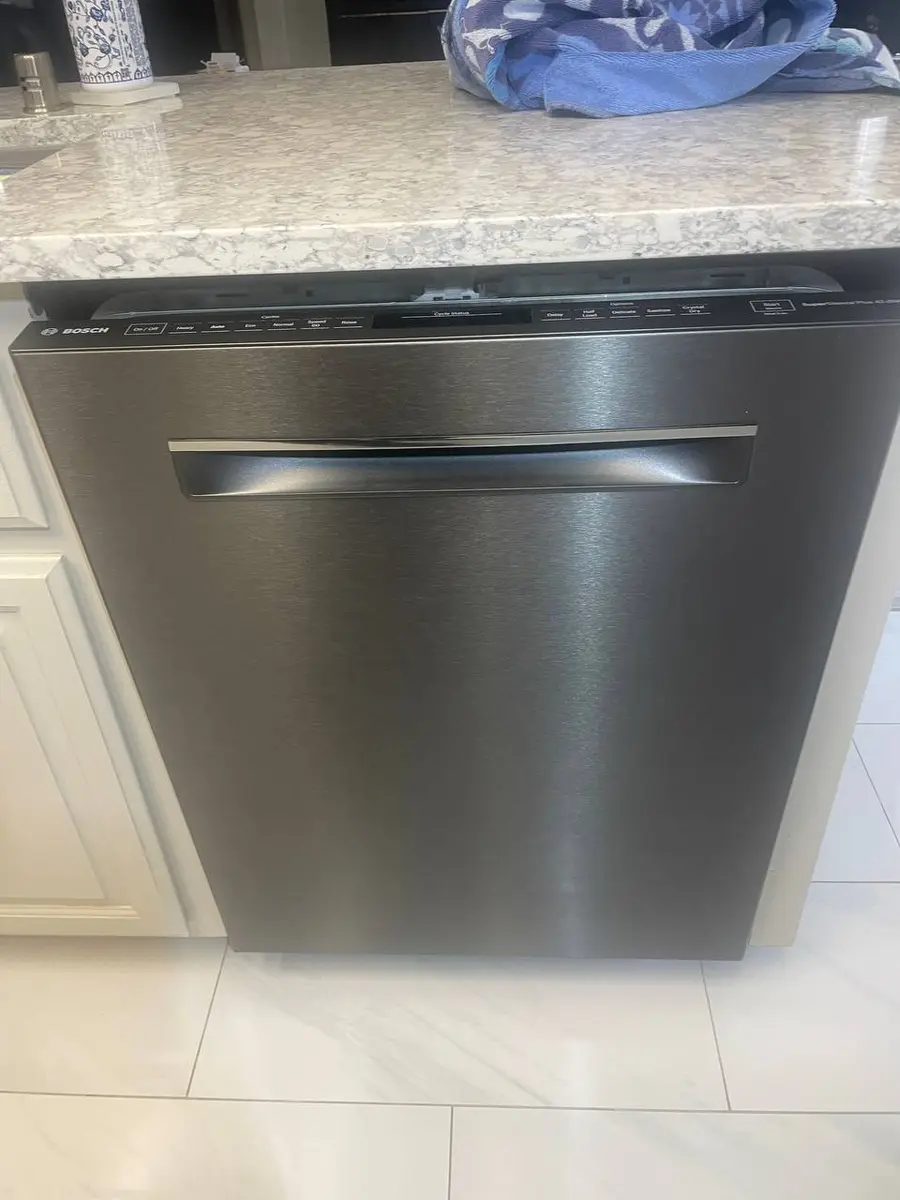
How to Disassemble a Whirlpool Dishwasher: Basics
You can reach almost every serviceable part of a Whirlpool dishwasher without pulling the unit out. Open the door, lift the racks, and the spray arms and dual filter come off by hand or with a quarter turn. About 8 Torx T20 screws free the inner door panel for the latch and dispenser, and two 1/4" hex screws drop the…
The right way to service a Whirlpool dishwasher depends on the model series, and this guide covers the current variants. Plenty of maintenance and part swaps happen with the unit in place, reached from the front and through the kick-plate area below. This is basic disassembly — everything you can get to without disconnecting water lines or removing the countertop mounting screws.
It covers filter cleaning, spray-arm replacement, rack-adjuster repairs (the W10350376 upper-rack wheels are the most common Whirlpool dishwasher failure), door-gasket replacement, and inner-door access for the detergent dispenser or door latch.
Tools, Parts, and Safety First#
- Tools needed: Torx T20 driver, 1/4" hex nut driver, soft cloth, magnetic tray for screws
- Parts needed: Depends on your repair — this guide covers access only
- Time required: 15-25 minutes for full interior disassembly
- Difficulty: Beginner
- Safety warning: Always disconnect power at the circuit breaker before removing the inner door panel or accessing any electrical components. For filter and spray arm work only, disconnecting power is recommended but not strictly necessary if you do not run a cycle.
Do You Have the Right Tools?
Water pressure gauge ($60), spray arm tester, float switch multimeter ($85), and drain inspection camera. Our technician arrives with $3,000+ in professional tools — your diagnostic is free.
Licensed & Insured · 90-Day Warranty · Same-Day Service
Step-by-Step Instructions#
Step 1 — Open the door and pull the racks#
Open the door fully and draw the lower rack straight out on its rollers, lifting the front slightly to clear the track stops. Do the same with the upper rack, and if your model has a 3rd-level rack (the shallow utensil tray at the very top), pull it forward on its tracks and lift it off. Rest the racks on a towel.
Step 2 — Remove the upper rack adjusters (for rack repair)#
The W10350376 rack adjuster is the most-replaced part on Whirlpool dishwashers — the little wheels the upper rack rolls on wear and crack, so the rack sags or drags. Each adjuster clips to the rack track inside the tub. Squeeze the retaining tabs on the adjuster body and pull it straight out of the track; the rollers and end caps come out as one unit, no tools needed.
Step 3 — Remove the lower spray arm#
The lower arm sits on a hub in the center of the tub floor. Some models use a twist nut under the arm; others are a friction fit that pulls straight up. For a twist-nut model, reach under and turn the nut counterclockwise, then lift the arm off. For a friction fit, grip the arm at the center and pull straight up with moderate force.
Step 4 — Remove the middle spray arm#
The middle arm mounts to the bottom of the upper-rack support. With the upper rack out, reach up to where the arm meets the feed tube, push the arm upward against the connector, and twist counterclockwise to release it into your hand. Watch for the small washer or O-ring at the joint — do not lose it.
Step 5 — Remove the upper spray arm#
The upper arm clips to the tub ceiling. Find the retaining tabs on either side of its center mount, press both inward at once, and pull the arm straight down; on some models it unscrews counterclockwise from a threaded fitting. Check the O-ring at this joint — a worn one here weakens spray pressure to the top rack.
Step 6 — Remove the dual filter assembly#
With the lower arm off, the cylindrical upper filter in the center of the tub floor is exposed. Grip its handle and twist about a quarter turn counterclockwise; it unlocks and lifts straight out. Then lift the flat lower mesh filter, which sits in a groove and comes straight up. That opens access to the chopper blade and sump area. With both filters out, take a moment to look the sump over: food debris and glass fragments collect here, and a jammed chopper blade is what drives most drainage and cleaning complaints. Wipe the sump clean before anything goes back, since debris left behind gets pulled straight back into the wash and can re-clog the filter within a cycle or two.
Step 7 — Access the inner door panel#
To reach the detergent dispenser, door latch (W10862259), wax motor, or door vent, open the door flat and find the roughly 8 Torx T20 screws around the perimeter of the inner stainless door panel. Remove them all and carefully separate the inner panel from the outer door — it may stick against the gasket, so pull evenly to avoid bending. With it off, you have direct access to:
- Detergent dispenser mechanism and wax motor (center-left)
- Door latch assembly (top center)
- Vent and fan assembly (top, used for drying)
- Wiring harness routing for all door components
- Door gasket retaining channel
Step 8 — Remove the door gasket#
The door-perimeter gasket seats in a channel by friction — nothing glued or screwed. Start at a corner, pull the gasket lip out of the channel, and work around the perimeter; if it resists, a flat-blade screwdriver pries it free without damaging the gasket or the channel edges. Installing the new one is the reverse: press it into the channel from the top and work out to the corners.
Step 9 — Access the kick-plate area (without a full pull-out)#
Remove the two 1/4" hex-head screws holding the lower access panel (kick plate); it drops forward and out. From there you can reach:
- Water inlet valve (W10872255) — lower left, on the braided supply line
- Electrical junction box — lower right, where house wiring lands
- Drain hose routing — down the left side to the sink connection
- Float switch — the small dome on the bottom-left of the tub floor (its wiring is visible from below)
Step 10 — Reassembly sequence#
Reassemble in reverse, watching a few points per part:
- Door gasket: start at top center, press firmly into the channel, no twists or bunching at the corners
- Inner door panel: line up every screw hole before driving any screw; Torx T20, snug only — overtightening strips the plastic
- Filters: lower mesh first (into the groove), then the upper cylinder twisted clockwise to lock
- Spray arms: lower arm onto the hub, nut clockwise (finger tight plus half a turn); middle and upper reconnect by pushing up and twisting clockwise
- Racks: upper first, then lower, 3rd-level last; test the slide action before loading dishes
Parts Commonly Accessed This Way#
| Part | Part Number | Typical Failure | Access Method |
|---|---|---|---|
| Upper rack adjuster | W10350376 | Cracked wheels, rack sags | Squeeze tabs, pull from track |
| Door latch | W10862259 | Door won't lock, F5E1 error | Inner door panel removal |
| Lower spray arm | varies by model | Cracked, leaking at hub | Twist nut CCW, lift off |
| Dual filter | varies by model | Clogged, torn mesh | Quarter turn CCW, lift |
| Door gasket | varies by model | Leaking, mold growth | Pull from channel |
| Chopper blade | W10083957 | Jammed, broken teeth | Filter removal exposes it |
Safety First — Know the Risks
Live 120V wiring in a wet environment is one of the most dangerous DIY scenarios. Water + electricity = serious shock risk. Our techs are licensed and insured — let them handle the risk.
Licensed & Insured · 90-Day Warranty · Same-Day Service
When Should You Call a Professional?#
EasyBear technicians serving Sacramento and the Bay Area carry Whirlpool-specific diagnostic tools and replacement parts on every service call. Call one if the door hinge springs are broken and the door falls open violently (spring replacement needs special tools and carries injury risk), if you need the circulation or drain pump (which means pulling and tipping the unit), if the control board needs replacing (some models require separating the door halves at the hinge), or for any task that needs electrical testing under power.
Need Professional Help?#
Need help with this repair? Schedule a free diagnostic — our technicians handle Whirlpool dishwasher repairs same-day.
Appliance Repair Technician & Diagnostics Specialist · 10 years experience
Electronics and diagnostics specialist with 10 years of experience in modern smart appliance repair, specializing in LG and Samsung.