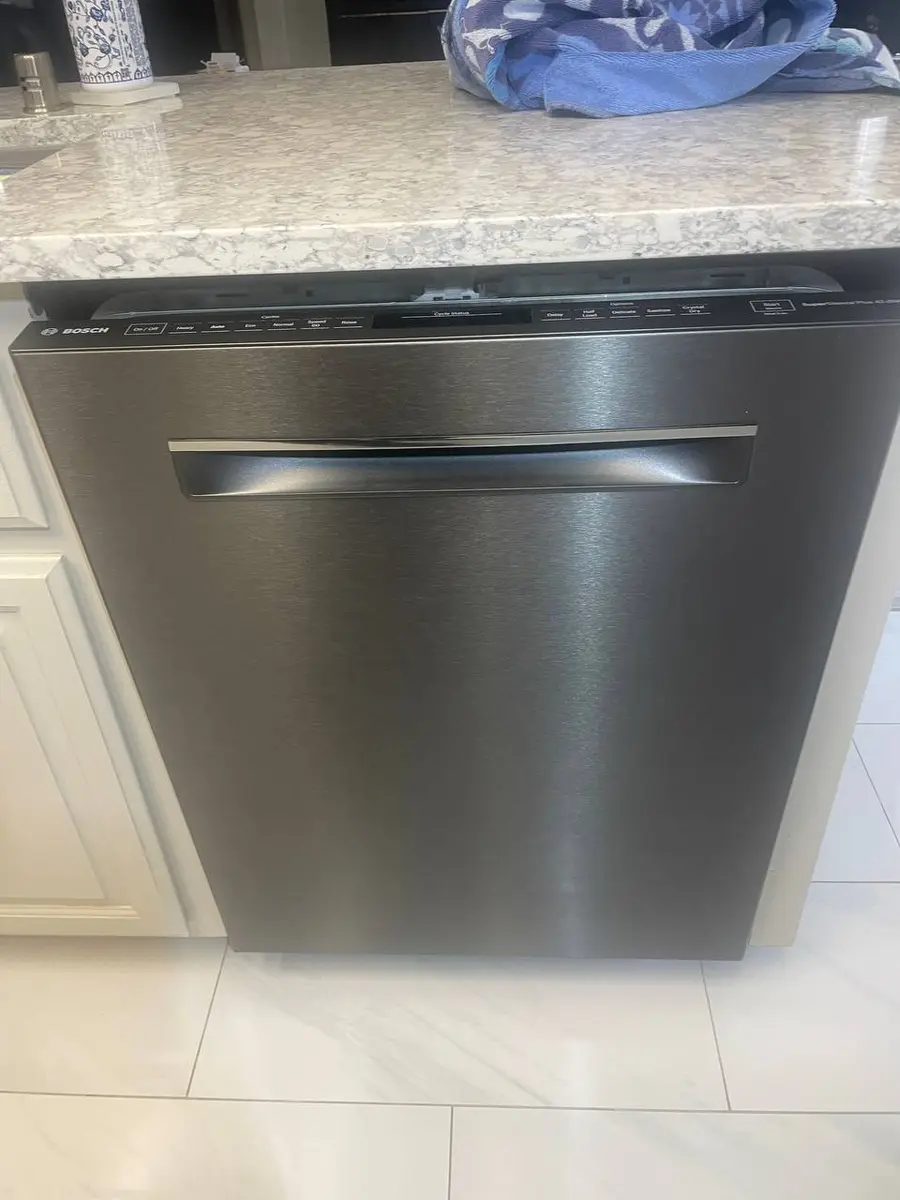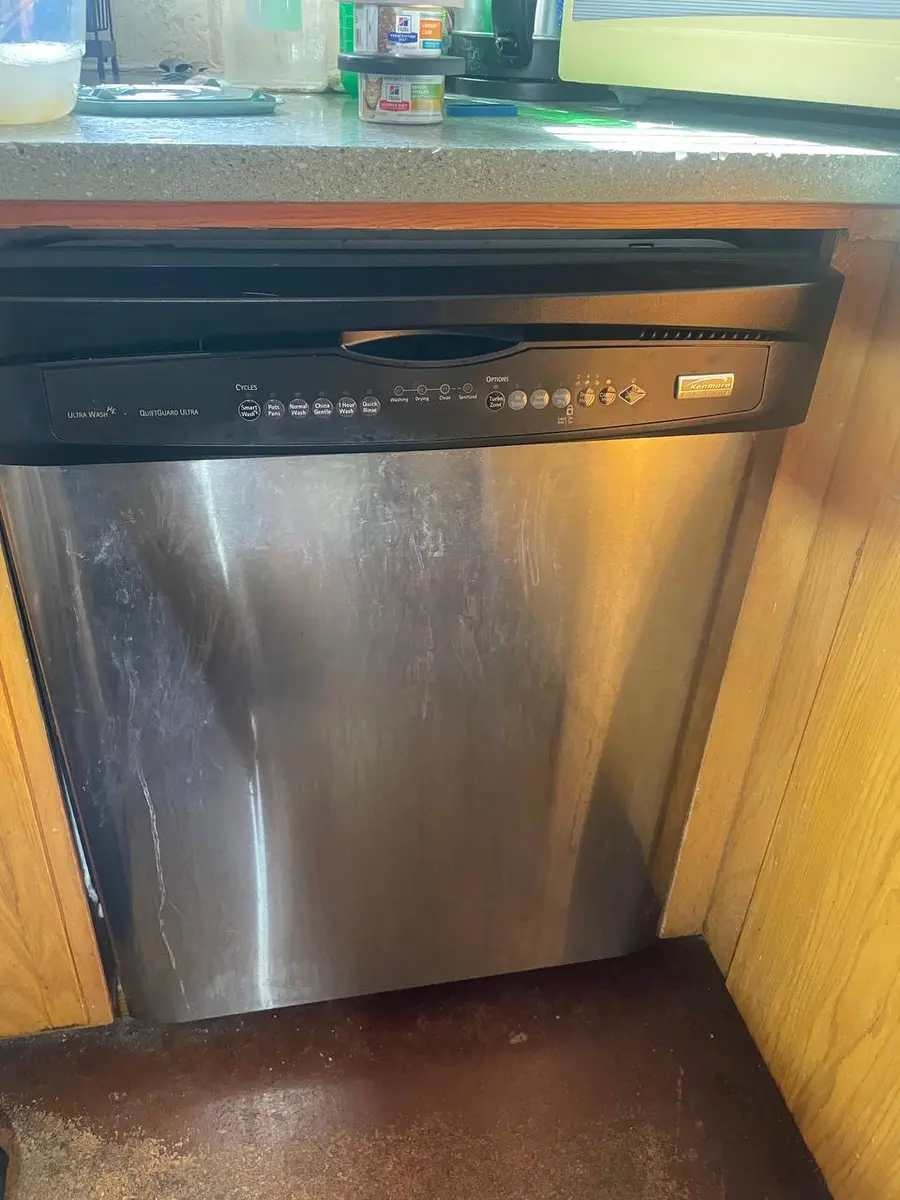
How to Fully Disassemble a Whirlpool Dishwasher
A full Whirlpool dishwasher teardown goes further than an in-tub clean: kill power and water, drop the kick plate, disconnect the supply line and drain hose, remove the two countertop screws, and slide the unit out. From there the inner door panel (about 8 Torx T20 screws) opens the latch and dispenser, and tipping…
This is the complete access guide, from kick plate to control board, for WDT750, WDT730, WDF520, and similar Whirlpool dishwashers. Whirlpool uses Torx T20 fasteners (not Phillips like Samsung or Bosch), with 1/4" hex screws on access panels. Before starting, find your tech sheet — taped inside the inner door panel or under the console — since its wiring diagram and component locations are invaluable during reassembly.
Tools, Parts, and Safety First#
- Tools needed: Torx T20 driver, 1/4" hex nut driver, Phillips #2 screwdriver (secondary), 5/16" nut driver (mounting brackets), flathead screwdriver (prying clips), magnetic parts tray, smartphone (for photos)
- Parts needed: None (disassembly procedure)
- Time required: 35-45 minutes for full disassembly
- Difficulty: Intermediate
- Safety warning: Disconnect power at the circuit breaker. Turn off the water supply valve. If the dishwasher is hardwired, verify zero voltage at the junction box with a non-contact voltage tester.
Do You Have the Right Tools?
Water pressure gauge ($60), spray arm tester, float switch multimeter ($85), and drain inspection camera. Our technician arrives with $3,000+ in professional tools — your diagnostic is free.
Licensed & Insured · 90-Day Warranty · Same-Day Service
Step-by-Step Instructions#
Step 1 — Disconnect power and water#
Turn off the dishwasher's dedicated breaker and close the hot-water supply valve under the sink (follow the braided steel line from the dishwasher to find it). Open the door and press Cancel/Drain to release standing water, then close it and wait 2 minutes for the drain cycle to finish before proceeding.
Step 2 — Remove the kick plate#
The kick plate is held by two 1/4" hex screws, one at each end. Remove both and the panel drops down and forward, exposing the junction box, water inlet valve, drain-pump area, and supply connection. Label or photograph all wire colors and hose routing before disturbing anything.
Step 3 — Disconnect the water supply line#
With channel-lock pliers or a wrench, disconnect the braided steel supply line from the inlet valve at the bottom-left, keeping a towel ready for residual water, and cap the line or set it in a pan to avoid drips while you work.
Step 4 — Disconnect the drain hose under the sink#
The drain hose leaves the dishwasher on the left and routes to an air gap, a high loop, or the garbage disposal. Disconnect it at the sink-side connection with pliers on the spring clamp, letting residual water drain into a bucket.
Step 5 — Remove the countertop mounting screws#
Open the door fully and look at the top inner edge of the opening — two Torx T20 screws (sometimes Phillips, depending on the installer) drive up into the countertop underside. These are the only screws holding the dishwasher in place, so remove them.
Step 6 — Slide the dishwasher forward#
Close the door, protect the floor with cardboard, grip the sides, and slide the unit straight forward on its leveling legs. Pull it out far enough to reach the rear and underside — typically 18-24 inches gives adequate working room.
Step 7 — Remove the inner door panel#
Open the door fully. The inner stainless door panel is held by about 8 Torx T20 screws around the perimeter — remove them all, and the inner panel separates from the outer door, opening access to the door latch (W10862259), the detergent dispenser motor, the vent assembly, and the door wiring harnesses.
Step 8 — Access the control board#
The main control board sits behind the outer door panel at the top of the door, visible from the inside once the inner panel is off. Some models require removing the outer panel by unscrewing the handle screws and the Torx T20 screws along the top edge. The board (W11305310 on newer models — always verify for yours) disconnects via multiple ribbon cables and wire-harness connectors.
Step 9 — Remove the spray arms#
Inside the tub, remove the spray arms for sump access: the lower arm twists off (center nut counterclockwise, then lift), the middle arm releases where it meets the bottom of the upper rack (push up, twist counterclockwise), and the upper arm pulls down after pressing its retaining clips. Keep track of any washers or spacers.
Step 10 — Remove the filter assembly and reach the sump#
Grip the upper cylindrical filter handle and twist it counterclockwise a quarter turn to unlock, then lift it out, and lift the lower flat mesh filter straight up from its groove. That exposes the chopper blade (W10083957) and the sump, where the circulation and drain pumps connect from below.
Step 11 — Access the pump assembly from below#
To reach the drain pump (W10876537) and circulation pump, tip the dishwasher onto its back on a blanket — the whole pump and motor assembly is then accessible from the bottom. The drain pump usually has a bayonet mount (twist counterclockwise to release) or 2-3 Torx T20 screws, while the circulation pump is larger and held by a retaining ring or screws to the sump housing.
Step 12 — Remove the spray-arm feed tubes (if needed)#
The middle spray-arm water feed runs up the left side of the tub interior and connects at the bottom to the circulation-pump output, secured by a single mid-point Torx T20 screw. The upper spray-arm feed routes through the tub corner and connects at the top. Only remove these if you need to replace them or reach components behind them. Photograph the routing before you pull a feed tube, since the middle-arm tube and the upper-arm tube look similar out of the machine but seat into different ports, and a swapped feed tube leaves one rack washing at reduced pressure. If a tube resists coming free, check for a hidden clip at the top corner rather than forcing it, because the plastic elbows crack easily when levered.
Reassembly Notes#
Reassemble in exact reverse, watching a few checkpoints. Do not overtighten the inner-door Torx T20 screws into the plastic frame — they strip easily, so snug plus a quarter turn is enough. The upper cylindrical filter must lock with a clockwise quarter turn; if it spins freely, lift and reseat it. Tighten spray-arm nuts finger-tight plus a half turn with pliers, since overtightening cracks the plastic hub. On the braided supply line, use thread tape and tighten a quarter turn past hand-tight. And drive the countertop screws back into the same holes rather than making new ones in the counter.
Safety First — Know the Risks
Live 120V wiring in a wet environment is one of the most dangerous DIY scenarios. Water + electricity = serious shock risk. Our techs are licensed and insured — let them handle the risk.
Licensed & Insured · 90-Day Warranty · Same-Day Service
Torx T20 Fastener Map#
| Location | Quantity | Fastener Type | Notes |
|---|---|---|---|
| Countertop mounting | 2 | Torx T20 | Upper door frame edge |
| Inner door panel perimeter | ~8 | Torx T20 | Around entire inner door |
| Kick plate | 2 | 1/4" hex | Panel drops down |
| Sump drain pump | 2-3 | Torx T20 | Or bayonet mount |
| Spray arm feed tube | 1-2 | Torx T20 | Mid-tub left side |
| Mounting brackets (legs) | 2-4 | 5/16" nut | Adjustable leveling |
When Should You Call a Professional?#
EasyBear technicians serving Sacramento and the Bay Area carry Whirlpool-specific diagnostic tools and replacement parts on every service call. Call one if the dishwasher is hardwired and you are not comfortable verifying the junction box is de-energized, if it sits under a granite countertop with custom trim (extraction without damage takes experience), if you need to separate the outer tub for bearing or seal work (specialized tub-splitting tools), or if multiple components have failed and you suspect a control board (which needs voltage testing under power).
The Real Cost of DIY
Average DIY attempt: $150-400 in tools you may use once, plus the risk of further damage. Our diagnostic visit costs $0 — we find the problem and give you an honest quote.
Licensed & Insured · 90-Day Warranty · Same-Day Service
Need Professional Help?#
Need help with this repair? Schedule a free diagnostic — same-day Whirlpool dishwasher service across the Bay Area.
Lead Appliance Repair Technician · 12 years experience
Experienced technician with 12 years specializing in washing machine and dryer repairs across all major brands.