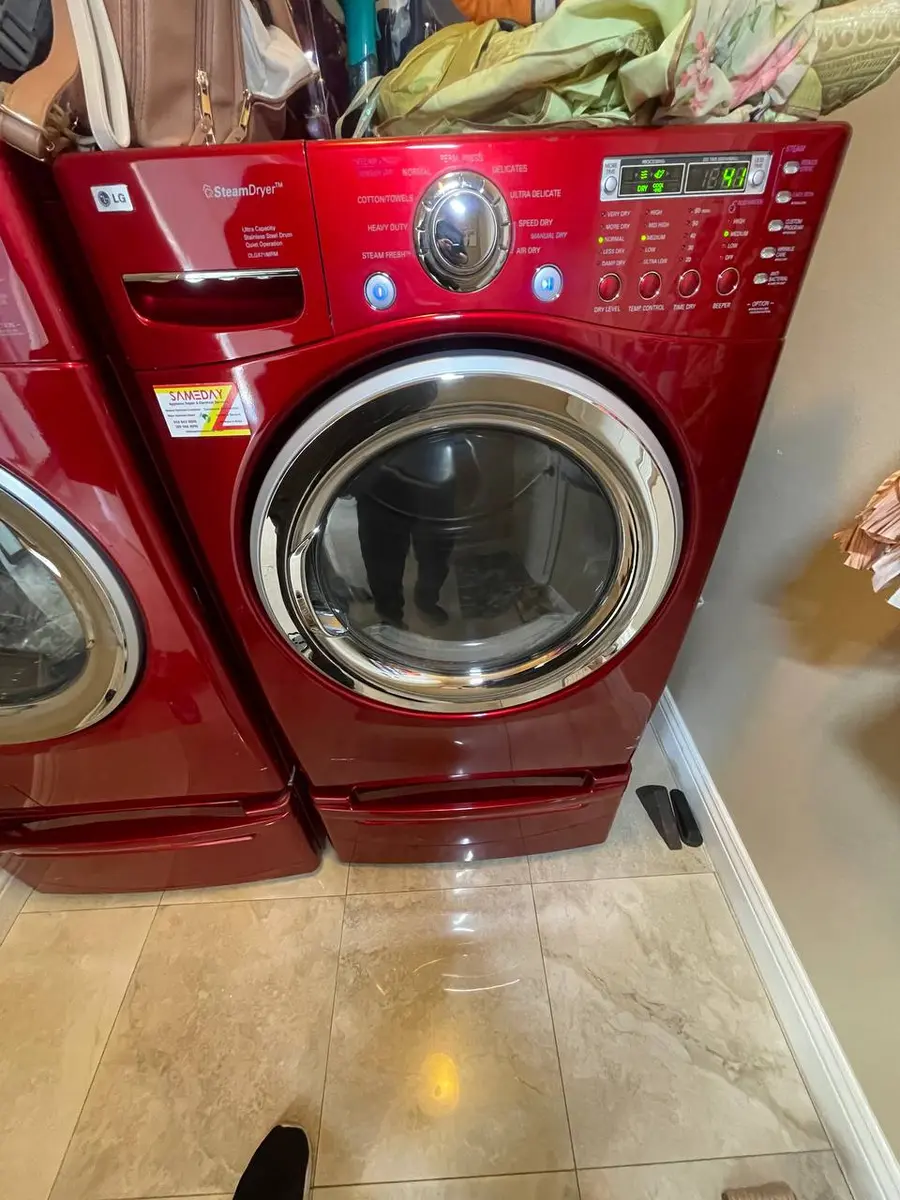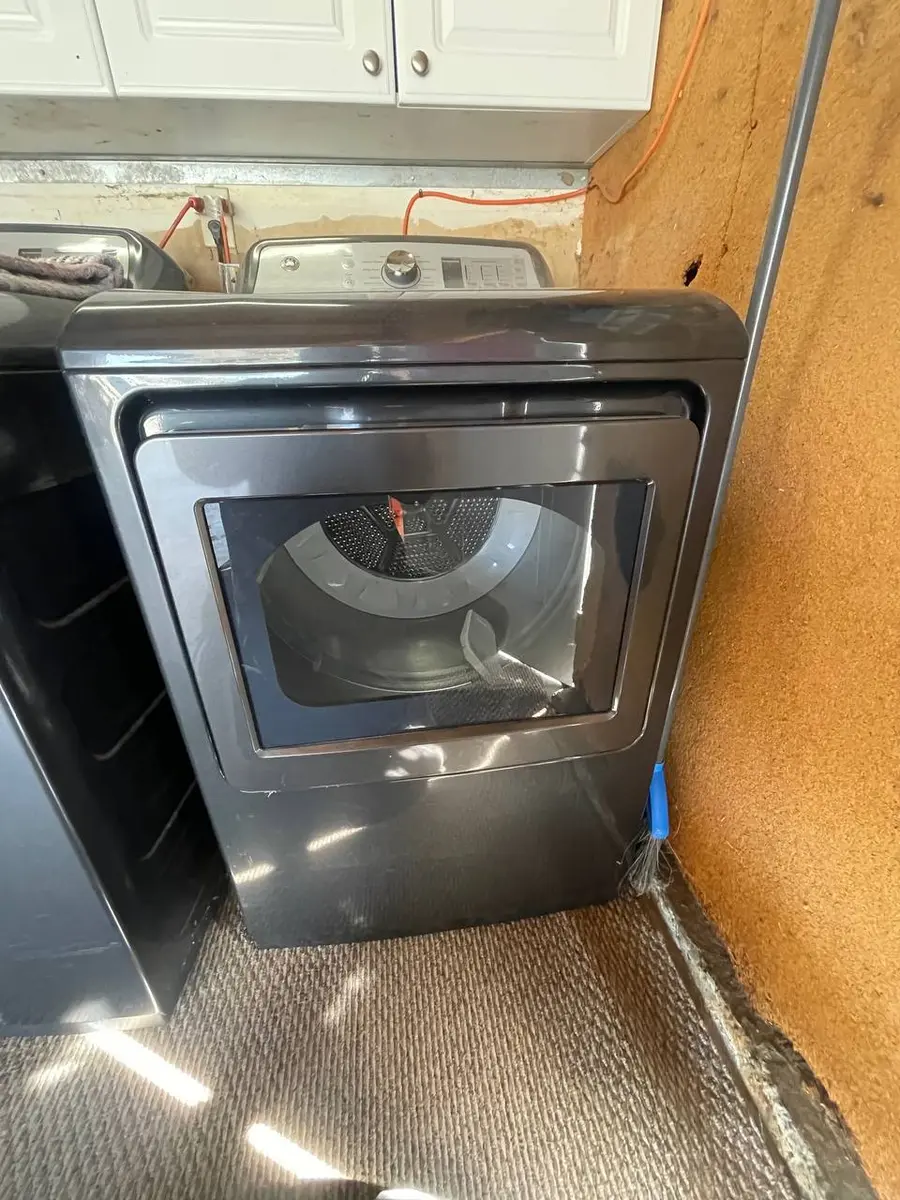
How to Disassemble an LG Dryer
Disassembling an LG dryer goes top panel, front panel (putty-knife clips), and drum, which then exposes the belt, idler pulley, and motor, with the element behind the rear panel on electric models. Plan on an intermediate 15-60 minutes with a #2 Phillips, a putty knife, and a 5/16-inch nut driver.
The drum will not lift until the belt is fully off the motor pulley and the rear support has cleared, so release the strong idler spring first, tilting the drum forward as it comes out. Keep the belt path in a photo, because the idler tension has to be re-created exactly on reassembly.
Before You Start#
- Tools needed: Phillips #2 screwdriver, putty knife (for front panel clips), 5/16-inch nut driver, flat-blade screwdriver, work gloves
- Time required: 15-60 minutes depending on depth of disassembly
- Difficulty: Intermediate
- Safety warning: Unplug the dryer. For gas models, close the gas supply valve. Wait 5 minutes after unplugging. LG dryers retain some charge in the motor start capacitor.
Do You Have the Right Tools?
Gas leak detector ($130), thermal fuse tester ($95), belt tension gauge, and vent inspection camera ($180). Our technician arrives with $3,000+ in professional tools — your diagnostic is free.
Licensed & Insured · 90-Day Warranty · Same-Day Service
Step-by-Step Instructions#
Step 1: Remove the Top Panel#
Two Phillips screws are located at the rear of the top panel (facing rearward into the lip). Remove both screws. Slide the top panel toward the rear approximately one inch to clear the front retaining clips, then lift straight up. This reveals the top of the drum, the lint duct pathway, and the upper front panel mounting screws.
Step 2: Remove the Front Panel#
With the top panel off, locate the 2-3 Phillips screws at the top of the front panel (they were hidden by the top panel). Remove them. The front panel is now held only by lower clips — support the panel while pulling the top edge forward. The bottom clips release as you tilt the panel toward you.
Disconnect the door switch wire harness (small 2-wire connector near the top of the front panel). Set the front panel aside. The drum is now fully exposed from the front.
Step 3: Remove the Drum#
The drum sits on rear support rollers (or a rear bearing depending on model) and is held in position by the multi-rib drive belt looped around its circumference. The belt routes from the drum, under the idler pulley, and around the motor pulley.
To remove the drum, reach underneath and release tension on the belt by pushing the idler pulley toward the motor (releasing spring tension). Slip the belt off the motor pulley. The belt is now loose around the drum. Lift the drum straight up and forward, pulling it out through the front opening. Set it aside.
Step 4: Access the Drive Belt, Idler Pulley, and Motor#
With the drum removed, you have clear access to: the drive motor (bottom, with pulley), the idler pulley (spring-tensioned arm), and the belt path. The belt loops around the drum exterior, under the idler pulley (creating tension), and around the motor pulley in a specific routing pattern.
If replacing the belt: note the routing before removal. The belt wraps around the drum with the grooved side against the drum surface. It then routes under the idler and around the motor pulley.
Step 5: Access the Heating Element (Electric Models)#
On LG electric dryers (DLE series), the heating element is typically located behind the rear panel (lower section) or in a housing at the bottom-rear of the machine. Remove the rear panel (Phillips screws around perimeter) to access the element housing.
The element slides out of its housing after disconnecting 2 high-limit thermostats, 1 thermal fuse, and the element wire terminals. On some models the element housing is accessible from inside after drum removal.
Step 6: Access the Gas Burner (Gas Models)#
On LG gas dryers (DLG series), the gas burner assembly is at the bottom-front of the machine, accessible after removing the front lower panel. The assembly includes the gas valve solenoids, igniter, and flame sensor. These components are accessible without drum removal on most models.
Step 7: Access the Blower and Exhaust Duct#
The blower housing is at the bottom-rear (electric) or bottom-front (gas) of the machine, connected to the drum's exhaust outlet and the external vent duct. With the drum removed, you can see into the blower housing and clean packed lint that bypassed the filter.
To remove the blower for cleaning or replacement, disconnect the vent duct connection and remove the blower housing screws. The blower wheel is press-fit or bolted to the motor shaft.
Step 8: Access the Heat Pump Condenser (DLHX Models)#
LG Dual Inverter Heat Pump dryers have an additional lower front compartment containing the condenser coils, compressor, and refrigerant lines. Access is through the lower front panel. The condenser filter sits in front of the condenser coils and should be cleaned monthly.
Troubleshooting Common Issues#
- Front panel clips break: LG front panels use plastic clips that can break if forced. Insert the putty knife between the panel and cabinet to identify clip locations before pulling
- Drum will not lift out: ensure the belt is fully released from the motor pulley. Also check that the drum rear support (rollers or bearing slide) is not catching. Tilt the drum forward as you lift
- Cannot release belt tension: the idler pulley spring is strong. Use a large flat-blade screwdriver as leverage to push the idler arm if fingers cannot provide enough force
Safety First — Know the Risks
Gas dryers carry carbon monoxide and explosion risk. Even electric dryers involve 240V circuits that can deliver a fatal shock. Our techs are licensed and insured — let them handle the risk.
Licensed & Insured · 90-Day Warranty · Same-Day Service
When This Repair Won't Solve It#
- The sealed refrigerant system on heat-pump DLHX models requires HVAC certification and is not part of this teardown.
- A seized rear drum-bearing shaft takes force that risks frame damage and is better left to a pro.
- Gas-burner work belongs to anyone comfortable with gas connections, not to a first-time teardown.
When Should You Call a Professional?#
EasyBear technicians serving Sacramento and the Bay Area carry LG-specific diagnostic tools and replacement parts on every service call.
- If you need to access the heat pump refrigerant system (certified HVAC required)
- If the drum rear bearing shaft is seized (requires force that risks frame damage)
- If gas burner work is needed and you are not comfortable with gas connections
The Real Cost of DIY
Average DIY attempt: $150-400 in tools you may use once, plus the risk of further damage. Our diagnostic visit costs $0 — we find the problem and give you an honest quote.
Licensed & Insured · 90-Day Warranty · Same-Day Service
FAQ#
Q: Do I need to remove the drum to replace the LG dryer belt? A: Yes. The belt wraps around the drum exterior, so the drum must be lifted out to install a new belt. However, drum removal on LG dryers is straightforward once the front panel is off — it lifts straight out.
Q: Is the LG heat pump dryer disassembly different from standard models? A: The top panel, front panel, and drum removal are identical. The difference is that DLHX models have no heating element — instead they have a sealed heat pump system at the bottom.
Q: Can I access the motor without removing the drum? A: Partially. The motor is visible from the front after front panel removal. However, full motor replacement requires drum removal to access the belt and motor mounting.
Q: What size belt does an LG dryer use? A: LG dryers use a multi-rib belt (typically 4-rib) that measures approximately 90-93 inches depending on model drum size. Always order by model number for correct length.
This is one of the more common maintenance tasks our technicians walk customers through — the steps below reflect what works in practice.
Need help with this repair? Schedule a free diagnostic — our technicians handle LG dryer repairs same-day.
Appliance Repair Technician · 11 years experience
Experienced technician with 11 years specializing in Frigidaire and Electrolux refrigerator and dryer repair with a focus on safety.