Bosch Ascenta Teardown: Panel and Clip Order
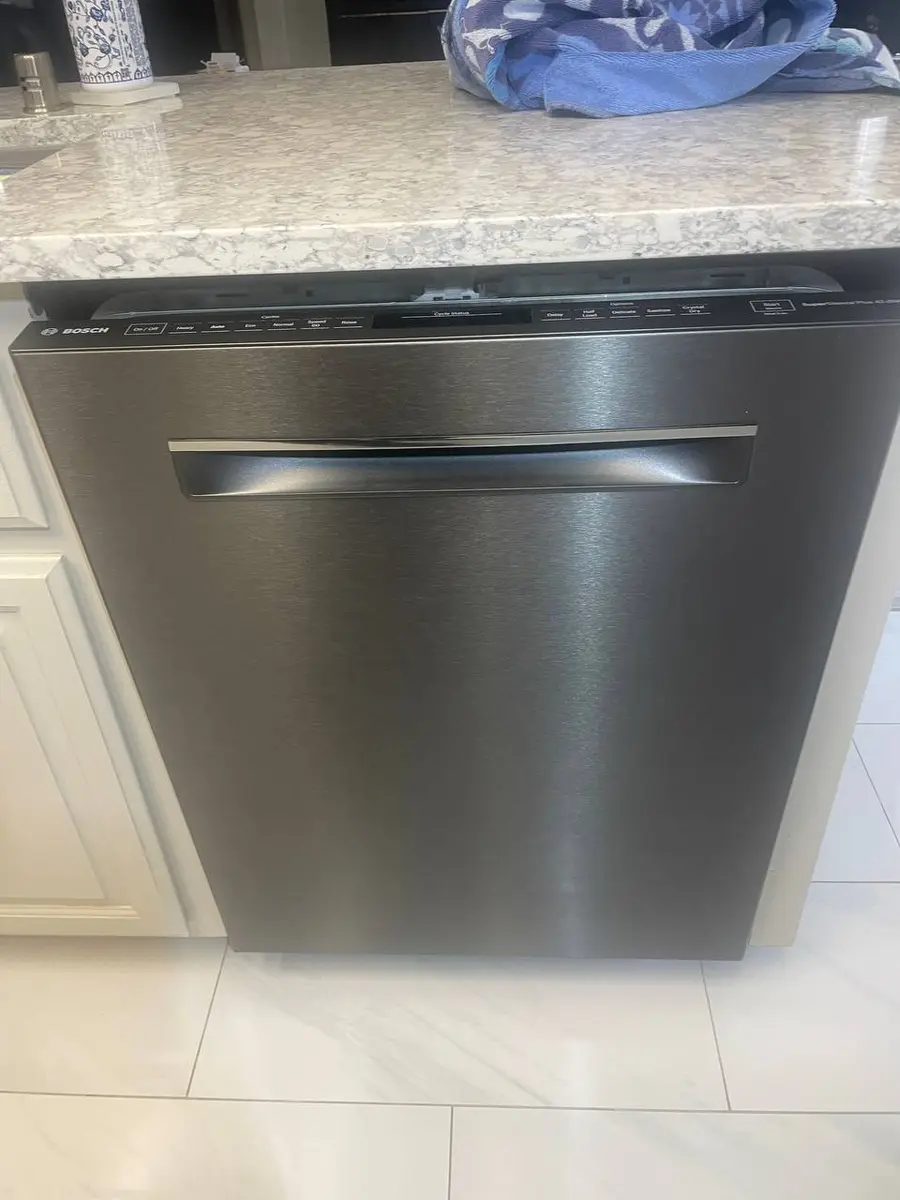
The Ascenta comes apart in a specific order that protects the harnesses, and it differs from Bosch's higher series in ways that matter. If your model number starts with SHE3 or SHE4 this is your machine; SHPM, SHP and SHX belong to the 500 and 800 series guide. Reckon on 15-40 minutes depending how deep you go. Tools:…
Before touching it: breaker off, hot water supply valve closed under the sink, door open, and confirm the panel is dark. At 60-70 lbs an Ascenta is lighter than a 500 or 800 series because it carries less sound insulation, but you still want a helper before it goes over.
Tub side first#
Pull both racks to their stops, lift the front slightly and slide them out. The lower spray arm lifts straight off its mounting post — grip the centre hub and pull firmly upward. Then the triple-filter: a quarter turn counterclockwise on the cylindrical mesh handle, following the moulded arrow, then the flat fine filter out by its edge. That exposes the sump for pump and sensor access.
For the upper spray arm, push the plastic stop tabs at the back of each rack track inward and slide the tracks forward and out. The arm then unscrews counterclockwise — a plastic nut, hand tight only, so no tools.
Do You Have the Right Tools?
Water pressure gauge ($60), spray arm tester, float switch multimeter ($85), and drain inspection camera. Our technician arrives with $3,000+ in professional tools — your diagnostic is free.
Licensed & Insured · 90-Day Warranty · Same-Day Service
The kick plate and the door#
Two screws hold the kick plate at the bottom edge, one near each corner. Early production from 2012 to 2014 used Phillips there; later machines use Torx T20. The panel either slides forward and drops away, or releases flexible top tabs when you pull the bottom out first.
The Ascenta puts its controls on the front face of the door where you can see them, unlike the 500 and 800 series which hide them along the top edge — so the outer door panel is what has to come off to reach the board. Open the door flat, remove the Torx T15 screws around the inner door perimeter (6-8 of them), and hold the outer panel as the last screw comes out. It slides downward and separates, weighs 5-8 lbs, and belongs on something padded because stainless marks easily.
Behind it you have the control board housing at the top, the detergent dispenser in the middle and the door latch at the top edge. The board sits under a plastic cover held by 2-3 Torx T15 screws. Photograph the connections before you touch them: the ribbon cables use zero-insertion-force connectors that need the locking tab lifted first, while the wire harnesses are press-release.
Getting underneath#
Two metal brackets screw up into the countertop from the top of the door opening. Remove those screws — Phillips or Torx T20 — close the door, and check you have slack in the supply line and drain hose before sliding the unit forward.
For the pumps and the inlet valve you need the base plate off, which means disconnecting the supply line with a 10mm wrench and the drain hose at its spring clamp, then tipping the machine onto its back on a moving blanket with a second pair of hands. The base plate has 4 Torx T20 screws around the perimeter. Off it comes, and the pump assembly, wiring and AquaStop sensor are all in front of you.
Safety First — Know the Risks
Live 120V wiring in a wet environment is one of the most dangerous DIY scenarios. Water + electricity = serious shock risk. Our techs are licensed and insured — let them handle the risk.
Licensed & Insured · 90-Day Warranty · Same-Day Service
Ascenta against the higher series#
| Ascenta, SHE3 and SHE4 | 500 and 800 series | |
|---|---|---|
| Control panel | Front-facing, visible | Top edge, hidden |
| Fasteners | Phillips and Torx mixed | Torx throughout |
| Sound insulation | Minimal, 50-52 dB | Heavy, 42-44 dB |
| Weight | 60-70 lbs | 75-90 lbs |
| Base plate screws | 4 | 4-6 |
| Custom panel option | No | Yes on the 800 |
Putting it back#
Line the front control cutout up precisely with the outer door panel — 2mm out and the buttons stop responding. Check the lower rack stop bumpers are still in place, because they pop off during rack removal and are easy to lose. Insert the kick plate top edge first and then push the bottom home, since forcing those flex tabs cracks them. Slide the outer door panel upward into position and start the bottom screws first. And go gently on Phillips screws throughout: they strip far more readily than Torx, so snug is the target, never tight.
Cannot tip the machine safely, stripped a Phillips head, or seeing stress cracks at the tub mounting points? Book a repair — the lighter Ascenta chassis is more prone to that last one.
Appliance Repair Technician & Diagnostics Specialist · 10 years experience
Electronics and diagnostics specialist with 10 years of experience in modern smart appliance repair, specializing in LG and Samsung.