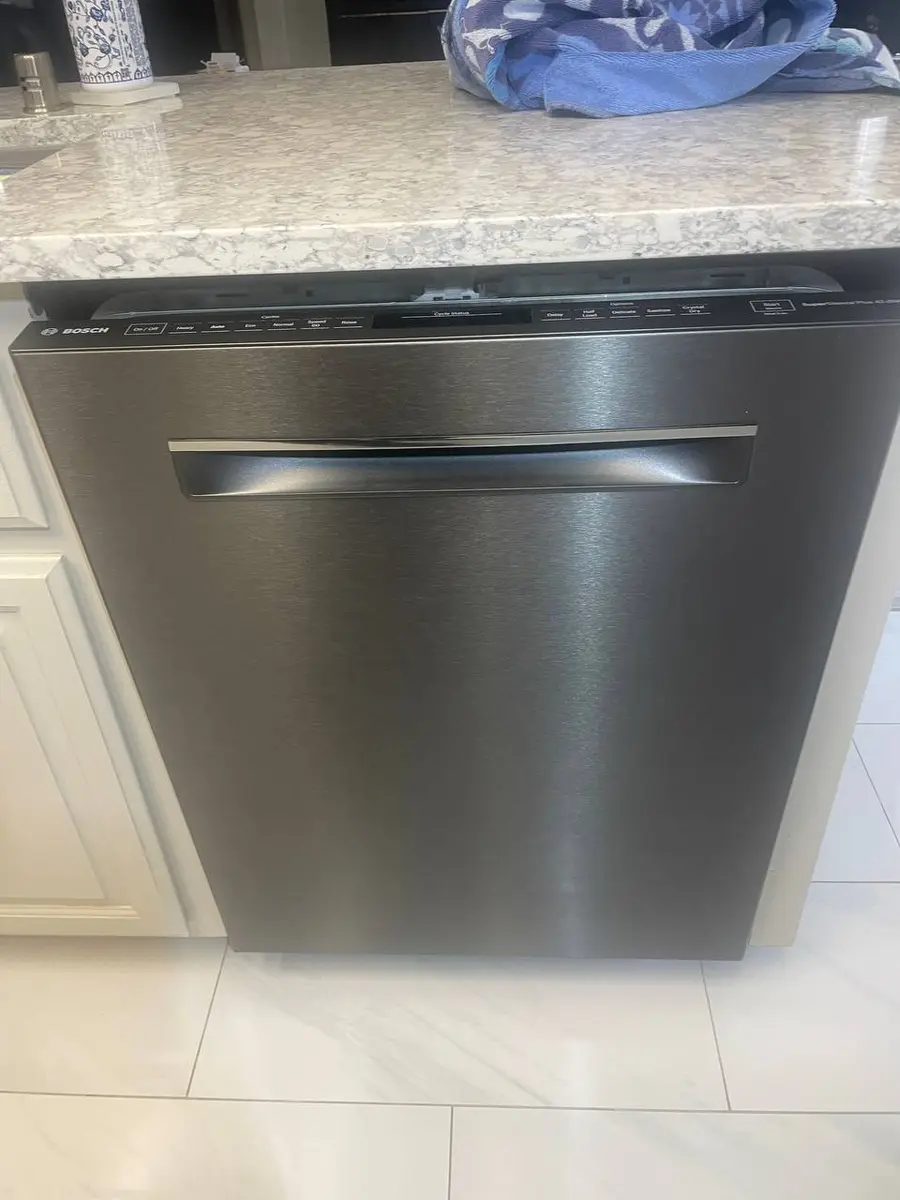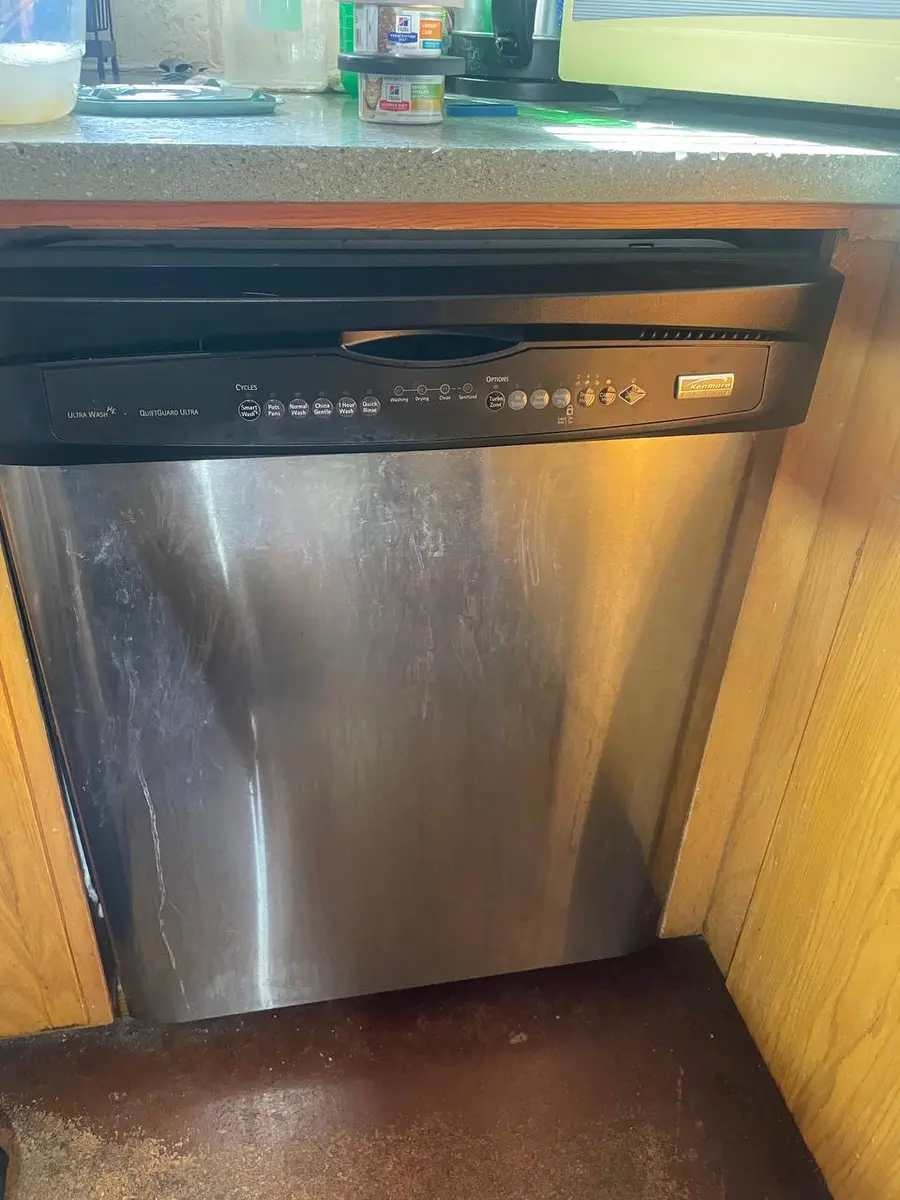
A GE dishwasher that won't start splits into two very different problems: a completely dead panel, or a lit panel that just won't begin a cycle. Sorting out which one you have narrows the cause fast — this guide ranks them and walks each check.
The likely culprit#
Most likely: a door latch or latch-switch failure. The latch assembly both holds the door shut and tells the control the door is secure; if the switch doesn't confirm closure, a lit panel simply won't start the cycle. If the latch checks out, work down through power, the control board, and the thermal fuse.
That is the likelihood order, and it is the one every guide gives. It is not the order to work in. Two of the six causes below cost nothing at all to eliminate and between them account for a meaningful share of the list, while the two that need a meter sit at the expensive end and cannot be reached without cutting power and opening the door panel. Working likeliest-first means opening the machine before you have checked whether the child lock is on. The ladder further down is the same six causes sorted by what each one costs you to rule out.
Do You Have the Right Tools?
Water pressure gauge ($60), spray arm tester, float switch multimeter ($85), and drain inspection camera. Our technician arrives with $3,000+ in professional tools — your diagnostic is free.
Licensed & Insured · 90-Day Warranty · Same-Day Service
Dead panel vs. lit panel#
- Dead panel — no lights, no response to any button: look at the power supply (breaker, GFCI, junction box), a blown thermal fuse, or a total control-board failure.
- Lit panel but no cycle — the display works but nothing starts: look at the door latch switch, child lock, or a partial control-board failure.
Safety first#
Before checking wiring or the junction box, disconnect power at the breaker and verify power is off with a non-contact voltage tester before touching any wiring.
Never bypass the door latch switch — it exists to prevent the machine from running with the door open.
Safety First — Know the Risks
Live 120V wiring in a wet environment is one of the most dangerous DIY scenarios. Water + electricity = serious shock risk. Our techs are licensed and insured — let them handle the risk.
Licensed & Insured · 90-Day Warranty · Same-Day Service
Ranked causes at a glance#
Match your symptom to the table, top row first:
| Likely cause | How common | What you'll notice / what to check |
|---|---|---|
| Door latch or switch failure | 28% of cases | Lit panel, door closes, but no cycle; latch/switch WD13X10052 not confirming closure. |
| Power supply failure | 22% of cases | Dead panel; check breaker, GFCI, and 120V at the junction box on a dedicated 15A or 20A circuit. |
| Control board failure | 20% of cases | Dead or partial response; main board WD21X24901 not driving the relays. |
| Thermal fuse blown | 15% of cases | Dead panel after an overheat; the one-time fuse has permanently opened. |
| Child lock active | 8% of cases | Lock icon lit; controls ignored until the lock pad is held. |
| Water-supply fill timeout | 7% of cases | Starts then quits when water doesn't arrive within the fill window. |
Cheapest first: the order to actually work in#
Same six causes as the table above, re-sorted by what it costs to eliminate each one. Work down the list and stop as soon as the machine starts.
- Look at the panel for a lock icon. Free, instant, and it takes the child-lock row off the list outright. Hold the lock pad — on most models the Heated Dry pad — for three seconds. On a connected machine the same lock can be cleared from the app.
- Reset the protected outlet and cycle the breaker. Free, and it does two jobs at once: it eliminates the whole power-supply row on a plug-in installation, and a full minute off often clears a lock state that has stuck with an unresponsive pad.
- Close the door firmly and squarely, then watch the Start indicator. Free. A door that has drifted out of square is the cheap version of the most common cause on the list, and a flashing Start indicator points straight at the latch switch rather than at anything else.
- Open the cupboard and check the water supply valve and the inlet line. Free, and it is the only cause here that presents as a machine that starts and then quits within a minute or two. If your complaint is "it starts and stops," this step comes first rather than fourth.
- Now the meter, with power off at the breaker and verified dead. Continuity across the latch switch as the door closes, then continuity across the thermal fuse. This is the first step that needs tools and the first that needs the door panel open.
- The board, last and only on evidence. Look for burn marks, swollen capacitors and corroded pins, and reseat every ribbon and harness before condemning it. And if the thermal fuse was open at step five, find what overheated before fitting a new one — a fuse replaced without that is a fuse that blows again.
Steps one to four need nothing but your hands and cover four of the six causes. That is the argument for cost order over likelihood order: the likeliest cause is not the cheapest to test, and the cheapest tests are the ones that let you stop early.
Where this comes from: the six causes ranked in the table above — door latch or switch, power supply, control board, thermal fuse, child lock, and fill timeout — re-sorted by the cost of eliminating each rather than by frequency, using the checks this page already specifies for each one. The safety order is unchanged: nothing here has you touching wiring before the breaker is off and verified. The percentages beside those causes order them against one another and name no sample they were measured over, so no share is repeated here.
The Real Cost of DIY
Average DIY attempt: $150-400 in tools you may use once, plus the risk of further damage. Our diagnostic visit costs $0 — we find the problem and give you an honest quote.
Licensed & Insured · 90-Day Warranty · Same-Day Service
Working through each cause#
1. Door latch or switch failure (28% of cases)#
The latch assembly (GE WD13X10052) contains the mechanical latch that holds the door shut and the switch that signals the board the door is secure. If the switch doesn't make contact, the panel lights but the cycle never starts. Check that the door closes firmly and squarely, then test the latch switch for continuity as the door latches. A flashing Start LED typically points straight at this switch.
2. Power supply failure (22% of cases)#
A completely dead panel is a power problem. GE dishwashers are either plug-in on a GFCI outlet under the sink or hardwired to a junction box, so identify which you have. Reset the GFCI, check the breaker — dishwashers belong on a dedicated 15A or 20A circuit — and on hardwired units verify 120V is present at the junction-box wire nuts with the power confirmed off first. Rodent-chewed cords are worth a look on older installs.
3. Control board failure (20% of cases)#
The main control board (GE WD21X24901, which varies by model) sits at the top of the inner door panel. If power reaches the board but nothing happens, or the response is erratic, the board has likely failed. Inspect it for burn marks, swollen capacitors, or corroded pins, and make sure the ribbon cables and harnesses are fully seated. Match any replacement to your exact model and serial, since GE uses multiple board revisions.
4. Thermal fuse blown (15% of cases)#
The thermal fuse is a one-time safety device that permanently breaks the circuit if the dishwasher overheats, leaving the panel dead. Test it for continuity with the power off; an open fuse must be replaced, not reset. Because it blows for a reason, check the board and wiring for the overheating source before simply fitting a new fuse.
5. Child lock active (8% of cases)#
A lock icon or a small Lock LED means the controls are disabled. Most GE models unlock by pressing and holding the Lock pad (or the Heated Dry pad) for 3 seconds, and connected models can be unlocked from the SmartHQ app. If the lock pad itself is unresponsive, a hard reset — breaker off for 60 seconds, then on — often clears the state.
6. Water-supply fill timeout (7% of cases)#
Some GE dishwashers start, open the fill valve, then cancel the cycle if water doesn't arrive within the timeout, so a unit that starts and immediately stops can be a water-supply issue rather than an electrical one. Confirm the supply valve under the sink is open and the inlet line isn't kinked. An H2O code points directly at no water being detected.
GE start-failure error codes#
If the display shows a code, it narrows the cause immediately:
| Code | Meaning | Likely cause |
|---|---|---|
| H2O | No water detected | Supply valve closed or inlet valve failed |
| C1 | Stuck relay | Control board failure |
| C3 | Leak detected | Flood sensor in the base pan activated |
Don't Void Your Warranty
Opening your appliance yourself may void the manufacturer warranty. Our repair comes with a 90-day guarantee, and we document everything for warranty compliance.
Licensed & Insured · 90-Day Warranty · Same-Day Service
Models this commonly affects#
We see start failures across GE dishwasher models including the GDT630 and GDT640 series, though the dead-panel vs. lit-panel diagnosis above applies across the lineup. The thermal fuse on many of these is GE WD15X10003.
The short version#
- Door latch / switch — 28%; lit panel, no cycle, WD13X10052.
- Power supply — 22%; dead panel, check GFCI, breaker, 120V at the junction box.
- Control board — 20%; WD21X24901 not driving the relays.
- Thermal fuse — 15%; dead after an overheat, reads open.
- Child lock — 8%; hold the Lock pad 3 seconds.
- Fill timeout — 7%; starts then quits, often an H2O code.
Is It Worth Your Time?
Dishwasher issues overlap between drain pump, wash motor, inlet valve, and control board. DIY diagnosis averages 3-5 hours. Our technician diagnoses the issue in about 30 minutes — same-day appointments available.
Licensed & Insured · 90-Day Warranty · Same-Day Service
What the repair usually involves#
A GE no-start repair starts by classifying dead-panel vs. lit-panel, then works the matching branch — power and thermal fuse for a dead panel, latch switch and control board for a lit one. Each suspect is confirmed with a meter before replacement, and the unit is run through the start of a cycle to verify it latches, fills, and begins.
Keeping it from coming back#
Close the door squarely so the latch isn't strained, keep the dishwasher on its own dedicated circuit, and clear child lock before assuming a fault. Addressing a flaky latch early keeps a cheap switch from turning into a control-board job.
The Risk of Getting It Wrong
A wrong diagnosis often turns a simple fix into a costly replacement. Without proper diagnostic tools, you might replace the wrong part — or cause additional damage. Our free diagnostic eliminates the guesswork.
Licensed & Insured · 90-Day Warranty · Same-Day Service
When to call a professional#
Call a technician if the dishwasher stays dead after checking power and the thermal fuse, if a lit panel won't start after the latch and child-lock checks, or if you'd be working at the junction box or the control board. The cost depends on whether it's the latch, the fuse, or the board plus labor, and a tech can confirm before starting.
Still won't start? Book an EasyBear technician — we service GE dishwashers and carry the latch, control-board, and thermal-fuse parts these models use.
What a technician will want to know before the visit#
Every one of these is free, and together they usually let a technician arrive with the right part rather than arrive to look.
Which installation you have. Plug-in on a protected outlet under the sink, or hardwired into a junction box. It changes what can be reset and what has to be metered.
Dead or lit. No lights at all is a different half of the list from a panel that lights up and ignores you, and it is the first branch of every diagnosis on this page.
What the Start indicator does. Steady, flashing, or nothing. A flashing Start indicator points at the latch switch specifically, and it is the kind of detail that gets forgotten between the fault and the phone call.
Whether a lock icon was showing. Worth stating even if you cleared it, because a machine that was locked and is now working needed no repair at all.
Whether it ever starts and then quits. A dishwasher that begins a cycle has already proved the panel, the latch signal and the board, which moves the whole conversation to the water supply.
What you have already reset, and what changed. A breaker reset that made no difference is information; a breaker reset that fixed it for two days is better information.
The last one is the most valuable and the most often left out. Intermittent faults are diagnosed from patterns rather than from measurements, and the pattern lives with you rather than with the technician.
Free Diagnostic Visit — Zero Risk
Our certified technician comes to your home, diagnoses the problem with professional tools, and gives you an honest quote — all at zero cost. No parts markup, no hidden fees. If you decide not to proceed, you pay nothing.
Licensed & Insured · 90-Day Warranty · Same-Day Service
The two failures that look identical from a step away#
A locked panel and a failed panel present the same way: the display is lit, the machine is unresponsive, and nothing you press changes anything. People spend real money on the second when they had the first, and there are only two things that separate them.
The first is the icon. A lock symbol somewhere on the display is decisive when it is there — but on some panels it is small, on others it shares space with a cycle indicator, and on a machine in a dim under-counter position it is genuinely easy to miss. Look at the display straight on and in good light before concluding it is absent.
The second is a full power interruption. A lock state is held by the board, so cutting power for a minute drops it along with everything else the board was holding. That is why the hard reset earns its place on this list even when the lock pad itself appears unresponsive: it does not repair anything, it just clears a state that a stuck pad could not.
If the panel comes back after that minute and behaves normally, nothing was ever wrong with the machine. If it comes back and still ignores you, then the free checks are genuinely finished and the panel or the board is in question — and you have that answer for the cost of a minute rather than the cost of a part.
Senior Gas Appliance Specialist · 18 years experience
AGA-certified gas appliance specialist with 18 years of experience in residential and commercial oven, range, and cooktop repairs.