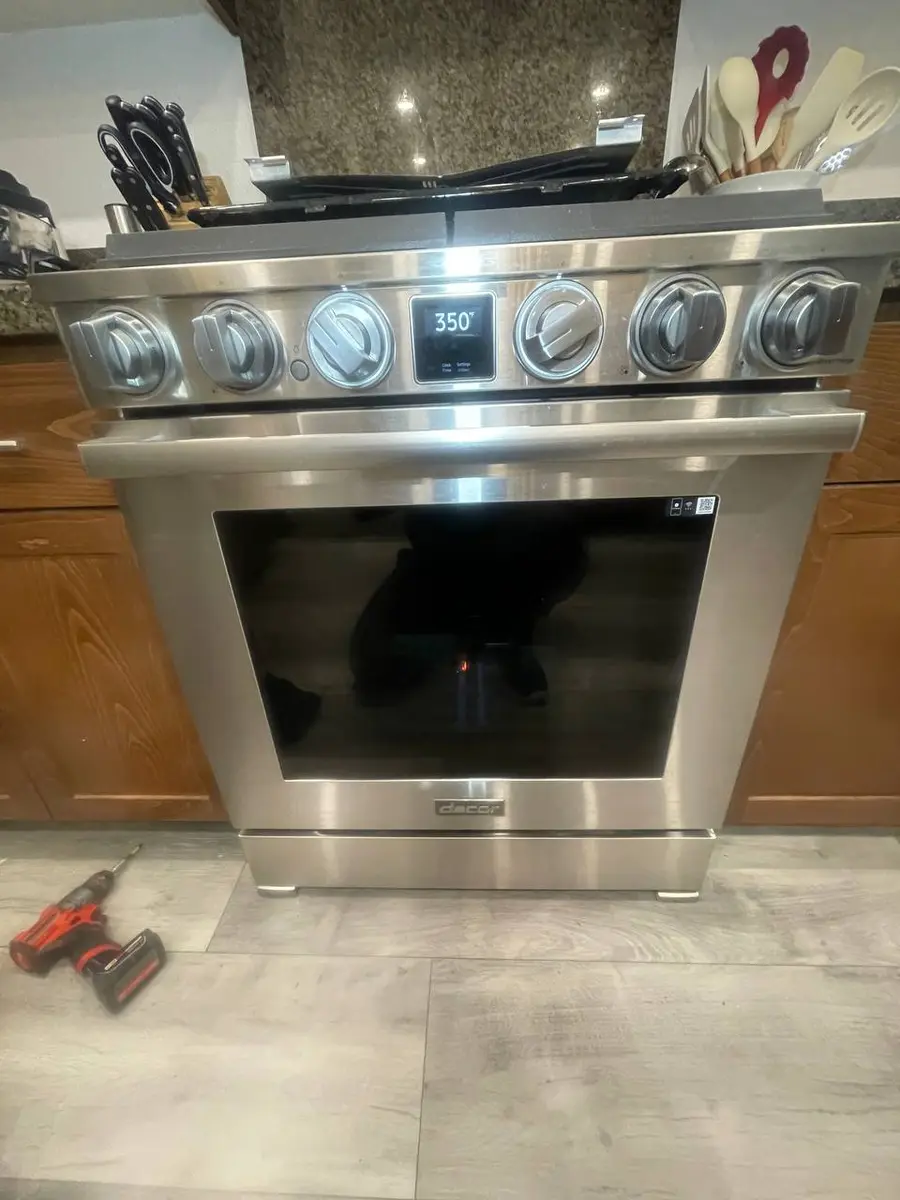
Bosch Oven Control Board Replacement
A Bosch oven control board that throws an E302 or E303 sensor fault, won't heat with a working display, or shows a garbled screen usually needs replacing — but on a 240V oven this is high-voltage work, and E302/E303 can be the cheaper temperature sensor rather than the board. Test the sensor first.
Wall-oven and range boards aren't interchangeable, so identify yours before ordering.
Wall oven vs. range board#
A wall-oven board runs only the oven cavity (or two cavities on a double). A slide-in range board also drives the cooktop burners or induction elements — a far busier circuit that switches both the 240V oven heat and each burner, with a different connector layout that won't match a wall-oven board. Every Bosch oven sold here runs on a dedicated 240V circuit (unlike the 120V dishwashers and dryers), and the power section switches up to 40A to the bake and broil elements, so a mis-wired connector can destroy the board, burn out an element, or start a fire.
Do You Have the Right Tools?
Combustion analyzer ($300), igniter tester ($120), temperature calibrator ($150), and gas pressure manometer. Our technician arrives with $3,000+ in professional tools — your diagnostic is free.
Licensed & Insured · 90-Day Warranty · Same-Day Service
Reading the failure#
- E302 or E303 — a sensor fault: the board can't read the oven's RTD temperature probe. Test the probe first — a Bosch RTD reads about 1,100 ohms at room temperature — since the sensor is the cheaper cause.
- E305 — a door-lock fault on self-cleaning models: the board commanded the lock but got no confirmation, which can be the lock motor or a board relay.
- Garbled or flickering display — the display driver has failed from thermal stress; on TFT color displays that means a board replacement.
- Controls work but no heat — a bake or broil relay has failed open; confirm by metering the element terminals during a bake command, where you should see 240V.
- Clock resets or loses time — the board's backup battery or clock crystal, both integrated into the board.
To reach diagnostics, with the oven off hold the clock button while turning the selector to the 12 o'clock position.
Replacing the board — 240V, treat with respect#
Lethal-shock warning: switch off the oven's dedicated 240V breaker at the panel — not just the oven control — and verify no voltage with a non-contact tester before touching any wiring. Many areas require a licensed electrician for 240V appliance work.
- Kill the breaker and confirm it's dead.
- On a wall oven, remove the oven from the cabinet; on a range, pull it forward for rear access.
- Remove the control-panel cover or rear access panel (Torx T20).
- Photograph the connectors — Bosch oven boards carry 8–12 for elements, sensors, door lock, display, clock, convection fan, light, and (on ranges) the burners.
- Disconnect them all and remove the four Torx T15 mounting screws.
- Fit the new board with its thermal-isolation pad correctly seated between board and bracket.
- Reconnect every plug in its original spot — swapping the bake and broil element connectors fires the wrong element.
- Restore power, run the service-mode self-test, set the clock, check calibration against an oven thermometer, and finish with a 10-minute bake at 350°F.
Safety First — Know the Risks
Gas ovens involve live gas lines — a loose connection creates explosion and carbon monoxide risk. Electric ovens run on 240V circuits. Our techs are licensed and insured — let them handle the risk.
Licensed & Insured · 90-Day Warranty · Same-Day Service
Parts and cost#
| Item | Notes | Cost & effort |
|---|---|---|
| Oven control board | Wall-oven or range-specific | Board only — 240V handling |
| RTD temperature sensor | ~1,100 ohms at room temp | Cheaper — test before the board |
| Thermal-isolation pad | Board-to-bracket | Reuse or replace with the board |
Convection and board life#
Bosch's European Convection heats with a dedicated ring element around the convection fan, on its own board relay separate from bake and broil — so convection can fail on its own while conventional baking still works, which points straight at that relay. Boards last roughly 10–18 years, with thermal cycling the main enemy: self-clean drives the oven to 880–900°F and bakes the electronics, so hold self-clean to once or twice a year, keep the control-panel cooling fan clear, run the oven on a properly sized 40A circuit, and don't block the oven vent with cookware or foil.
Bosch oven repair — diagnosis, parts, and the fix in one visit across Sacramento and the Bay Area. Schedule a visit
Appliance Repair Technician · 8 years experience
Experienced technician with 8 years specializing in dishwasher repairs and European appliance brands including Bosch and Thermador.