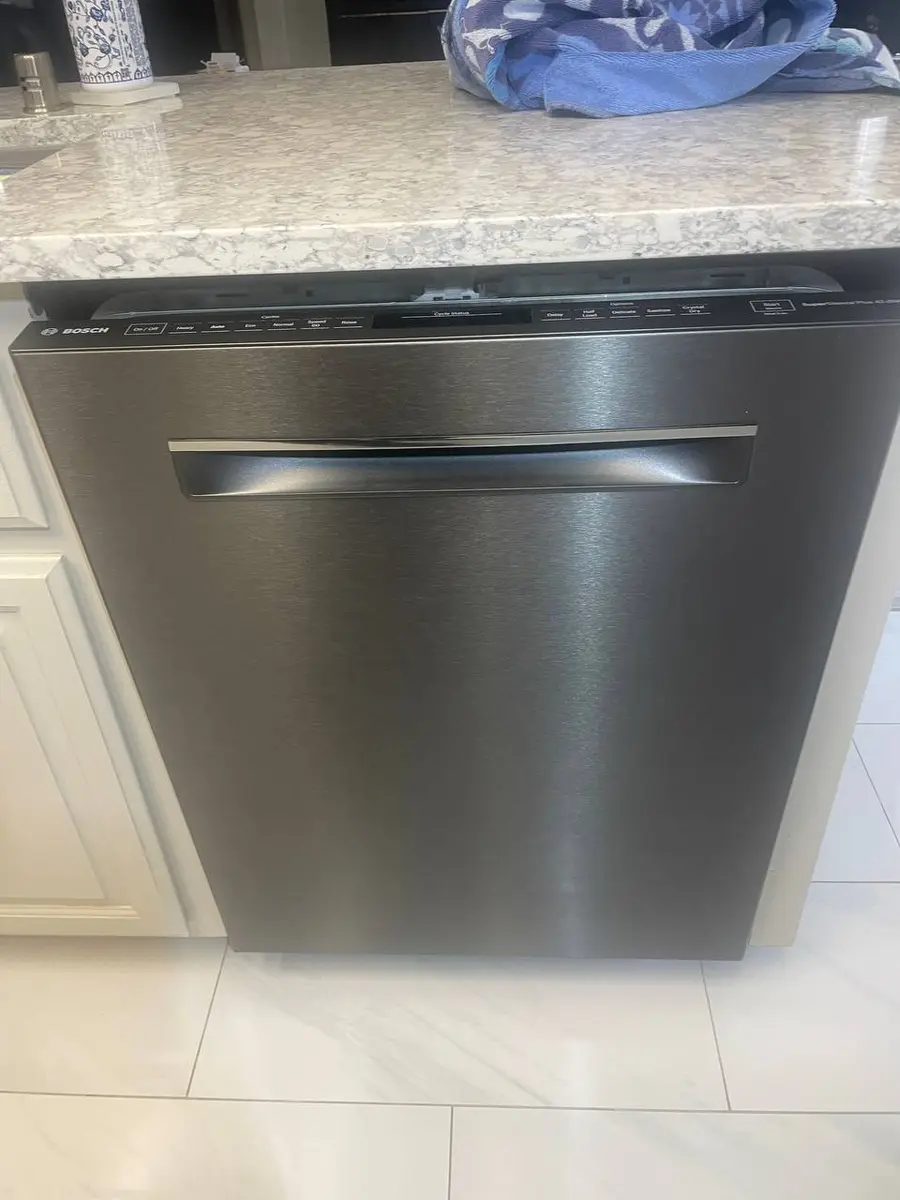
Bosch Dishwasher Overflowing — Inlet Valve, Float Switch & AquaStop Diagnosis
An overflowing Bosch dishwasher triggers the machine's built-in flood protection before water reaches the floor in most cases. Bosch's AquaStop system — a double-solenoid shutoff valve integrated into the supply hose — combined with the base pan float switch creates a two-layer defense against flooding. Error code E17 indicates the anti-flood system detected water level exceeding maximum safe height in the wash tub.
However, if overfilling occurs faster than the protection systems can respond, or if both the inlet valve and the float switch fail simultaneously (rare but possible), water can escape through the door seal. Understanding the fill control architecture specific to Bosch helps pinpoint which component has failed.
Bosch Water Level Control Architecture
The fill system operates through these components:
- AquaStop supply hose — contains an electrically controlled shutoff valve that only opens when the control module commands it. If power is lost, the valve springs closed (fail-safe design)
- Dual-solenoid inlet valve (BSH 00622058) — receives water from the AquaStop hose, controls entry into the tub. Two solenoids allow different fill rates
- Flow meter — counts pulses as water passes through, telling the control module exactly how much water has entered
- Anti-flood float switch — a backup sensor in the tub that physically rises when water level is too high, triggering E17
- Base pan float switch — the lowest-level defense, triggers E15 if any water reaches the machine base
Do You Have the Right Tools?
Water pressure gauge ($60), spray arm tester, float switch multimeter ($85), and drain inspection camera. Our technician arrives with $15K+ in professional tools — your diagnostic is free.
Licensed & Insured · 90-Day Warranty · Same-Day Service
Cause 1: Inlet Valve Stuck Open (40% of Cases)
The dual-solenoid inlet valve (BSH 00622058) uses electromagnetic force to hold its diaphragm open during fill. When the control module cuts power, a spring closes the diaphragm. If mineral deposits prevent the diaphragm from seating fully, or if debris holds it slightly open, water continues entering the tub after the fill command ends.
Critical symptom: Water continues entering the machine even after the cycle pauses (open the door mid-fill — you should hear filling stop immediately. If water continues flowing for more than 2–3 seconds after door opening, the valve is stuck).
Diagnosis:
- Shut off the water supply valve under the sink
- If the overfilling stops, the valve is the confirmed source
- With power disconnected: remove the lower access panel and locate the inlet valve
- Disconnect the water supply hose and look at the valve inlet screen — heavy mineral deposits here often correlate with internal diaphragm deposits
- With the hose removed and water supply on, briefly test: water should NOT flow through the valve body when it's not energized. If it drips or flows, the valve is stuck open and must be replaced
Repair Steps:
- Shut off water supply and disconnect power
- Remove the lower access panel (2x T20 Torx)
- Disconnect the supply hose from the inlet valve (10mm wrench on fitting)
- Disconnect the electrical connector to the valve solenoids
- Remove the valve from its mounting bracket (usually 1–2 screws)
- Install replacement valve (BSH 00622058) — note orientation of dual solenoid connectors
- Reconnect water supply, check for leaks, then restore power and test
Parts Cost: $35–$65 (inlet valve BSH 00622058) Professional Repair Cost: $120–$200
Cause 2: Flow Meter Failure (25% of Cases)
The flow meter (a small turbine sensor in the fill path) sends pulses to the control module — each pulse represents a specific volume of water. The control module counts pulses to determine when the tub has received the correct fill volume. If the flow meter fails or sends inaccurate readings, the control module may allow overfilling because it doesn't "know" how much water has entered.
Diagnosis: If the machine consistently overfills by a similar amount (not catastrophic flooding, but water level higher than normal), the flow meter is likely under-reporting. In diagnostic mode, you may see E14 (flow sensor fault).
Repair Steps:
- Disconnect power and water supply
- Locate the flow meter — it's in the fill path between the inlet valve and the tub connection
- Remove the flow meter (disconnect hose connections and electrical connector)
- Check for mineral deposits on the turbine that might slow its rotation (causing under-count)
- If cleaning doesn't restore accurate counting, replace the flow meter
Parts Cost: $25–$55 (flow meter) Professional Repair Cost: $100–$180
Safety First — Know the Risks
Live 120V wiring in a wet environment is one of the most dangerous DIY scenarios. Water + electricity = serious shock risk. Our techs are licensed and insured — let them handle the risk.
Licensed & Insured · 90-Day Warranty · Same-Day Service
Cause 3: Anti-Flood Float Switch Stuck (20% of Cases)
The tub-level float switch is a mechanical backup that physically rises with water level. If debris (food particles, mineral scale, or a broken dish fragment) prevents the float from rising, it can't signal the control module to stop filling even when water reaches the overflow threshold.
Diagnosis: With the tub empty and filters removed, locate the float mechanism in the sump area. Manually lift the float — you should feel minimal resistance and hear a click (the micro-switch activating). If the float is stuck in the down position, clean and free it.
Repair Steps:
- Remove the lower rack, spray arm, and filter assembly
- Locate the float mechanism in the sump (appears as a small dome or disc that moves up and down)
- Check for debris around the float shaft — food particles or calcium can lock it in place
- Clean the shaft and float housing thoroughly
- Verify free vertical movement — the float should rise and fall with zero resistance
- If the switch itself has failed (float moves freely but no signal): test the micro-switch with a multimeter and replace if defective
Parts Cost: $15–$35 (float switch assembly) Professional Repair Cost: $89–$160
Cause 4: Control Board Timing Error (10% of Cases)
The control module orchestrates fill timing — it opens the inlet valve for a calculated duration based on flow meter feedback. If the processor or timing circuit on the board malfunctions, it may leave the inlet valve energized too long or fail to close it on schedule.
Diagnosis: This is typically diagnosed by exclusion — if the inlet valve, flow meter, and float switch all test good, but overfilling persists, the control board's fill management logic is suspect.
Repair: Control board replacement (model-specific). Parts: $150–$350, professional: $250–$500.
Same-Day Appliance Repair
Fixed or It's Free
$89 → $0 Service Call & Diagnosis — offer ends May 25
The Real Cost of DIY
Average DIY attempt: $150-400 in tools you may use once, plus the risk of further damage. Our diagnostic visit costs $0 — we find the problem and give you an honest quote.
Licensed & Insured · 90-Day Warranty · Same-Day Service
Cause 5: Drain Backup Into Tub (5% of Cases)
If the drain hose lacks a proper high loop (must be at least 20 inches above floor level) or the air gap is blocked, dirty water from the sink drain can siphon back into the dishwasher tub. This appears as overfilling but is actually backflow, not excessive inlet flow.
Diagnosis: The "overfill" occurs while the machine is off — you find water in the tub without having run a cycle. Or the water level rises during the sink's use (running the garbage disposal or filling the sink pushes water back through the shared drain line).
Resolution:
- Verify the drain hose has a high loop — minimum 20 inches at peak
- If connected through an air gap, clean the air gap (usually a chrome dome on the countertop near the faucet)
- Check that the garbage disposal knockout plug was removed when the disposal was installed
- If the check valve in the drain hose connection has failed, replace it
Parts Cost: $5–$25 (high loop bracket, check valve) Professional Repair Cost: $89–$140
Emergency Steps for Active Overflow
- Shut off the water supply valve under the sink immediately — this is the fastest way to stop water entry
- Open the dishwasher door — this pauses operations and may trigger AquaStop
- Turn off the breaker — cuts power to the inlet valve (which should close without power, but belt-and-suspenders)
- Mop up standing water — prevent damage to flooring and cabinetry
- Do not restart until the cause is identified and repaired
Don't Void Your Warranty
Opening your appliance yourself may void the manufacturer warranty. Our repair comes with a 90-day guarantee, and we document everything for warranty compliance.
Licensed & Insured · 90-Day Warranty · Same-Day Service
Prevention
- Listen during fill — if filling seems to take longer than normal (more than 60 seconds), the flow rate has changed and investigation is warranted
- Clean the inlet screen annually — mineral deposits restrict flow, which can mask a deteriorating valve diaphragm
- Verify the high loop after any plumbing work under the sink — installers sometimes move the dishwasher drain hose without maintaining the loop
- Don't ignore E17 — an overfill code, even if it only appeared once, indicates a component that's beginning to fail
Bosch dishwasher overfilling or showing E17? Our technicians diagnose inlet valve, flow meter, and float switch issues on-site and carry replacement parts for same-visit repair. Schedule your Bosch dishwasher repair →