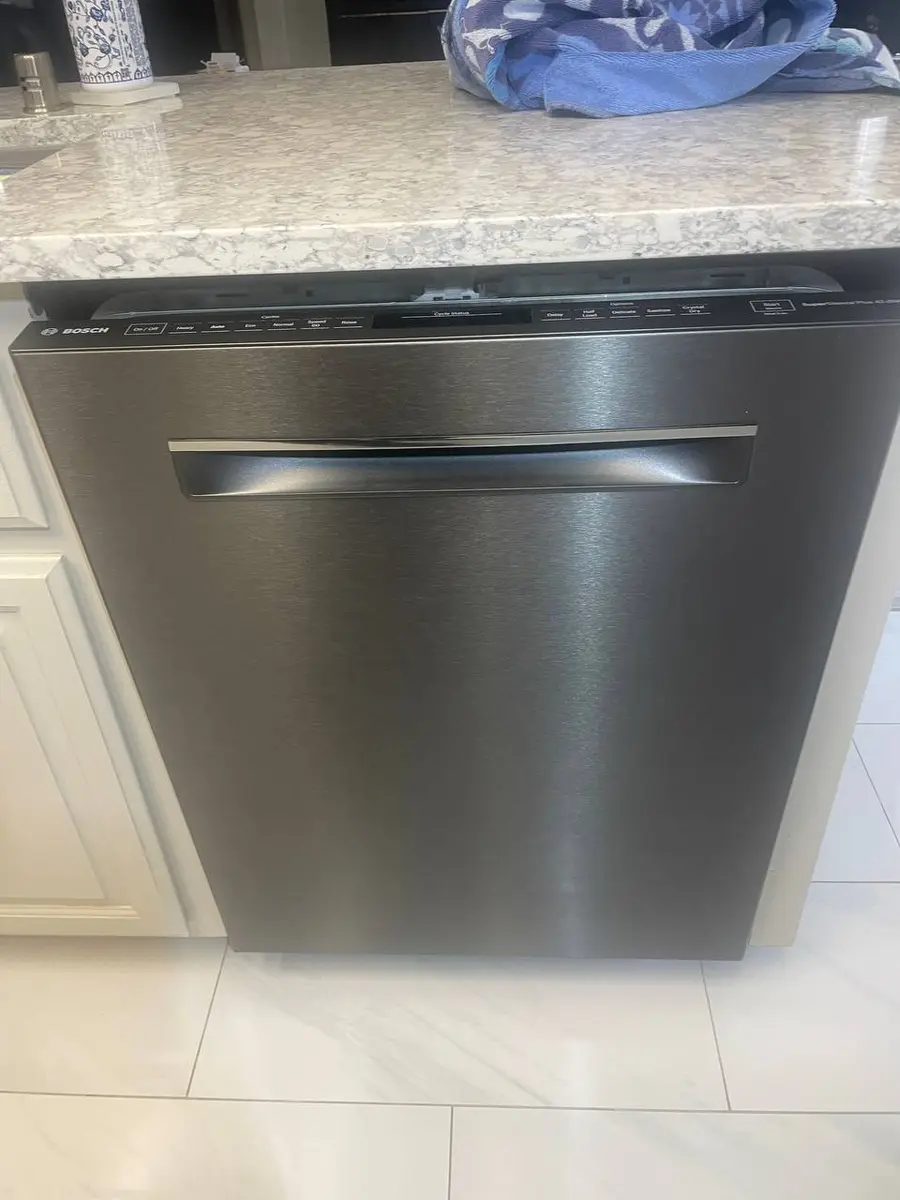
A Bosch [dishwasher](/blog/repair-or-replace-dishwasher) that will not heat almost always comes down to the flow-through heater — the heating device Bosch integrates into the circulation pump to warm water as it passes through — and its failure typically shows as an E09 code. Because there is no separate exposed element, this is largely a technician repair, but there are a few flow and supply checks you can make first that occasionally explain a "cold" machine. Cold water also explains poor drying, since Bosch relies on a hot final rinse.
Quick answer#
Open the door at the end of a cycle and touch two things before anything else: a plate, and the water sitting in the sump. Hot plates and wet plates are a drying complaint and cost nothing to improve. Cold plates and cold sump water with E09 on the display are a heating fault, and on a Bosch that means the flow-through heater built into the circulation pump — a technician repair, because the heater cannot be swapped on its own.
Between those two extremes sit the cases worth ruling out before you book: a first fill that arrived cold because the hot line was full of cold water, and a restricted filter choking the circulation the heater depends on. Both are yours to fix, both are free, and both present as a machine that will not heat. The table below separates all four from what you can observe at the end of one cycle.
Do You Have the Right Tools?
Water pressure gauge ($60), spray arm tester, float switch multimeter ($85), and drain inspection camera. Our technician arrives with $3,000+ in professional tools — your diagnostic is free.
Licensed & Insured · 90-Day Warranty · Same-Day Service
What the end of the cycle tells you#
Run a normal programme, open the door as soon as it finishes, and record three things: whether the dishes are warm, whether they are clean, and whether there is a code. Those three answers separate a heater repair from a setting.
| What you find when the cycle ends | What it points at | What it rules out |
|---|---|---|
| Dishes cold, the water left in the sump cold, and E09 on the display | The flow-through heater or its control — the technician case this page is about | Anything to do with drying, rinse aid or loading |
| Dishes clean and warm to the touch, but still wet | Drying rather than heating — rinse aid, plastics and load layout | The heater entirely; warm dishes are heated dishes |
| Wash water cold at the start of the cycle but warm later, no code | The supply: the first fill drew a line full of cold water | A failed heater, which cannot recover partway through |
| Dishes cold and the cycle also ran far longer than usual | Restricted circulation starving the heater — start at the filter | A dead heater as the first conclusion; the control is still trying |
| Everything cold on every cycle, and no code at all | Still the heater or its control — Bosch does not always post E09 for it | The comfort of assuming no code means no fault |
| Dishes cold, and other hot taps in the house are also disappointing | The household water heater, upstream of the dishwasher entirely | The machine; nothing inside it will fix a cold supply |
Rows three, four and six are all free to resolve and all of them present as a dishwasher that will not heat. Working through them first is the difference between one visit and none.
Where these rows come from: the causes ranked in the likelihood table further down this page — heater, heater control, temperature sensor, restricted flow, cold incoming supply — re-keyed on what a homeowner can feel and see at the end of one cycle rather than on the part a technician isolates, plus the heating-versus-drying distinction this page already draws. The share figures in that table are an ordering of causes on this fault; they are not repeated here, because these rows answer a different question and carry no measured frequency of their own.
How Bosch heats water#
Older dishwashers used an exposed coil in the tub floor. Bosch moved the heater into the circulation path: a flow-through heater warms the water continuously as the pump recirculates it, which is why the Bosch tub floor is clear and easy to clean. The trade-off is that the heater cannot be inspected or swapped on its own — it is bundled with the pump. The control watches a temperature sensor and, if the water does not reach target, posts E09 (with E01 seen on some related control faults) and gives up on heating.
Safety First — Know the Risks
Live 120V wiring in a wet environment is one of the most dangerous DIY scenarios. Water + electricity = serious shock risk. Our techs are licensed and insured — let them handle the risk.
Licensed & Insured · 90-Day Warranty · Same-Day Service
Causes by likelihood#
| Cause | Share of no-heat cases |
|---|---|
| Flow-through heater failed (E09) | 45% |
| Heater control / relay on the board | 25% |
| Temperature sensor misreading | 15% |
| Restricted flow (dirty filter) starving the heater | 10% |
| Cold incoming water supply | 5% |
The homeowner checks (do these first)#
- Run the kitchen hot tap until it is hot, then start the dishwasher — the first fill draws from that line, and a long cold run can start the cycle cold.
- Confirm the household water heater is actually delivering hot water and is not set low.
- Clean the sump filter. The flow-through heater needs good circulation; a clogged filter chokes flow and can trip a heating fault indirectly.
If the water is genuinely hot at the tap, the filter is clean, and it still runs cold with E09, the fault is inside the machine.
Why it is a technician repair#
The heater being integral to the pump means diagnosing a no-heat Bosch is about isolating which part of the circuit failed — the heater element, the control relay that powers it, or the sensor that reads temperature. That takes a meter: reading the heater for continuity, checking for switched voltage at the heater (0V when it should be live points at the control), and verifying the sensor’s resistance. This is not guesswork you can safely do at the panel; the tub must come apart at the sump.
Tell heating, washing, and drying complaints apart#
A no-heat Bosch shows up as three symptoms that share one root. Washing seems less effective because the water never gets hot enough to cut grease. Drying fails because condensation drying depends on a hot final rinse. And the cycle may simply post E09 and run cool. If you are seeing two or three of these at once, do not diagnose them as separate problems — they are one heater fault wearing three hats. That single insight saves a lot of wasted troubleshooting, and it is the most useful thing to tell a technician: "it stopped washing hot, drying, and it shows E09 together."
The Real Cost of DIY
Average DIY attempt: $150-400 in tools you may use once, plus the risk of further damage. Our diagnostic visit costs $0 — we find the problem and give you an honest quote.
Licensed & Insured · 90-Day Warranty · Same-Day Service
What a technician checks for E09#
- Reads the flow-through heater for continuity — an open element confirms the heater itself.
- Checks for switched voltage at the heater during the heat phase; the expected roughly 120V present with a good element but no heat points back at the heater, while 0V when it should be live indicts the control relay.
- Measures the temperature sensor’s resistance — an out-of-range sensor makes the board misjudge the water and can trip E09 or E01 falsely.
- Confirms circulation is not the real limiter — a clogged filter starving flow can masquerade as a heating fault.
Because the heater is bundled with the circulation pump, the fix is usually the pump/heater assembly, accessed at the sump with the panel off (T15 and T20 Torx, 50K-class parts on some builds).
Which parts a technician isolates#
- Flow-through heater / pump assembly: confirmed by continuity and by no temperature rise despite good flow.
- Control relay: if the heater is good but sees 0V when it should be powered, the board is not switching it.
- Temperature sensor: a sensor reading out of range makes the control think the water is hot when it is not, or trip E09 prematurely.
Reaching them means dropping the kick panel (T15 and T20 Torx) with the breaker off and working in the sump — technician territory.
Don't Void Your Warranty
Opening your appliance yourself may void the manufacturer warranty. Our repair comes with a 90-day guarantee, and we document everything for warranty compliance.
Licensed & Insured · 90-Day Warranty · Same-Day Service
The knock-on effect: no heat means no drying#
Because Bosch dries by condensation off a hot final rinse, a heater fault shows up as wet dishes too. If your Bosch stopped drying and washing hot at the same time, do not chase the drying separately — fix the heater and both return. That shared root cause is a useful clue when you describe the symptom to a technician.
The hot-tap trick, explained#
Running the kitchen faucet hot before you start the dishwasher is not folklore — it addresses a real cause. The dishwasher’s first fill pulls whatever water is sitting in the supply line, and if that line has gone cold, the machine begins its cycle with cold water and a heater that then has to claw the temperature up from a low start. On a marginal flow-through heater, that head start is the difference between reaching target and posting a heating fault. Purging the cold slug at the tap so the line is already hot lets the cycle begin warm and lets the heater simply maintain rather than rescue the temperature. It will not fix a truly failed heater, but it removes one variable and occasionally cures a borderline "not hot enough" complaint outright.
Is It Worth Your Time?
Dishwasher issues overlap between drain pump, wash motor, inlet valve, and control board. DIY diagnosis averages 3-5 hours. Our technician diagnoses the issue in about 30 minutes — same-day appointments available.
Licensed & Insured · 90-Day Warranty · Same-Day Service
Preventing heating problems#
- Keep the filter clean so the heater always has full flow.
- Run the hot tap before starting so the machine begins with hot water.
- Address an E09 promptly — running cold cycles wastes every load until it is fixed.
Frequently Asked Questions#
Why is my Bosch dishwasher not heating the water?#
Bosch heats water with a flow-through heater built into the pump, and its failure is the leading cause of cold cycles — often flagged as E09. Less commonly the water inlet is feeding cold water too slowly, or a sensor is misreading. A cold final rinse also explains poor drying.
What does E09 mean on a Bosch dishwasher?#
E09 points at the heating circuit — typically the flow-through heater element or its control. When it fails, the water is not heated, so wash performance and drying both suffer. Confirming it needs a technician, because the heater is integrated with the pump.
Can I fix a Bosch dishwasher that won't heat myself?#
The DIY side is limited: confirm your incoming water is hot, run a hot tap at the sink before starting, and clean the filter so flow is not restricted. The heater itself is integrated with the circulation pump and is a technician repair.
Is a Bosch dishwasher heating fault worth repairing?#
On a unit under about ten years old, generally yes — the heater/pump assembly is a defined repair and far cheaper than replacing the machine. A technician confirms E09 is the heater and not the control before quoting.
My Bosch dishwasher leaves dishes wet but they are hot. Is the heater failing?#
No — hot dishes mean the heater did its job. Bosch relies on the heat held in the load and the tub for the drying phase rather than on a separate drying element, so wet-but-hot is a drying complaint, and the levers for it are rinse aid, the amount of plastic in the load, and whether items are nested so water can run off. A heater that had failed would leave the same dishes cold.
Should I run the kitchen hot tap before starting a Bosch dishwasher?#
It is worth doing and it costs nothing. The dishwasher draws its first fill from the same hot line the kitchen tap uses, so if that line has been standing it delivers a slug of cold water at exactly the moment the cycle is trying to get up to temperature. Running the tap until it is genuinely hot puts hot water at the machine's inlet from the start. If doing that visibly improves the result, the answer was the supply rather than the heater.
Appliance Repair Technician · 8 years experience
Experienced technician with 8 years specializing in dishwasher repairs and European appliance brands including Bosch and Thermador.