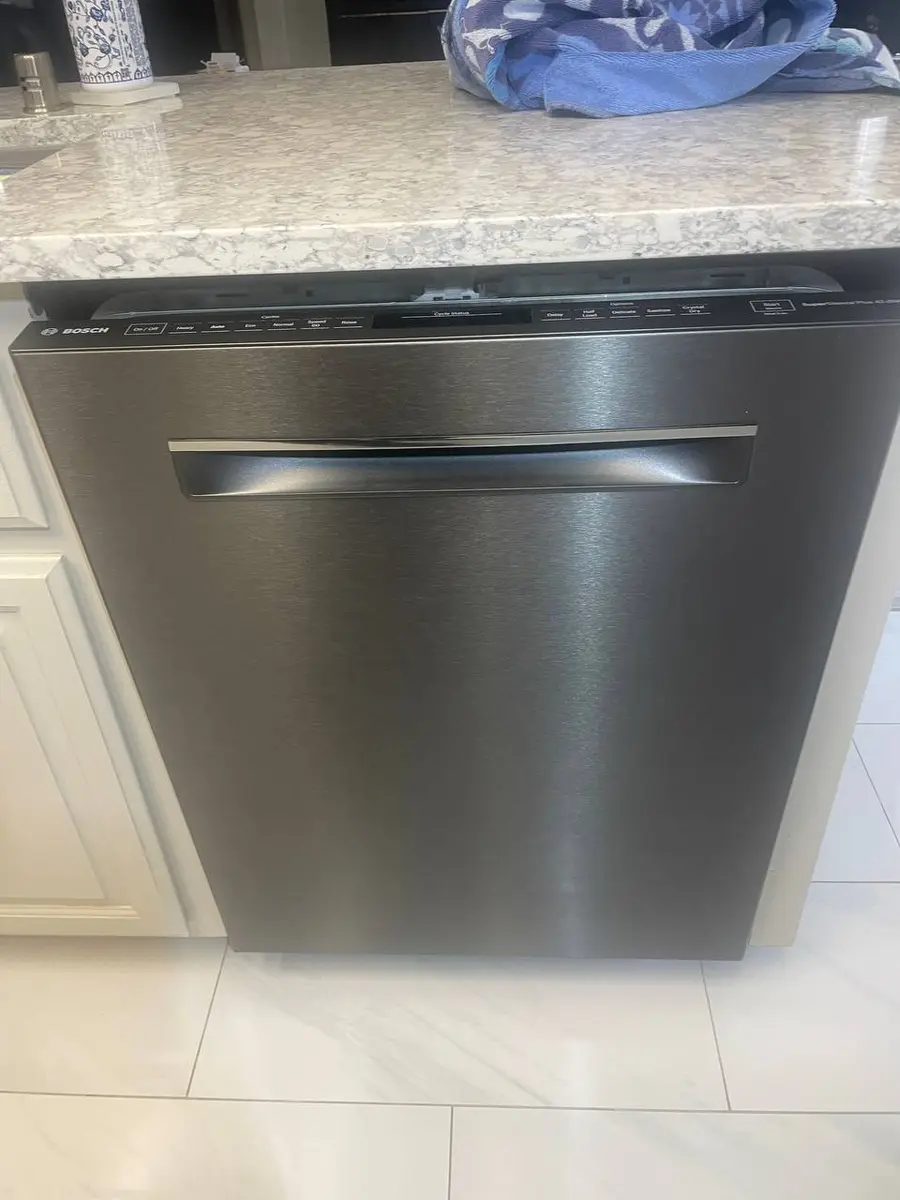
Bosch Dishwasher Leaking — AquaStop, Door Seal & Pump Seal Diagnosis
Water appearing around or beneath a Bosch dishwasher triggers a unique response compared to other brands: the AquaStop flood-protection system. This Bosch-exclusive technology includes a float switch in the base pan beneath the wash tub. Any water accumulation — even a tablespoon — triggers error code E15, shuts off the water inlet valve integrated into the supply hose, and halts all machine operations. This means many Bosch "leaks" are actually the AquaStop system doing its job by detecting and containing a minor seepage before it becomes floor damage.
Understanding where the water originates determines whether you need a simple gasket replacement or a more involved pump seal repair. Bosch dishwashers (100 through 800 series, model prefixes SHE, SHX, SHP, SHV) share the same basic sealing architecture, making this guide applicable across the range.
How AquaStop Changes Leak Diagnosis
On most dishwasher brands, a small leak might go unnoticed for weeks, slowly damaging cabinetry and flooring. Bosch's AquaStop system changes this equation:
- The base pan (a shallow tray beneath the entire dishwasher tub) catches any internal drip
- A polystyrene float switch rides in this pan
- Any water accumulation lifts the float, triggering E15
- The AquaStop valve in the supply hose simultaneously closes, preventing additional water entry
- The machine stops mid-cycle and the E15 code displays
Critical fact: The AquaStop supply hose is a sealed unit containing both the shutoff valve and the pressure sensor. It cannot be spliced, repaired, or bypassed. If the AquaStop hose itself fails, you must replace the entire assembly.
Do You Have the Right Tools?
Water pressure gauge ($60), spray arm tester, float switch multimeter ($85), and drain inspection camera. Our technician arrives with $15K+ in professional tools — your diagnostic is free.
Licensed & Insured · 90-Day Warranty · Same-Day Service
Identifying the Leak Source
Before disassembly, determine where water appears:
- Under the front of the door: Door gasket or tub-to-door junction
- Beneath the machine (only visible when pulled out): Internal seal — pump, hose connection, or tub joint
- Under the kick panel area: Drain hose connection or inlet hose weeping
- E15 code with no visible external water: Internal micro-leak caught by the base pan float
Cause 1: Door Gasket Deterioration (30% of Cases)
The Bosch door gasket runs around the entire tub opening perimeter. Unlike some brands that use a single continuous gasket, Bosch uses a main perimeter gasket plus separate rubber baffles at the bottom corners of the tub opening. These bottom baffles are a common failure point — they lose flexibility after years of heat cycling and allow water to seep past during high-pressure wash phases.
Sound/Visual signature: Water appears at the front of the machine, often dripping from the lower door edge. Most noticeable during intensive wash cycles when spray pressure is highest.
Repair Steps:
- Open the door and visually inspect the entire perimeter gasket — look for tears, compression set (permanent deformation where the door presses), or hardening
- Pay special attention to the bottom corner baffles — these separate pieces take the most heat exposure
- Run your finger along the gasket channel — food debris trapped here prevents proper sealing
- To replace: the main gasket pulls from its channel without tools (it press-fits into a groove)
- Clean the channel thoroughly with warm soapy water before installing the new gasket
- Start installation at the top center and work down both sides simultaneously to ensure even tension
- Replace bottom baffles separately — they push into molded receptacles at the lower corners
Parts Cost: $30–$65 (door gasket) + $15–$25 (bottom baffle set) Professional Repair Cost: $100–$180
Safety First — Know the Risks
Live 120V wiring in a wet environment is one of the most dangerous DIY scenarios. Water + electricity = serious shock risk. Our techs are licensed and insured — let them handle the risk.
Licensed & Insured · 90-Day Warranty · Same-Day Service
Cause 2: Base Pan Water Accumulation — E15 False Trigger (25% of Cases)
The most common "leak" on Bosch dishwashers isn't a leak at all — it's residual water in the base pan triggering the E15 float switch. This happens after:
- New installation (factory test water remains)
- The machine was tilted during delivery or repositioning
- Condensation accumulates over time from minor temperature differentials
- A single spill or splash during a previous door-open mid-cycle event
Diagnosis: If you see E15 but find no active water source, the base pan simply needs draining.
Repair Steps:
- Disconnect power at the breaker and shut off the water supply
- Remove the bottom access panel (2x T20 Torx screws)
- Tilt the entire dishwasher backward approximately 45 degrees — have a helper hold it
- Water in the base pan will flow back into the tub (where the drain pump can evacuate it next cycle)
- Alternatively, use towels or a wet-dry vacuum to absorb moisture from the base pan directly
- With the pan dry, the float switch drops and E15 clears on next power-up
- Monitor over the next several cycles — if E15 returns, an active internal leak exists and requires further diagnosis
Parts Cost: $0 (if no actual leak exists) Professional Repair Cost: $89–$120 (service call for diagnosis and pan drainage)
Cause 3: Pump Seal or Sump Gasket Failure (20% of Cases)
The circulation pump (BSH 00442548) connects to the sump housing through a large rubber seal ring. Heat cycling and detergent exposure gradually degrade this seal, allowing water to weep into the base pan. Similarly, the drain pump (BSH 00631200) mounts with an O-ring that can fail.
Diagnosis: Pull the dishwasher out and remove the base plate. With the machine running, observe the pump connections — any moisture on the pump housings or drips forming at connection points confirm a seal failure. Use a flashlight and mirror if access is limited.
Repair Steps:
- Disconnect power and water supply
- Remove the base plate for full access to the pump area
- Lay the machine on its back (protect flooring)
- Identify which pump is leaking: circulation pump (larger, center) or drain pump (smaller, offset)
- For the drain pump: twist off with a quarter turn (bayonet mount), replace the O-ring, reinstall
- For the circulation pump: disconnect hoses (spring clamps), remove mounting, replace the seal ring between pump and sump housing
- Run a test cycle with the machine pulled forward so you can observe the base pan area — confirm no recurrence
Parts Cost: $15–$40 (seal rings/O-rings) or $45–$280 (pump replacement if housing cracked) Professional Repair Cost: $150–$300
The Real Cost of DIY
Average DIY attempt: $150-400 in tools you may use once, plus the risk of further damage. Our diagnostic visit costs $0 — we find the problem and give you an honest quote.
Licensed & Insured · 90-Day Warranty · Same-Day Service
Cause 4: Spray Arm Seal Leakage (12% of Cases)
The upper spray arm receives water through a feed tube that connects at the top of the tub. The seal where this tube penetrates the tub can deteriorate, allowing pressurized wash water to escape into the area between the inner door panel and outer door — water then runs down and appears at the machine base.
Diagnosis: This leak manifests during wash phases only (when the spray arms are pressurized). Water appears inside the door panel or runs down the inner door face. Remove the inner door panel (6x T15 Torx) and check for water tracks.
Repair Steps:
- Remove the upper rack and its feed tube assembly
- Inspect the grommet/seal where the feed tube passes through the tub wall
- Replace the worn grommet — it should be pliable rubber, not hard or cracked
- Reassemble and run a heavy-wash cycle to verify under maximum pressure
- If the tub wall itself is damaged around the grommet hole (corrosion or crack), a tub repair epoxy may be needed
Parts Cost: $8–$25 (feed tube grommet) Professional Repair Cost: $100–$175
Same-Day Appliance Repair
Fixed or It's Free
$89 → $0 Service Call & Diagnosis — offer ends May 25
Cause 5: Drain Hose Connection Weeping (8% of Cases)
The drain hose connects to the pump outlet with a spring clamp. Over time, the rubber hose at the connection point can harden and shrink, losing its grip on the nipple. Water then weeps during drain cycles — enough to trigger E15 over multiple cycles even though each individual drip is minor.
Repair Steps:
- Remove the bottom panel and inspect the drain hose connection at the pump
- Feel the hose rubber at the connection — if it's hard or cracked, it needs replacement
- Squeeze the spring clamp with pliers, slide it back, and pull the hose off
- Cut 1 inch off the hose end (if the rest is good) to expose fresh, flexible rubber
- Slide the hose back over the pump nipple and reposition the spring clamp
- Alternatively, replace the entire drain hose if multiple sections have hardened
Parts Cost: $15–$35 (drain hose) Professional Repair Cost: $89–$150
Don't Void Your Warranty
Opening your appliance yourself may void the manufacturer warranty. Our repair comes with a 90-day guarantee, and we document everything for warranty compliance.
Licensed & Insured · 90-Day Warranty · Same-Day Service
Cause 6: Inlet Valve or AquaStop Hose Failure (5% of Cases)
The dual-solenoid inlet valve (BSH 00622058) has internal seals that can weep when not energized (the valve should be completely closed between cycles). If you find water in the base pan accumulating when the dishwasher hasn't been run, the inlet valve is likely leaking through.
Diagnosis: Shut off the water supply for 24 hours. If E15 doesn't trigger during this period but does after you restore water, the inlet valve leaks when pressurized but not energized.
Repair Steps:
- Shut off water supply and disconnect power
- Remove the bottom access panel
- Locate the inlet valve (where the supply hose connects, typically left side)
- Disconnect the supply hose (10mm wrench) and the internal distribution hose
- Remove the valve mounting screws and extract the valve
- Install replacement valve (BSH 00622058) — note the orientation of the dual solenoid connectors
- Reconnect water supply and check for leaks at all connections before reinstalling the access panel
Parts Cost: $35–$65 (inlet valve BSH 00622058) Professional Repair Cost: $120–$200
Tools Required for Bosch Leak Diagnosis
- T15 and T20 Torx drivers — Bosch uses Torx exclusively (not Phillips)
- 10mm socket or wrench — water supply connections
- Flashlight and inspection mirror — for viewing base pan area without removing machine
- Towels and shallow pan — for catching water when opening pump covers
- Multimeter — testing AquaStop valve continuity if suspect
Is It Worth Your Time?
Dishwasher issues overlap between drain pump, wash motor, inlet valve, and control board. DIY diagnosis averages 3-5 hours. Our technician diagnoses the issue in about 30 minutes — same-day appointments available.
Licensed & Insured · 90-Day Warranty · Same-Day Service
Prevention
- Inspect the door gasket quarterly — look for food debris in the channel and any hardening of the rubber
- Check the bottom corner baffles annually — these small rubber pieces take the most wear
- Don't overload — excessive dish height can deflect spray patterns and force water against door seals
- Use correct detergent amounts — excess suds increase pressure inside the tub during wash phases
- Keep the AquaStop hose straight — kinking stresses the internal valve mechanism
Water pooling around your Bosch dishwasher or E15 flashing on the display? Our technicians carry AquaStop hose assemblies, door gaskets, and pump seal kits specific to Bosch models. We identify the exact leak source on-site — most repairs completed same-visit. Schedule your Bosch dishwasher repair →