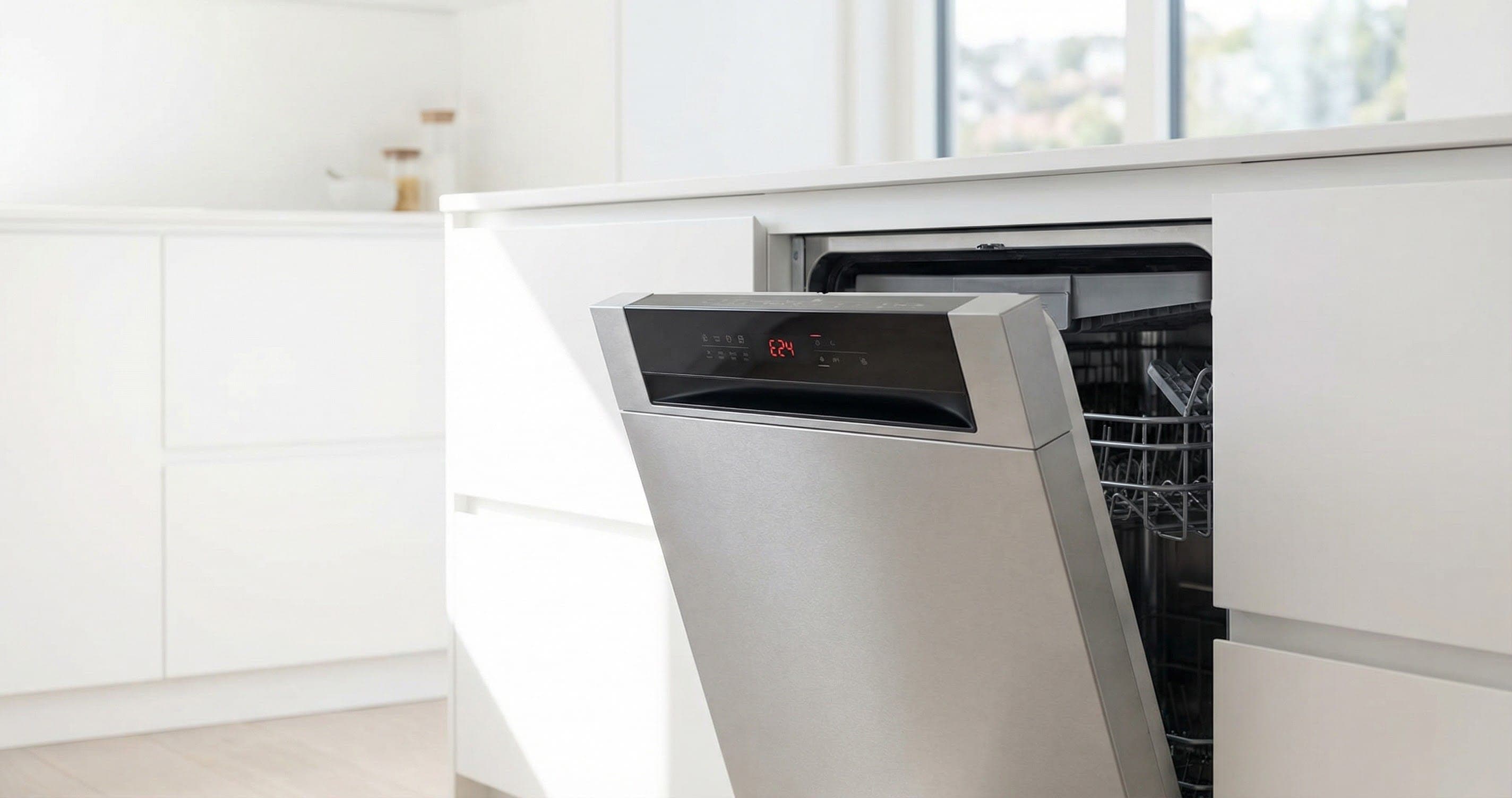
Bosch Dishwasher Fan Replacement — Ventilation System and CrystalDry Blower Service
Bosch dishwashers take a fundamentally different approach to drying than most American brands. Instead of a heated-dry element baking moisture off dishes (the approach used by GE, Whirlpool, and most domestic makers), Bosch uses condensation drying on its 300 and 500 Series units and a zeolite-mineral CrystalDry system on the 800 Series. Both approaches rely on fan assemblies to circulate air — but the fans serve completely different purposes depending on the series, and they are not interchangeable.
On the 300 and 500 Series, a single circulation fan pulls ambient air through a vent channel along the side wall of the tub. This air contacts the stainless steel tub walls, which act as condensing surfaces — hot humid air from the wash deposits its moisture on the cooler steel, and the resulting condensate drains out. The fan speeds this natural process. When it fails, dishes come out warm but wet, often with water pooling in concave surfaces like mugs and bowls.
The 800 Series adds a second fan dedicated to the CrystalDry system. This fan forces heated air through a cassette filled with zeolite minerals — naturally occurring volcanic crystals that absorb moisture and release heat in the process. The zeolite fan runs at higher RPM than the condensation fan and operates in a sealed airpath separate from the main tub ventilation. The zeolite cassette regenerates automatically during the next wash cycle using the wash water's heat.
How to Identify Which Fan Has Failed
Bosch does not display a dedicated fan error code. Instead, fan failure manifests through drying performance degradation:
- Dishes wet after every cycle, regardless of program — the condensation fan (300/500 Series) or the zeolite blower (800 Series) has stopped running. Open the door immediately after a cycle ends and listen — on a working unit, you should hear the fan running for 30-60 seconds after the final drain
- CrystalDry indicator illuminated but dishes still wet (800 Series only) — the zeolite blower motor has failed while the zeolite heating element still works. The minerals absorb moisture but the heated dry air is not being circulated back into the tub
- Musty odor developing between uses — inadequate air circulation after cycles allows standing moisture to breed bacteria. The fan normally continues running briefly after the door is closed to ventilate residual humidity
- Rattling or grinding from the left side panel — the condensation fan sits behind the left tub wall. Bearing wear produces noise before the motor fails entirely. The CrystalDry fan sits at the top rear of the 800 Series and produces a higher-pitched whine when its bearings degrade
To confirm fan failure electrically: access the fan motor connector from underneath the unit (Torx T20 kick plate removal). Measure resistance across the fan motor terminals — a healthy motor reads 20-60 ohms. Open circuit means a failed winding.
Do You Have the Right Tools?
Multimeter ($85), vacuum pump ($250), diagnostic software, and specialized hand tools. Our technician arrives with $15K+ in professional tools — your diagnostic is free.
Licensed & Insured · 90-Day Warranty · Same-Day Service
Cost Breakdown
| Component | Range |
|---|---|
| OEM condensation fan (300/500 Series) | $40–$85 |
| OEM CrystalDry blower (800 Series) | $65–$120 |
| Professional labor | $100–$175 |
| Total with professional service | $140–$295 |
The CrystalDry blower costs more because it operates in a heated environment and uses higher-temperature-rated bearings. The condensation fan runs at ambient temperature and is a simpler component. Both are BSH-specific parts — no aftermarket equivalents exist for the CrystalDry blower, and aftermarket condensation fans for the 300/500 Series rarely match the airflow specifications required for effective condensation drying.
Replacing the Condensation Fan (300/500 Series)
The condensation fan mounts behind the left tub wall, accessible from the left side of the unit:
- Disconnect power at the breaker and water at the supply valve
- Remove the dishwasher from the cabinet — slide it forward enough to access the left side panel. Remove the Torx T15 screws securing the side panel (typically 4 screws along the edges)
- The fan assembly sits midway up the left wall, mounted in a plastic shroud that directs airflow through the condensation channel
- Disconnect the 2-pin fan motor connector
- Remove the three Torx T10 screws securing the fan shroud to the tub wall
- Slide the shroud assembly out — the fan motor and impeller come out as a unit
- If replacing only the motor: remove the impeller from the motor shaft (it press-fits). If replacing the entire assembly, install the new shroud unit
- Reinstall in reverse order, ensuring the shroud gasket seats against the tub wall with no gaps — air leaks reduce condensation efficiency dramatically
- Run a full wash cycle with drying and check dishes for residual moisture. Properly functioning condensation drying leaves minimal water on flat surfaces, though concave items (mugs, bowls) will always retain some drops
Safety First — Know the Risks
Appliances involve high voltage (120-240V), pressurized water, gas lines, and chemical refrigerants. Over 400 DIY repair injuries are reported yearly. Our techs are licensed and insured — let them handle the risk.
Licensed & Insured · 90-Day Warranty · Same-Day Service
Replacing the CrystalDry Blower (800 Series)
The CrystalDry blower sits at the top rear of the unit, integrated with the zeolite cassette housing:
- Disconnect power and water. Pull the unit from the cabinet for rear access
- Remove the rear access panel (Torx T15 screws, typically 6)
- The zeolite cassette housing is a white plastic enclosure at the top. The blower motor bolts to the side of this housing
- Disconnect the blower motor connector (3-pin — includes a tachometer feedback wire that reports fan speed to the board)
- Remove the two Torx T15 screws securing the motor to the housing. The motor slides out of its port
- Do not disturb the zeolite cassette itself — the minerals are sensitive to contamination and are not serviceable
- Install the replacement motor, ensuring the rubber grommet seats properly to prevent vibration
- Reassemble, run the CrystalDry Auto program, and verify the fan activates during the drying phase
Same-Day Appliance Repair
Fixed or It's Free
$89 → $0 Service Call & Diagnosis — offer ends May 25
Fan Lifespan and Prevention
Condensation fans last 8-12 years. CrystalDry blowers last 6-10 years due to the higher thermal stress. Factors that shorten fan life:
- Blocked ventilation path — items placed against the left tub wall block airflow to the condensation channel, forcing the fan to work harder
- Detergent residue buildup — excess detergent creates foam that enters the ventilation channel and deposits on the fan impeller, causing imbalance and accelerated bearing wear
- Running rinse-only cycles excessively — the condensation and CrystalDry systems are designed for full wash cycles. Repeated short cycles without the drying phase can leave the zeolite cassette saturated, forcing longer regeneration periods and additional thermal stress on the blower
Maintain fan longevity by keeping the left tub wall clear of dishes, using the correct detergent amount (Bosch recommends 20-25ml per cycle), and running a complete program including drying at least once weekly.
The Real Cost of DIY
Average DIY attempt: $150-400 in tools you may use once, plus the risk of further damage. Our diagnostic visit costs $0 — we find the problem and give you an honest quote.
Licensed & Insured · 90-Day Warranty · Same-Day Service
FAQ
Why are my Bosch dishes wet after the cycle?
Bosch uses condensation drying (300/500 Series) or CrystalDry zeolite drying (800 Series) — neither uses a heated-dry element. If dishes are wetter than usual, the drying fan may have failed. Open the door immediately after a cycle and listen for fan operation. Concave items like mugs normally retain some drops even with working drying.
Does the Bosch 300 Series have CrystalDry?
No. CrystalDry is exclusive to the 800 Series. The 300 and 500 Series use condensation drying with a single circulation fan. The drying performance difference is significant — CrystalDry delivers noticeably drier results, especially on plastics.
Can I add a heated-dry element to my Bosch dishwasher?
No. Bosch dishwashers are not designed for resistive heated drying. The stainless steel tub, plastic tub components, and rack materials are rated for condensation or CrystalDry temperatures only. A heated element would damage internal components.
How do I know if the fan or the zeolite cassette failed?
If the fan motor reads correct resistance (20-60 ohms) but CrystalDry still underperforms, the zeolite minerals may be exhausted — this happens after 10+ years. If the motor reads open circuit, the fan is the failure point. The zeolite cassette is not user-serviceable and requires professional replacement.
Bosch dishwasher not drying properly? Our technicians diagnose condensation fan and CrystalDry blower issues and carry OEM replacement parts. Book a technician →
