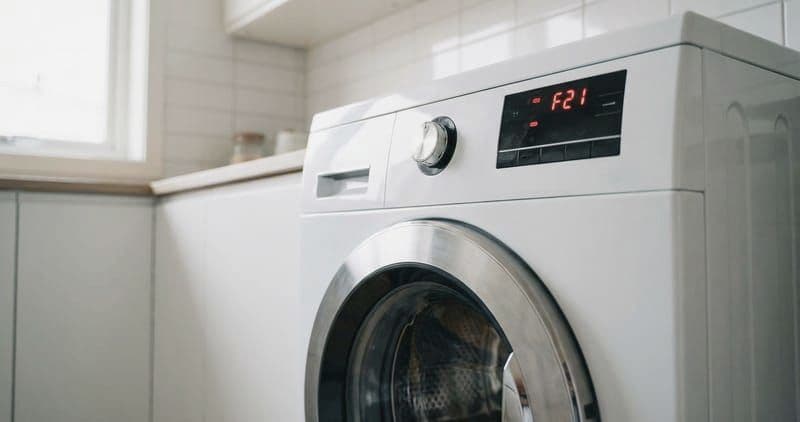
When a Whirlpool washer shows vibrating shaking, it is telling you something specific. Below are the causes we see most, ranked, with what each looks like and how to check it.
The likely culprit#
Most likely: machine not level. All four feet must firmly contact the floor with no rocking. The single most typical cause of Whirlpool washer vibration is improper leveling. If that checks out, look next at suspension rods failed.
Do You Have the Right Tools?
Bearing puller set ($120), drum spider wrench ($85), multimeter ($85), and diagnostic software. Our technician arrives with $3,000+ in professional tools — your diagnostic is free.
Licensed & Insured · 90-Day Warranty · Same-Day Service
Ranked causes and what to look for#
Match your symptom to the rows below, starting at the top:
| Likely cause | How common | What you'll notice / what to check |
|---|---|---|
| Machine Not Level | 28% of cases | The single most frequent cause of Whirlpool washer vibration is improper leveling. |
| Suspension Rods Failed | 25% of cases | The four suspension rods each have a rubber dampening insert. |
| Shock Absorbers Worn | 22% of cases | Front-load shocks mount between the outer tub and the base frame. |
| Unbalanced Load / Adaptive Wash Limitation | 12% of cases | Whirlpool's Adaptive Wash system senses load imbalance and attempts to redistribute by adding water and retumbling. |
| Shipping Bolts Not Removed | 8% of cases | Whirlpool front-load washers ship with 3-4 steel shipping bolts that lock the tub to the frame during transport. |
| Counterweight Loose or Broken | 5% of cases | The concrete counterweights bolted to the outer tub on WFW front-loaders weigh 25-40 lbs total. |
Sorting it out, step by step#
Move through these in order — the first match is usually the fix.
1. Machine Not Level (28% of cases)#
Under the hood, the single most frequent cause of Whirlpool washer vibration is improper leveling. All four feet must firmly contact the floor with no rocking. Whirlpool washers use adjustable threaded legs at all four corners (WTW) or front two corners with self-adjusting rear legs (WFW). Set a bubble level on top and adjust the feet until it sits solid — an unlevel unit shakes progressively worse.
2. Suspension Rods Failed (25% of cases)#
After 6-8 years these inserts harden and crack, losing their ability to absorb tub oscillation. One failed rod throws off the balance of the entire suspension system. The four suspension rods each have a rubber dampening insert. Rule it in or out with a visual check and a continuity test where possible.
3. Shock Absorbers Worn (22% of cases)#
Behind the scenes, front-load shocks mount between the outer tub and the base frame. They contain oil-filled damping chambers that resist tub movement. When the oil weeps or the seals degrade, the shocks provide no resistance and the heavy tub bounces freely during spin. Set a bubble level on top and adjust the feet until it sits solid — an unlevel unit shakes progressively worse.
4. Unbalanced Load / Adaptive Wash Limitation (12% of cases)#
Whirlpool's Adaptive Wash system senses load imbalance and attempts to redistribute by adding water and retumbling. However, single heavy items (comforters, bath mats, weighted blankets) or loads of all-towels can exceed the system's ability to rebalance. The washer may display error code F0E5 (unbalanced) and refuse to reach full spin speed. Rock the unit gently; any wobble means the feet or suspension need attention first.
5. Shipping Bolts Not Removed (8% of cases)#
In practice, whirlpool front-load washers ship with 3-4 steel shipping bolts that lock the tub to the frame during transport. If these bolts are not removed during installation, the tub cannot float on its shock absorbers and all vibration transfers directly to the cabinet and floor. Detection: Look at the rear of the machine for large bolts (typically red or orange) passing through the rear panel into the tub. With the unit unplugged, inspect this part for visible wear or a loose connection and test it before replacing.
6. Counterweight Loose or Broken (5% of cases)#
If the mounting bolts loosen (vibration over time), the weight shifts during spin and sets up severe imbalance. Rarely, the concrete block itself cracks. The concrete counterweights bolted to the outer tub on WFW front-loaders weigh 25-40 lbs total. Rule it in or out with a visual check and a continuity test where possible.
Safety First — Know the Risks
High-voltage components and pressurized water lines create flood and shock risk. A single loose fitting can cause thousands in water damage. Our techs are licensed and insured — let them handle the risk.
Licensed & Insured · 90-Day Warranty · Same-Day Service
The short checklist#
Here is the whole diagnosis on one line each:
- Machine Not Level — 28% of the time; rock the unit gently.
- Suspension Rods Failed — 25% of the time; with the unit unplugged, inspect this part for visible wear or a loose connection and test it before replacing.
- Shock Absorbers Worn — 22% of the time; rock the unit gently.
- Unbalanced Load / Adaptive Wash Limitation — 12% of the time; set a bubble level on top and adjust the feet until it sits solid — an unlevel unit shakes progressively worse.
- Shipping Bolts Not Removed — 8% of the time; rule it in or out with a visual check and a continuity test where possible.
What fixing it usually involves#
The repair path is predictable: diagnose, access, replace, and verify. A tech confirms the machine not level or works down the list, fits the right part, and runs a cycle to be sure it holds.
The Real Cost of DIY
Average DIY attempt: $150-400 in tools you may use once, plus the risk of further damage. Our diagnostic visit costs $0 — we find the problem and give you an honest quote.
Licensed & Insured · 90-Day Warranty · Same-Day Service
Keeping it from coming back#
A little routine care goes a long way: keep the washer clean, level, and free of buildup, and this symptom is far less likely to return.
When it is a job for a pro#
Call a technician if the symptom persists after the checks above, if the repair means reaching power, gas, or sealed components, or if your Whirlpool washer is still under warranty — DIY work can void it. What you pay comes down to the failed component and the labor for your unit — a diagnostic visit confirms the number up front.
If the fix is beyond a quick DIY, request a technician who works on Whirlpool washers and can diagnose it in one visit.
Lead Appliance Repair Technician · 12 years experience
Experienced technician with 12 years specializing in washing machine and dryer repairs across all major brands.