Whirlpool Washer Sensor Replacement
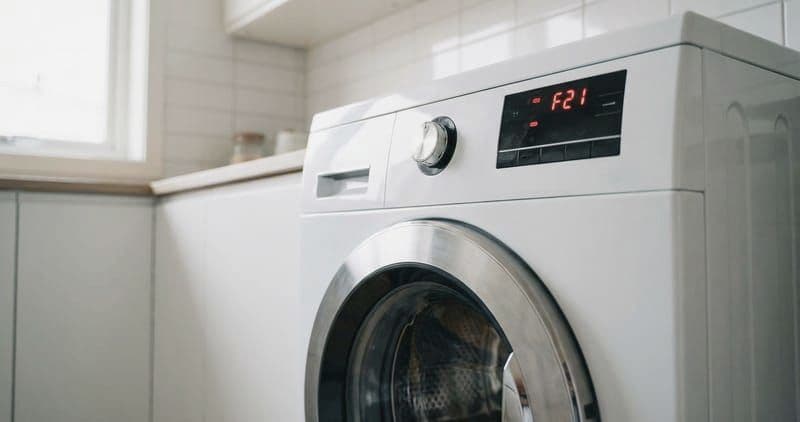
A Whirlpool washer uses several sensors, and each fails with its own signature — a water-level pressure sensor, a temperature thermistor, a motor speed sensor, and a lid or door sensor. Read the fault code to find which one: an F8E1 points at water level, an F7E1 at the motor sensor. Match the OEM part, such as…
Unlike a simple appliance with one thermostat, a modern Whirlpool washer is a network of sensors feeding one control. That is a strength when it works and a puzzle when it fails, because "the washer is acting up" can trace to any of four different sensors. The fastest path to the right part is the fault code, which names the circuit the control is unhappy with.
The Sensors and What Each Does#
- The pressure sensor reads water level through an air hose to the tub. It decides when the selected fill is reached.
- The temperature thermistor reports incoming water temperature so the control can add hot or cold.
- The motor speed sensor, or tachometer, tells the control how fast the drum is turning for balanced spins.
- The lid or door switch confirms the machine is safe to run.
Do You Have the Right Tools?
Bearing puller set ($120), drum spider wrench ($85), multimeter ($85), and diagnostic software. Our technician arrives with $3,000+ in professional tools — your diagnostic is free.
Licensed & Insured · 90-Day Warranty · Same-Day Service
Match the Code to the Sensor#
Whirlpool's paired fault codes point straight at the circuit:
- F8E1 means the washer cannot reach the water level it expects — the pressure sensor or its hose
- F7E1 and F7E5 indicate a motor or motor-sensor fault — the drive can't confirm speed
- Related codes such as F7E5 and F8E1 narrow to specific sensor and drive circuits
Look the exact code up on your tech sheet, then test the named part rather than guessing.
Symptoms Without a Code#
- The washer overfills or underfills — suspect the pressure sensor and its hose
- Wash water is the wrong temperature — suspect the thermistor
- Spins are rough, unbalanced, or the drum will not ramp up — suspect the motor speed sensor
- The washer will not start at all — suspect the lid or door switch
Safety First — Know the Risks
High-voltage components and pressurized water lines create flood and shock risk. A single loose fitting can cause thousands in water damage. Our techs are licensed and insured — let them handle the risk.
Licensed & Insured · 90-Day Warranty · Same-Day Service
Test Before You Replace#
Each sensor has a quick check. For the pressure sensor, clear and reseat its air hose first, since sludge in the hose is the top cause of a false level fault. For the thermistor, unplug the washer and measure its resistance against the chart for the water temperature. For the motor sensor, inspect its position at the rotor and its connector. Confirming with a meter keeps you from replacing a good, expensive part on a hunch.
Step-by-Step Replacement#
- Unplug the washer and shut off the water if you will open the fill area.
- Access the failed sensor — the pressure sensor sits high on the tub or cabinet, the thermistor at the inlet or heater, the motor sensor at the rear rotor.
- Photograph the wiring, then release the connector.
- Unclip or unscrew the old sensor and fit the new part, such as WPW10178988, in the same position.
- Reconnect the wiring and, for the pressure sensor, reseat its air hose fully without kinks.
- Restore power, run a cycle, and confirm the fault is gone and the function is correct.
The Real Cost of DIY
Average DIY attempt: $150-400 in tools you may use once, plus the risk of further damage. Our diagnostic visit costs $0 — we find the problem and give you an honest quote.
Licensed & Insured · 90-Day Warranty · Same-Day Service
Tools You Will Need#
- A screwdriver and nut driver for the panels
- A multimeter to test thermistor and sensor circuits
- A brush or compressed air to clear the pressure hose
Common Mistakes to Avoid#
- Replacing the pressure sensor before clearing its hose, which causes most level faults.
- Ignoring the fault code and swapping sensors at random.
- Disturbing the motor-sensor alignment at the rotor, which creates a new spin fault.
Don't Void Your Warranty
Opening your appliance yourself may void the manufacturer warranty. Our repair comes with a 90-day guarantee, and we document everything for warranty compliance.
Licensed & Insured · 90-Day Warranty · Same-Day Service
What Happens If You Delay#
A washer running on a bad sensor makes poor decisions — overfilling toward a leak, washing cold when it should be warm, or hammering through unbalanced spins that stress the bearings and suspension. None of it improves on its own, and an unbalanced spin left unaddressed can loosen the drum over time. Fixing the failed sensor early keeps the washer gentle on itself.
Repair or Replace the Washer#
Sensors are among the cheaper parts on the machine, so replacing one is worthwhile. Only weigh a new washer if the bearings, drum, or main control have also failed.
Is It Worth Your Time?
Washer problems have dozens of possible causes from bearings to control boards. Average DIY troubleshooting: 3-5 hours plus parts ordering delays. Our technician diagnoses the issue in about 30 minutes — same-day appointments available.
Licensed & Insured · 90-Day Warranty · Same-Day Service
What It Costs#
There is no single price — each sensor is a different, generally inexpensive part, and clearing a hose may be the whole fix. Because the code and the hose check narrow the fault for free, always do them first. Match the correct sensor to your model before ordering.
How Long It Lasts#
Washer sensors commonly last the life of the machine. Detergent sludge in the pressure hose and moisture at connectors are the usual early-failure causes, so correct detergent dosing, an occasional tub-clean cycle, and dry, seated connectors all help the sensors last.
The Risk of Getting It Wrong
A wrong diagnosis often turns a simple fix into a costly replacement. Without proper diagnostic tools, you might replace the wrong part — or cause additional damage. Our free diagnostic eliminates the guesswork.
Licensed & Insured · 90-Day Warranty · Same-Day Service
Where Each Sensor Lives#
Knowing the location speeds the fix. The pressure sensor sits high on the tub or cabinet, tied to the tub by a thin air hose and an air trap at the base. The temperature thermistor sits at the water inlet or in the heater circuit on models that heat their own water. The motor speed sensor rides at the rear of the drive motor or on the rotor of a direct-drive machine, reading a magnetic ring as it turns. The lid or door switch is at the opening. Opening only the panel that reaches your suspect sensor saves time and avoids disturbing the others.
Reading Combined Faults#
Sometimes the washer throws more than one code, and the order matters. A water-level fault that appears alongside a motor fault often traces to a single root — a machine that cannot fill correctly may abort the spin and log a motor code as a side effect. Resolve the earliest, most fundamental fault first, usually fill and water level, then re-run the cycle and see which codes remain. Chasing a downstream code before fixing the upstream cause wastes parts and time.
Lead Appliance Repair Technician · 12 years experience
Experienced technician with 12 years specializing in washing machine and dryer repairs across all major brands.