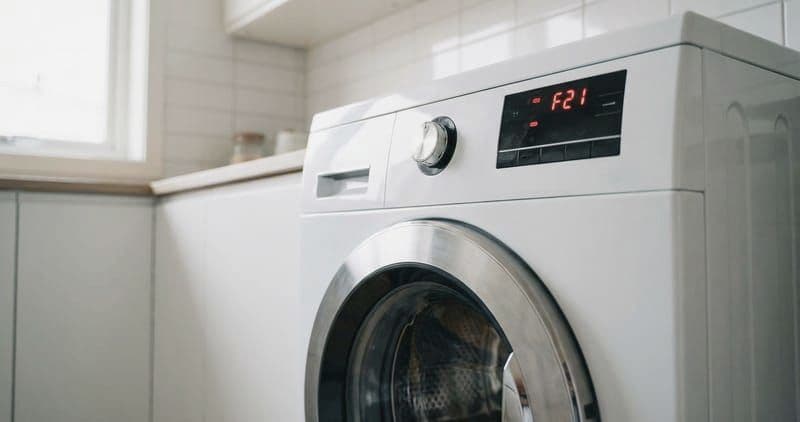
What is the Whirlpool Washer HC error?#
HC means the washer detected that the hot inlet is delivering cold water and the cold inlet hot — in other words, the supply hoses are crossed. It is almost always an installation mix-up, and swapping the two hoses at the back of the machine fixes it in a couple of minutes. Check the hose connections before assuming anything is broken.
HC on a Whirlpool Washer: likely causes and repair cost#
On a Whirlpool Washer, the HC code signals: hot/cold hoses reversed.
| Likely cause | Typical likelihood |
|---|---|
| Supply hoses crossed at the washer inlets during installation | Most common |
| Hot and cold swapped at the wall valves rather than the machine | Common |
| One inlet thermistor drifted, making correct hoses read as reversed | Less common |
Typical professional repair: up to $120 · Difficulty: easy · often owner-fixable
Fastest thing to try first: Swap hot and cold water supply hoses.
Symptoms that often accompany HC: Hot water cycle uses cold water; Cold water cycle uses hot water; Clothes shrink on cold-water settings
Technician diagnostic sequence for HC:
- Check the hose connections at the back of the washer — hot (red/left) should connect to the hot valve, cold (blue/right) to cold
- Also verify the hoses are correctly matched at the wall valve end
- After swapping, run a hot water cycle and feel the door glass (front-load) or open the lid during fill (top-load) to confirm hot water arrives when expected
Field note: The Adaptive Wash temperature sensor detects that the hot inlet delivers cold water and vice versa. This code only appears on models with thermistors on both inlet paths. On Amana models, which often lack dual thermistors, reversed hoses go undetected and simply wash at wrong temperatures.
Do You Have the Right Tools?
Bearing puller set ($120), drum spider wrench ($85), multimeter ($85), and diagnostic software. Our technician arrives with $3,000+ in professional tools — your diagnostic is free.
Licensed & Insured · 90-Day Warranty · Same-Day Service
How to troubleshoot the HC error yourself#
This is a genuinely quick owner fix. Shut off both supply valves, then look at where the hoses meet the washer inlets — the hot supply should feed the hot inlet and cold the cold. If they are crossed, swap them. If the machine's inlets look correct, the mix-up may be at the wall valves instead, where hot and cold were plumbed to the wrong taps; swap them there. Reopen the valves and run a warm cycle to confirm the temperatures now match. Where DIY ends is the rare electronic case: if the hoses are genuinely correct at both ends and HC still shows, one inlet thermistor may have drifted so that correct hoses read as reversed, and diagnosing that sensor is a technician job rather than another hose swap.
Is the Whirlpool Washer HC error worth fixing?#
HC almost never costs anything — it is a two-minute hose swap, and the whole point of the code is that the washer caught the error for you. In the uncommon case where a drifted inlet thermistor is falsely reporting reversed hoses, a technician repair tops out around $120, still trivial against a new machine. There is no replacement decision to make here; correct the hoses, and if the code truly persists on correct plumbing, a sub-$120 sensor check settles it.
Safety First — Know the Risks
High-voltage components and pressurized water lines create flood and shock risk. A single loose fitting can cause thousands in water damage. Our techs are licensed and insured — let them handle the risk.
Licensed & Insured · 90-Day Warranty · Same-Day Service
Whirlpool Washer HC: frequently asked questions#
What does HC mean on a Whirlpool washer?#
It means the hot and cold water supply hoses are reversed — the hot inlet is getting cold water and vice versa. It is usually an installation error.
Is it safe to keep using the washer with HC?#
It will wash at the wrong temperatures, which can shrink clothes on a cold setting, but it is not hazardous. Swapping the hoses fixes it.
Can I clear HC myself?#
Yes, easily. Shut the valves and swap the hot and cold hoses at the washer inlets, or at the wall if they were plumbed wrong there.
How much does it cost to repair HC?#
Usually nothing — it is a hose swap. If a drifted inlet thermistor is falsely reporting reversed hoses, a technician repair runs up to $120.
Which parts are involved in HC?#
Rarely any — it is the supply hoses. Only when the plumbing is genuinely correct does a drifted inlet thermistor become the suspect.
Is a washer with HC worth repairing?#
There is nothing to replace over it. Swapping the hoses is free, and even a sensor check stays under $120.
Why do reversed hoses trigger HC?#
The washer has a temperature sensor on each inlet path. When the hot inlet reads cold and the cold reads hot, it recognizes the hoses are crossed and raises HC.
Senior Appliance Repair Technician · 15 years experience
EPA-certified technician with 15 years of experience specializing in refrigerator and cooling system repairs.